|
Reconstruction and Postwar
American Civil
War Reconstruction and Aftermath
The
turn of the Century witnessed 14 year old girls marrying 70 year old Civil War veterans. The girl married
the senior citizen hoping to inherit his pension.
The Civil War's tragic
toll was death, wounds, destitution and diseases--including mumps, measles, smallpox, influenza, malaria,
typhoid, dysentery, cholera, chronic diarrhea, tuberculosis, gangrene, pneumonia, yellow fever, and venereal diseases--and
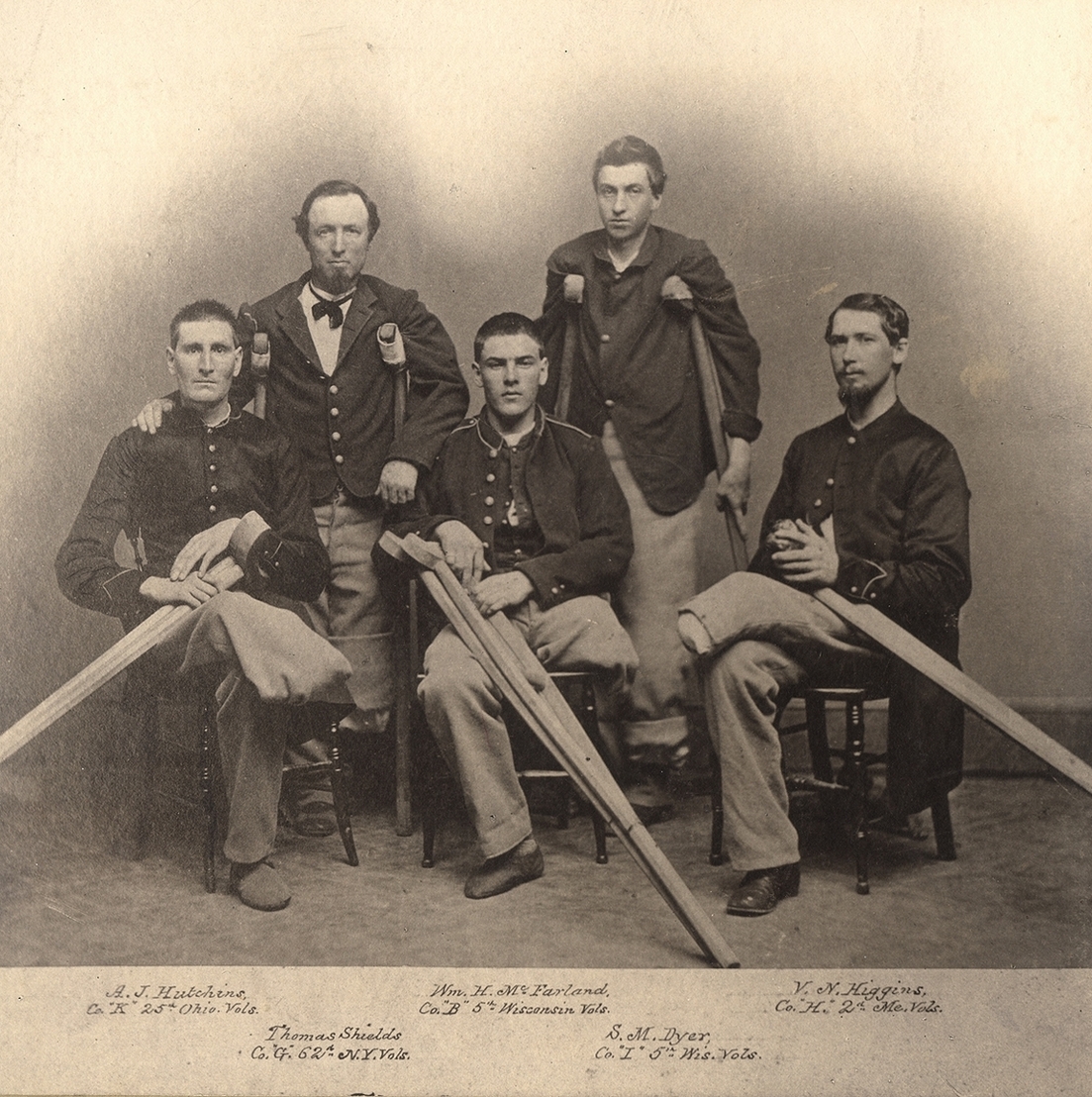
the diseases and mental illnesses pervaded many "veterans as well as their families." There were tens-of-thousands of widows, single
mothers and, consequently, the fatherless. The Reconstruction Era also witnessed tens-of-thousands of morphine addicts and homeless veterans; the veteran either had no home to return
to or a disability prevented him from enjoying life's basic tasks and responsibilities. Furthermore, Union
soldiers and veterans did not receive the Department of Veterans Affairs' benefits and assistance, because
it wasn't created until the twentieth century. During Reconstruction, United States census records reflect that many African Americans returned to the South and became sharecroppers for their former masters. In 1900, approximately 90 percent of all African
Americans still resided in the South. (See North Carolina Census Records.) Also during the era, outlaws flourished and the United States witnessed the Wild West. (Aftershock - Beyond the Civil War , vividly reflects the atrocities that shocked the United States during the Aftermath and
Reconstruction.) , vividly reflects the atrocities that shocked the United States during the Aftermath and
Reconstruction.)
| Civil War Reconstruction and Aftermath |
|
| Tens-of-thousands of amputees had little if any assistance after the Civil War |
The
Federal government’s view of former Confederates was that of "traitors, revolutionaries, and the enemy."
The United States Senate in 1866
"I
tell You, War is All Hell!" General William Tecumseh Sherman
The South suffered the greatest impact since most of
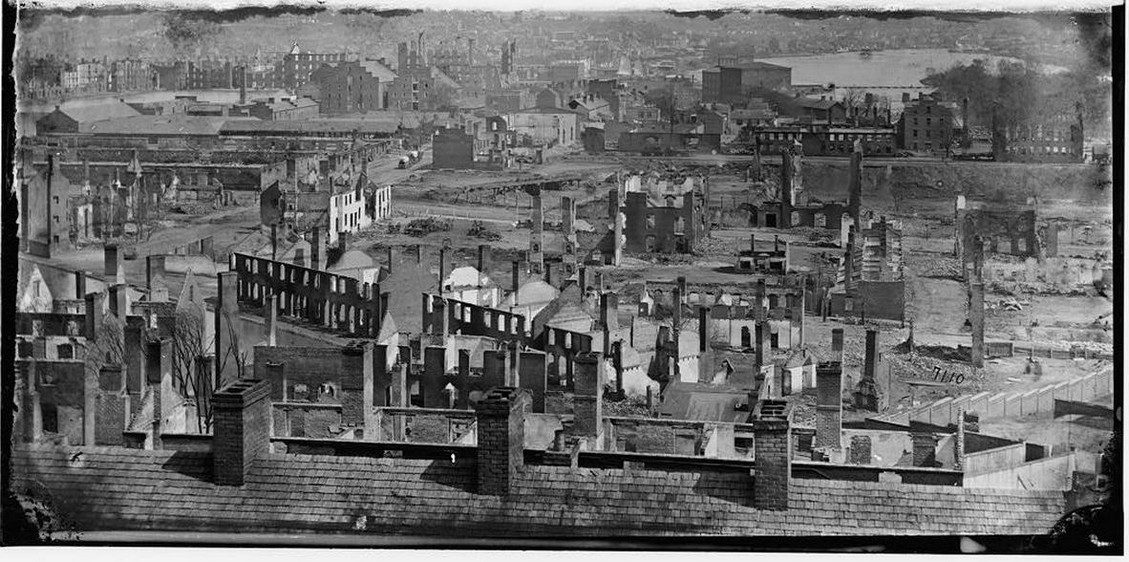
the battles and skirmishes were fought on Southern soil. Sherman's March to the Sea, for example, destroyed thousands
of homes, businesses and farms. In
many Southern states the infrastructure was annihilated and to make matters worse the states were bankrupt. These harsh conditions were greatly exacerbated in the South, since crops and livestock were now scarce. Much
of the South was scarred and reduced to ruin and rubble, it was a virtual waste land, and all they had was each other and
hope. The South, however, was not alone in her woes because the nation was now bankrupt and it would take decades to
recover.
In 1866, for example,
20% of Mississippi’s
entire state budget went to the procurement of artificial limbs, and, from 1871 to 1873, 3,929 Tennesseans filed claims with the Southern Claims
Commission. They claimed that their property had been confiscated by the U.S. military for use during
the Civil War. Immediately following the conflict, approximately 80,000 Alabama widows requested state assistance, while thousands
of additional widows didn't request any aid. Prior to the Civil War, in 1860, there were 69,000 farms in North Carolina and 46,000 of these, or 71%, were less
than 100 acres in size. In 1860 there were only 300 plantations of 1,000 acres or more in the state. The 1860 census
listed 121 planters and 85,198 farmers. North Carolina has a long history of small farms, and cutting trees for fence rails
was a major cause of forest destruction. The Civil War bankrupted most industries in
the Old North State, including agriculture.
It was common practice for
family, friends, neighbors, and even entire communities to serve in the same regiment, and many believed this unity made it unthinkable to coward and display the "white feather" in
the presence of the enemy. Overall, many entrusted their loved ones to enlist and serve with relatives and neighbors,
with the common belief that they maintained their loved ones' best interest in mind.
During
Reconstruction, families, communities and a wounded nation greatly needed more than ever--unity. Abiding unity, for example, was
demonstrated as many North Carolina highlanders served in the same regiments with the petitioners and founders of various
counties, including Jackson County, North Carolina, which formed on January 31, 1851, and in honor of President Andrew Jackson.
"Well, I was born 87 years ago, June 22, 1852. My father was shot in the arm while in action during the
first year of the Confederate War. He was sent home later because of illness and finally died with typhoid fever. He left
ma with six chilluns, three boys and three girls. I was the oldest and I had to help ma raise the chilluns, but we worked
hard, everybody had to work hard then." Mrs. W. W. Mize, Athens, Georgia, on October 3, 1939.
| A city in ruins as the result of Civil War |
|
| Reconstruction and Aftermath of Civil War. Library of Congress |
"You cannot qualify war in harsher terms than I will. War is
cruelty, and you cannot refine it; and those who brought war into our country deserve all the curses and maledictions a people
can pour out." William Tecumseh Sherman in his letter to the city of Atlanta in 1864.
Florida
Governor John Milton’s last words to the Florida legislature in 1865: "The Yankees have developed
a character so odious that death would be preferable to reunion with them." Milton was
a capable governor who valiantly defended states' rights and the Confederacy, but by the end of the war much of Florida
was occupied by Union forces and the state's finances were depleted. Overwhelmed by grief,
the 57 year old Governor allegedly committed suicide at his Florida
plantation on April 1, 1865.
As a direct result of the American Civil War, the United States witnessed the Thirteenth, Fourteenth, and Fifteenth
U.S. Constitutional Amendments.
When the war ceased,
leaders turned to the question of how to reconstruct the nation. One important issue was the right to vote. Among the hotly
debated issues, were "voting rights for black American men and former Confederate men."
In the latter half of the 1860s, Congress passed a series
of acts designed to address the question of rights, as well as how the Southern
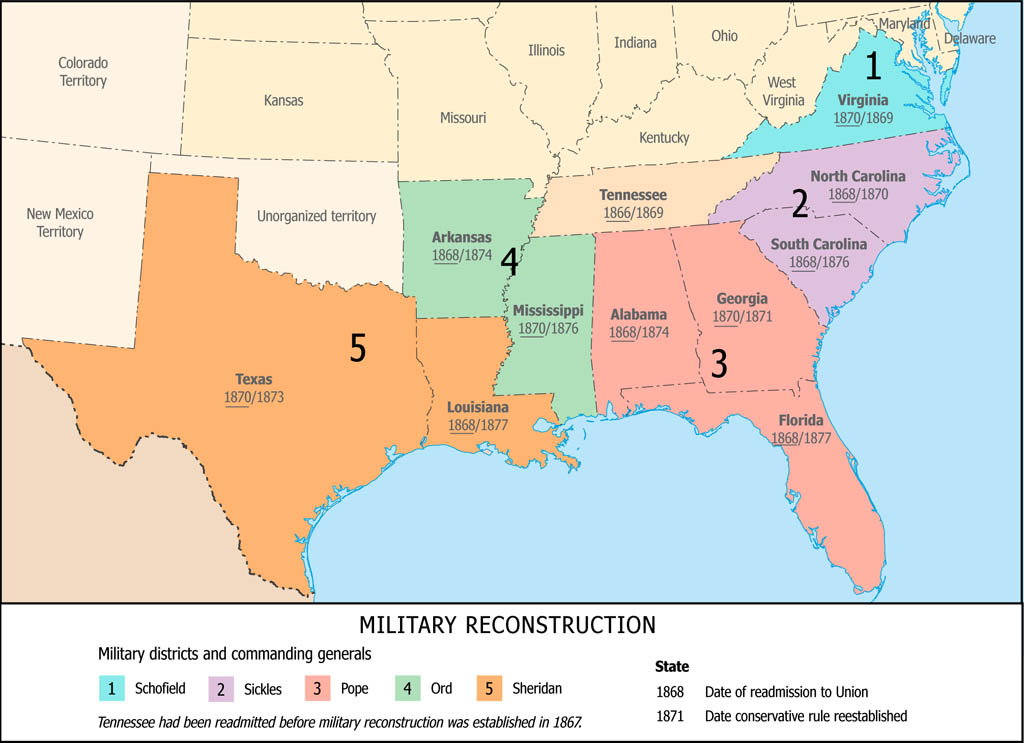
states would be governed. These acts included the Freedmen's Bureau, the Civil Rights Act of 1866, and several Reconstruction Acts (Reconstruction Timeline). The Reconstruction Acts established military rule over Southern states until new governments could be formed. They
also limited some former Confederate officials' and military officers' rights to vote and to run
for public office. The latter provisions, however, were only temporary and soon rescinded for almost all of those affected
by them. Meanwhile, the Reconstruction Acts gave former male slaves the right to vote and hold public office.
| Civil War Aftermath and Reconstruction |
|
| American Civil War Reconstruction Map |
Following the conflict, Congress passed three amendments to the
U.S. Constitution. The 13th Amendment formally abolished slavery in the nation and it was ratified on December
6, 1865. The 14th Amendment made African-Americans citizens and protected citizens from
discriminatory state laws. Southern states were required to ratify the Amendment before being readmitted to the union.
The 15th Amendment guaranteed African American men the right to vote. While African Americans received citizenship with the 14th Amendment to the U.S. Constitution, American Indians, or
Native Americans, on the other hand, were not citizens for another half-century. See Indian Citizenship Act of 1924.
Post Civil War, Confederate
President Jefferson Davis was indicted (never proven guilty) and confined to prison for two years. A large portion
of Davis's bond was posted by an ardent Unionist, Cornelius
“Commodore” Vanderbilt. The "Commodore" had even donated the S. S. Vanderbilt to Union forces during the
war; he was also a very prominent New Yorker, multi-millionaire and founder of Vanderbilt University. (His grandson
constructed America's largest home.) The United States imprisoned North Carolina Governor Zebulon Vance on May 13, 1865,
and North Carolina
was readmitted to the Union on July
4, 1868.
The
aftermath unity was further reflected as Zebulon Baird Vance was again elected as North Carolina's Governor (1876-1878). He also served
in the United States Senate from 1879-1894. The Tar Heel State also passed the "Amnesty Act of December 1866" by granting
amnesty to "all persons that committed homicides, felonies and misdemeanors during the course of the American Civil War."
Subsequently, the "North Carolina Constitutional Convention in 1868" created the most democratic constitution in the state's
history, and this was followed by the Civil Rights Act of 1875. Despite the high death toll of North Carolinians during the
War Between the States, between 1860 and 1890 the population doubled in Western North Carolina. The turn of the Century witnessed
14 year old girls marrying 70 year old Civil War veterans; they married these senior citizens hoping to inherit their pensions.
Population of the Cherokees in 1911 was 2,015. This included Swain, Jackson, Cherokee and Graham counties. Unfortunately,
during Reconstruction, American Indians remained targets of genocide. In 1868, U.S. Army General William Tecumseh Sherman
stated that "the more [Indians] we can kill this year, the less will have to be killed the next year, for the more I see of
these Indians, the more convinced I am that they all have to be killed or be maintained as a species of paupers. Their attempts
at civilization are simply ridiculous." And in 1869, General Phil Sheridan believed that "the only good Indian is a dead Indian."
Almost
140 years after the Civil War concluded, U.S. Marshals retrieved North Carolina's copy of the "Bill of Rights," which was confiscated during Sherman's March. In 2006, the
U.S. Court of Appeals for the 4th Circuit, based in Richmond, Va., affirmed an earlier ruling by U.S. District
Judge Terrence W. Boyle: "The document belongs to North Carolina."
"The men of the old Legion are not ashamed of their Confederate record and there is no bitterness to our
late foe." Lt. Col. William Stringfield, Thomas' Legion of Indians and Highlanders, on May 10, 1901.
(Sources and related reading listed at bottom of page.)
Recommended Reading: Civil War and
Reconstruction (781 pages). Description: Long considered the standard text in the field,
The Civil War and Reconstruction—originally written by James G. Randall and revised by David Donald—is now available
in a thoroughly revised new edition prepared by David Donald, Jean H. Baker, and Michael F. Holt. Maintaining the accuracy
and comprehensiveness that distinguished the original, the revised edition incorporates the best new scholarship in the field. Continued
below...
Expanded and updated coverage of social and cultural history includes
detailed discussions of southern society, slavery and the African-American experience, the experiences of women, and issues
of class. The postwar chapters - the aftermath - have been 'reconceived' to treat Reconstruction as a national,
rather than a regional, problem, exploring the connections between developments in the South and parallel changes in the North.
Recommended Reading: Ordeal By Fire: The Civil War
and Reconstruction (816 pages). Description: Pulitzer Prize winning author, James McPherson, Battle Cry of Freedom: The Civil War Era and For Cause and Comrades: Why Men Fought in the Civil War , describes the causes and origins of the Civil War; motivations and experiences of common
soldiers and the role of women; social, economic, political and ideological conflicts; as well as a comprehensive study of
the Reconstruction Era, commonly referred to as the Aftermath, and its consequences. Professor McPherson also includes
many visual aids such as detailed maps and comprehensive charts. , describes the causes and origins of the Civil War; motivations and experiences of common
soldiers and the role of women; social, economic, political and ideological conflicts; as well as a comprehensive study of
the Reconstruction Era, commonly referred to as the Aftermath, and its consequences. Professor McPherson also includes
many visual aids such as detailed maps and comprehensive charts.
Recommended Viewing: Aftershock - Beyond the Civil War (History Channel) (2006). Description:
Despite common belief, the Civil War does not end in 1865, and the blood of many Americans continues to flow freely. It is
a period known as "Reconstruction," a time many consider to be the darkest in American History. America
is supposed to be reuniting, healing its wounds, and moving past civil discord. But by examining what is really going on in
the post-Civil War South, one can see snapshots of a larger, more menacing picture, a picture shadowed by murder, terrorism,
and chaos. Continued below...
U.S. Army soldiers
plundered and pillaged southern homes and plantations during the Civil War
Aftermath and Reconstruction. Meanwhile, insurgencies led by disgruntled ex-Confederate soldiers rip through nearly
every southern state. Atrocities were conducted by both northerners and southerners, and "Aftershock
- Beyond the Civil War" is a must have video for every individual remotely interested
in the American Civil War.
Recommended
Reading:
A Short History of Reconstruction. Review: In an attempt to document the important issues of reconstruction, Eric Foner
compiled his book Reconstruction: America's
Unfinished Revolution, 1863-1877. Foner addresses all the major issues leading up reconstruction, and then finishing his book
shortly after the end of reconstruction and the election of Rutherford B. Hayes in 1876. In
the preface of his book, Foner discusses the historiography of Reconstruction. He notes that during the early part of the
twentieth century many historians considered Reconstruction as one of the darkest periods of American history. Foner notes
that this viewpoint changed during the 1960s as revisionists shed new "light" on reconstruction. The revisionists saw Andrew
Johnson as a stubborn racist, and viewed the Radical Republicans as "idealistic reformers genuinely committed to black rights."
The author notes that recent studies of reconstruction argue that the Radicals were actually quite conservative, and most
Radicals held on to their racist views and put up very little fight as the whites once again began to govern the south. Continued
below...
Foner
initially describes the African-American experience during the Civil War and Reconstruction. He argues that African-Americans
were not simply figures that took little or no action in the events of the day, and notes the enlistment of thousands of African-Americans
in the Union army during the war. Foner also notes that many of the African-Americans that eventually became civil leaders
had at one time served in the Union Army. He states, "For men of talent and ambition, the army flung open a door to advancement
and respectability." He notes that as reconstruction progressed, African-Americans were the targets of violence and racism. Foner believes that the transition of
slaves into free laborers and equal citizens was the most drastic example of change following the end of the war. He notes
how African-Americans were eventually forced to return to the plantations, not as slaves but as share croppers, and were thus
introduced to a new form of slavery. He argues that this arrangement introduced a new class structure to the South, and states
"It was an economic transformation that would culminate, long after the end of Reconstruction, in the consolidation of a rural
proletariat composed of a new owning class of planters and merchants, itself subordinate to Northern financiers and industrialists.”
The author illustrates how both blacks and whites struggled to use the state and local governments to develop their own interests
and establish their respective place in the evolving social orders. Another theme that he addresses in this excellent study is racism
itself and the interconnection of race and class in the South. Another subject he addresses is the expanded presence of federal authority, as
well as a growing idea and commitment to the idea that equal rights belonged to all citizens, regardless of race. Foner shows
how both Northern and Southern blacks embraced the power to vote, and, as Reconstruction ended, many blacks saw the loss of
suffrage and the loss of freedom. Foner illustrates that because the presence of blacks at the poll threatened the established
traditions, corruption increased, which helped to undermine the support for Reconstruction. The former leaders of the Confederacy
were barred from political office, who were the regions "natural leaders," a reversal of sympathies took place which portrayed
the Southern whites as victims, and blacks unfit to exercise suffrage. Reconstruction affected the North as well, but argues that it was
obviously less revolutionary than it was in the South. Foner notes that a new group of elites surfaced after the war, industrialists
and railroad entrepreneurs emerged as powerful and influential leaders alongside the former commercial elite. The Republicans
in the North did attempt to improve the lives of Northern blacks. However, there were far fewer blacks in the North, so it
was more difficult for blacks to have their agendas and needs addressed in the local legislatures. He states, "Most Northern
blacks remained trapped in inferior housing and menial and unskilled jobs." Foner adds that the few jobs blacks were able
to acquire were constantly being challenged by the huge influx of European immigrants. Foner's subject is definitely worthy of his original volume. Reconstruction
is a subject that can still be interpreted in several ways, including the revisionist school of thought. Foner, however, seems
to be as objective as possible on this subject, and has fairly addressed all major issues that apply.
Recommended Reading: Reconstruction: America's Unfinished Revolution, 1863-1877. Review: This "masterful
treatment of one of the most complex periods of American history" (New
Republic) made history when it was originally published in 1988. It redefined
how Reconstruction was viewed by historians and people everywhere in its chronicling of how Americans -- black and white --
responded to the unprecedented changes unleashed by the war and the end of slavery. This "smart book of enormous strengths"
(Boston Globe) has since gone on to become the classic work on the wrenching post-Civil War period -- an era whose legacy
reverberates still today in the United States.
Continued below...
About the Author: Eric Foner, DeWitt Clinton Professor of American History at Columbia
University, is the author of numerous works on American history, including
Free Soil, Free Labor, Free Men: The Ideology of the Republican Party Before the Civil War; Tom Paine and Revolutionary America;
and The Story of American Freedom. He has served as president of both the Organization of American Historians and the American
Historical Association, and has been named Scholar of the Year by the New York Council for the Humanities.
Recommended Reading: American Experience
- Reconstruction: The Second Civil War (PBS) (DVD) (175 minutes). Description: Spanning the years
from 1863 to 1877, this dramatic mini-series recounts the tumultuous post-Civil War years. America was grappling with rebuilding
itself, with bringing the South back into the Union, and with how best to offer citizenship to former slaves. Stories of key
political players in Washington are interwoven with those of ordinary people caught up in the turbulent social and political
struggles of the Civil War Aftermath and Reconstruction. Continued below...
Review: If there was a villain behind the curtain of the tragic story
of Reconstruction, then, according to some, it was John Wilkes Booth. It was President Andrew Johnson who, according
to many, mishandled Reconstruction. And to some, it was President U.S. Grant, former Union general, who allowed political
favors and exhaustive policies and bureaucratic red-tape to halt any final attempt at Reconstruction. "Reconstruction:
The Second Civil War" basically begins with Lincoln's assassination and continues through the United States' political
stages that included military rule and radical reconstruction (which were empowered by the Radical Republicans in Congress).
Still, if there is a clear lesson from this "American Experience" documentary, it is that the South might have lost the Civil
War but they managed to win Reconstruction. This two-part PBS documentary covers the momentous years 1863 to 1877. Part I,
"Revolution" produced and directed by Llewellyn M. Smith, begins with Lincoln's warning that Reconstruction would be "fraught
with great difficulty," and ends in 1867 when Congress passed the Radical Republican's Reconstruction plan that divided the
former Confederacy into five military districts, each commanded by a United States (Union) General with power to enforce law
and administer justice. New Southern governments would be created but were required to ratify the Fourteenth Amendment and
allow black men the right to vote, which saw former slaves being elected to public office. Part II, "Retreat," produced
and directed by Elizabeth Deane shows how the Democrats slowly but surely regained power in the Southern states and achieved
"redemption" for white Southerners. A compelling case is made for the acquiescence of Northerners with the concern of Southern
whites for keeping the blacks subordinate, and one of the more interesting episodes concerns the White League, which went
after carpetbaggers the way the Ku Klux Klan pursued freedmen. President Grant also sent federal troops to retake, by
force if necessary, the Louisiana legislature from a takeover by the White League. It was an intervention that apparently
offends Northerners as much as it did Southerners. By the time you get to the end of this documentary you are convinced that
the Civil War was a bloody tragedy, while Reconstruction was a complex tragedy.
While this documentary covers the history and politics of the period
it also focuses on a series of key individuals to tell the story of Reconstruction, much as Ken Burns did in "The Civil War."
Marshall Twitchell, from Vermont, a former brash Yankee officer turned opportunist, became a successful "Carpetbagger" in
Louisiana who had a violent Southern neighbor named B. W. Marston (whose descendant tells his family's side of the
story). The documentary also tells the story of Fan Butler, an innocent civilian, who tried to keep her family's
Georgia plantation, which grew rice, afloat through sharecropping. John Roy Lynch, on the other hand, was a freed
slave who succeeded in politics because of Reconstruction, while Abolitionist Tunis Campbell, whose contributions
are long overdue, tried to stop whites from controlling blacks in his county and measured his idealism with provocative
efforts that made him a target for trying to give the Negro supremacy over the white man. You can make your own judgment as
to how representative these choices are as focal characters, given that they represent both Southern and Northern as well
as white and black Americans, but they do allow the history to be personalized as well as setting up the historians being
interviewed to speak to the greater significance of their individual stories. With regards to the impeachment of Andrew Johnson,
I would contend that it does not necessarily need to be turned into a question of Reconstruction. Johnson's crime was not
that he wanted to fire a member of his cabinet, but rather than he tried to fire a Radical Republican when, you have to remember,
he was neither. Abraham Lincoln was not re-elected to the presidency as a Republican, but rather as a member of the "Union"
party, with Johnson, a Democrat who was the only U.S. Senator from the South not to resign following secession, as his running
mate. The first part of this documentary does a good job of trashing Johnson as racist who even betrayed his allegiance to
poor whites over the planters because of his disregard for the freed slaves. Grant, who assumed the White House from
Johnson, made numerous poor executive decisions regarding Reconstruction. Even when the Congress passed civil rights
legislation it was not enforced as the Democrats regain control of the South and eventually the laws were declared unconstitutional
by the Supreme Court. It would take a century for those rights to be passed again and actually become the law of the land.
Aftermath and Reconstruction was more than just a complex era, it was perhaps the most impossible balancing
act imaginable.
Sources: Official Records of the Union and Confederate Armies; Walter Clark,
Histories of the Several Regiments and Battalions from North Carolina in the Great War 1861-1865; National Park Service: American
Civil War; Weymouth T. Jordan and Louis H. Manarin, North Carolina Troops, 1861-1865; D. H. Hill, Confederate Military
History Of North Carolina: North Carolina In The Civil War, 1861-1865; Library of Congress; North Carolina Office of Archives
and History; North Carolina Museum of History; State Library of North Carolina; North Carolina Department of Cultural
Resources; North Carolina Department of Agriculture; National Archives and Records Administration; and Tennessee State Library
and Archives.
|
