|
Reconstruction
Nearly two years after the end of the American Civil War, the United States
Congress passed four statutes known as Reconstruction Acts: March 2, 1867; March 23, 1867; July 19, 1867; and March
11, 1868. (American Experience - Reconstruction: The Second Civil War, vividly reflects the nation's most tumultuous transition from Civil War to
Reconstruction.) The Reconstruction Acts' main points included:
- Creation of five military districts
in the seceded states (not including Tennessee, which had ratified the 14th Amendment and was readmitted to the Union)
- Required congressional approval for new state constitutions (which were required
for Confederate states to rejoin the Union)
- Confederate states must recognize and permit the voting rights to all
men
- All states must ratify the 14th Amendment
| Civil War and Reconstruction Results |
|
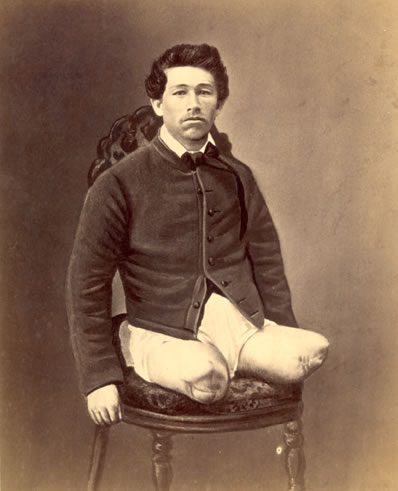
| Civil War Amputees and Reconstruction |
(Right) Private Columbus Rush, Company C, 21st Georgia, age 22, was
wounded during the assault on Fort Stedman, Virginia, on March 25, 1865, by a shell fragment that fractured both the right
leg below the knee and the left kneecap. Both limbs were amputated above the knees on the same day. He recovered quickly and
was discharged from Lincoln Hospital in Washington on Aug. 2, 1865. In 1866, while being treated at St. Luke's Hospital in
New York City, he was outfitted with artificial limbs. Reconstruction was an era of rebuilding but also an era of new
industries. One booming industry manufactured artificial limbs, and the demand was so great for prosthetics that in 1866, for example, 20% of Mississippi’s
entire state budget went to the procurement of artificial limbs.
When the Civil War ended, leaders turned to the question of how to reconstruct the nation.
One important issue was the right to vote. Hotly debated were rights of black American men and former Confederate men to vote.
| Reconstruction Era and Reconstruction Acts |
|
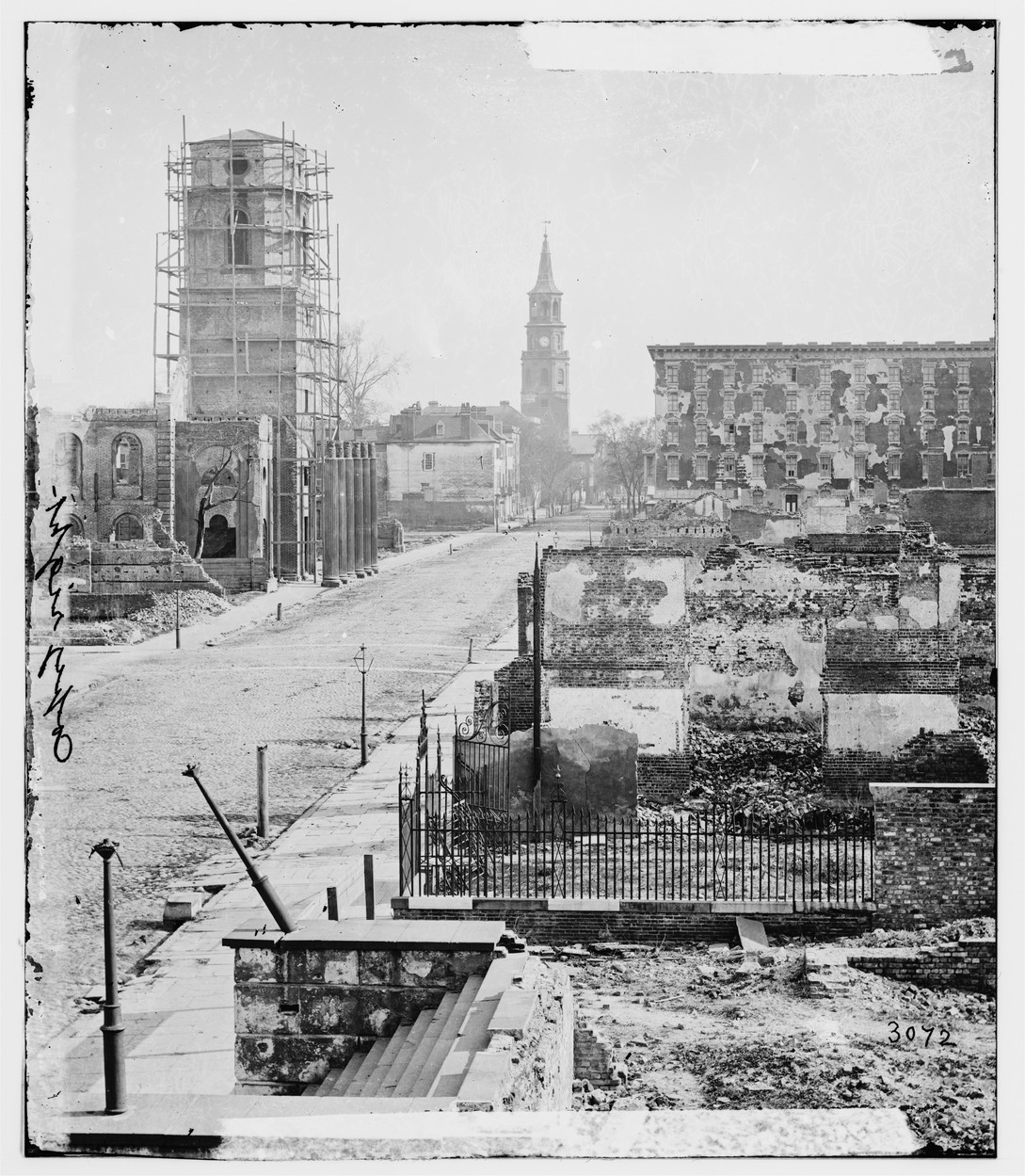
| Reconstruction for Charleston, S.C., meant rebuilding the City |
(About) Charleston in April 1865. View of Meeting Street, looking south
toward the Circular Church, the Mills House, and St. Michael's Church. Charleston, S.C. was considered the hotbed, the nest
that hatched the egg named secession, and when Gen. Sherman approached Charleston in '65, he reminded his command that this
is the city that caused this war! After Sherman hammered through the city, he continued north toward North Carolina. Reconstruction
concluded in 1877, but for Charleston and many other Southern cities, the ruins and scars of Civil War would be felt for generations.
In the latter half of the 1860s, Congress passed a series of acts
designed to address the question of rights, as well as how the Southern states would be governed. These acts included the
act creating the Freedmen's Bureau, the Civil Rights Act of 1866, and several Reconstruction Acts (see Reconstruction Timeline). The Reconstruction Acts established controversial military rule over Southern states until new governments could
be formed. They also limited some former Confederate officials' and military officers' rights to vote and to run for public
office. (However, the latter provisions were only temporary and soon rescinded for almost all of those affected by them.)
Meanwhile, the Reconstruction Acts gave former male slaves the right to vote and hold
public office. (See also: Black Code and Black Codes, Civil War Reconstruction: Amendments and Acts, and Reconstruction Era and Civil Rights.)
Congress also passed two amendments to the United States Constitution. The Fourteenth Amendment made African-Americans citizens and protected
citizens from discriminatory state laws. Southern states were required to ratify
the Fourteenth Amendment before being readmitted to the union. The Fifteenth Amendment guaranteed African American men the
right to vote. While African Americans received citizenship
with the 14th Amendment to the U.S. Constitution, American Indians, or Native Americans, on the other hand, were not
citizens for another half-century. See Indian Citizenship Act of 1924.
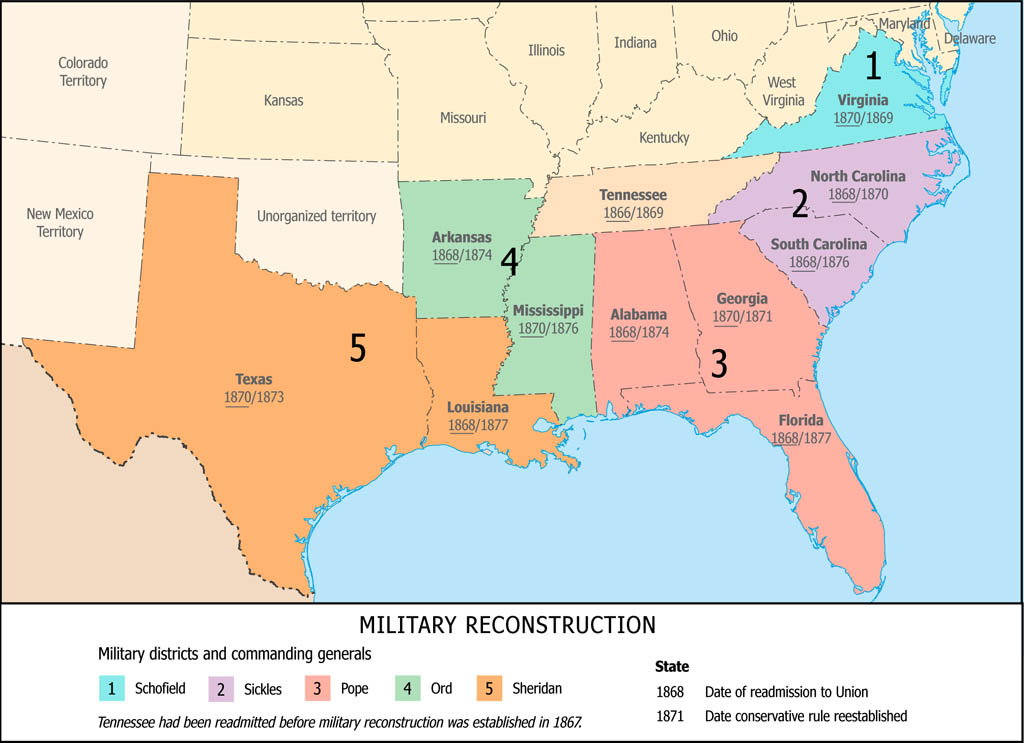
The first Reconstruction Act placed ten Confederate states under military control, grouping them into five
military districts:
- First Military District: Virginia, under General John Schofield
- Second Military District: North Carolina and South Carolina, under General Daniel Sickles
- Third Military District: Georgia, Alabama and Florida, under General John Pope
- Fourth Military District: Arkansas and Mississippi, under General Edward
Ord
- Fifth Military District: Texas and Louisiana, under Generals Philip Sheridan
and Winfield Scott Hancock
Tennessee was not made part of a military district (having already been
readmitted to the Union), and therefore federal controls did not apply. After his inauguration in 1877, President Hayes removes
the remaining federal troops in South Carolina, Florida, and Louisiana from political duty (guarding the statehouses). Redeemer
governments assume power in South Carolina, Florida, and Louisiana. Thus, Reconstruction formally ended. And, although the South had been defeated in Civil War, it claimed that it had won
the "War for Reconstruction."
| Civil War Reconstruction & Military Reconstruction |
|
| Civil War Reconstruction Map with military districts and commanding generals |
Significant Dates
| State |
|
Secession Ordinance |
Admitted C.S.A. |
Under Predominant
Union control |
Readmitted to the Union |
| South Carolina |
|
Dec. 20, 1860 |
Feb. 8, 1861 |
1865 |
Jul. 9, 1868 |
| Mississippi |
|
Jan. 9, 1861 |
Feb. 8, 1861 |
1863 |
Feb. 23, 1870 |
| Florida |
|
Jan. 10, 1861 |
Feb. 8, 1861 |
1865 |
Jun. 25, 1868 |
| Alabama |
|
Jan. 11, 1861 |
Feb. 8, 1861 |
1865 |
Jul. 13, 1868 |
| Georgia |
|
Jan. 19, 1861 |
Feb. 8, 1861 |
1865 |
1st Date Jul. 21, 1868;
2nd Date Jul. 15, 1870 |
| Louisiana |
|
Jan. 26, 1861 |
Feb. 8, 1861 |
1862 |
Jul. 9, 1868 |
| Texas |
|
Feb. 1, 1861 |
Mar. 2, 1861 |
1865 |
Mar. 30, 1870 |
| Virginia |
|
Apr. 17, 1861 |
May 7, 1861 |
1865;
(1861 for West Virginia) |
Jan. 26, 1870 |
| Arkansas |
|
May 6, 1861 |
May 18, 1861 |
1864 |
Jun. 22, 1868 |
| North Carolina |
|
May 20, 1861 |
May 21, 1861 |
1865 |
Jul. 4, 1868 |
| Tennessee |
|
Jun. 8, 1861 |
Jul. 2, 1861 |
1862 |
Jul. 24, 1866 |
| Missouri |
|
Oct. 31, 1861 |
Nov. 28, 1861 |
1861 |
Unelected Pro-Union Government from 1861 |
| Kentucky (Russellville Convention) |
|
Nov. 20, 1861 |
Dec. 10, 1861 |
1861 |
Pro-Union & C.S.A. Government from 1861 |
| Arizona Territory (Mesilla Government) |
|
Mar. 16, 1861 |
Feb. 14, 1862 |
1862 |
Not a state until 1912 |
(Sources and related reading below)
Recommended Reading: Ordeal By Fire: The Civil War and Reconstruction (816 pages). Description:
Pulitzer Prize winning author, James McPherson, Battle Cry of Freedom: The Civil War Era and For Cause and Comrades: Why Men Fought in the Civil War , describes the causes and origins of the Civil War; motivations and experiences of common
soldiers and the role of women; social, economic, political and ideological conflicts; as well as a comprehensive study of
the Reconstruction Era and its consequences. Professor McPherson also includes many visual aids such as detailed maps and
comprehensive charts. “A must have for the Civil War buff!” , describes the causes and origins of the Civil War; motivations and experiences of common
soldiers and the role of women; social, economic, political and ideological conflicts; as well as a comprehensive study of
the Reconstruction Era and its consequences. Professor McPherson also includes many visual aids such as detailed maps and
comprehensive charts. “A must have for the Civil War buff!”
Related Reading:
Recommended Reading: Civil War and Reconstruction (781 pages).
Description: Long considered the standard text in the field, The Civil War and Reconstruction—originally written
by James G. Randall and revised by David Donald—is now available in a thoroughly revised new edition prepared by David
Donald, Jean H. Baker, and Michael F. Holt. Maintaining the accuracy and comprehensiveness that distinguished the original,
the revised edition incorporates the best new scholarship in the field. Continued below...
Expanded and updated coverage of social and cultural history includes
detailed discussions of southern society, slavery and the African-American experience, the experiences of women, and issues
of class. The postwar chapters have been 'reconceived' to treat Reconstruction as a national, rather than a regional, problem,
exploring the connections between developments in the South and parallel changes in the North.
Recommended
Reading: A Short History of Reconstruction.
Review: In an attempt to document the important issues
of reconstruction, Eric Foner compiled his book Reconstruction: America's Unfinished Revolution,
1863-1877. Foner addresses all the major issues leading up reconstruction, and then finishing his book shortly after the end
of reconstruction and the election of Rutherford B. Hayes in 1876. In the preface of
his book, Foner discusses the historiography of Reconstruction. He notes that during the early part of the twentieth century
many historians considered Reconstruction as one of the darkest periods of American history. Foner notes that this viewpoint
changed during the 1960s as revisionists shed new "light" on reconstruction. The revisionists saw Andrew Johnson as a stubborn
racist, and viewed the Radical Republicans as "idealistic reformers genuinely committed to black rights." The author notes
that recent studies of reconstruction argue that the Radicals were actually quite conservative, and most Radicals held on
to their racist views and put up very little fight as the whites once again began to govern the south. Continued below...
Foner initially
describes the African-American experience during the Civil War and Reconstruction. He argues that African-Americans were not
simply figures that took little or no action in the events of the day, and notes the enlistment of thousands of African-Americans
in the Union army during the war. Foner also notes that many of the African-Americans that eventually became civil leaders
had at one time served in the Union Army. He states, "For men of talent and ambition, the army flung open a door to advancement
and respectability." He notes that as reconstruction progressed, African-Americans were the targets of violence and racism. Foner believes that the transition of slaves into free laborers
and equal citizens was the most drastic example of change following the end of the war. He notes how African-Americans were
eventually forced to return to the plantations, not as slaves but as share croppers, and were thus introduced to a new form
of slavery. He argues that this arrangement introduced a new class structure to the South, and states "It was an economic
transformation that would culminate, long after the end of Reconstruction, in the consolidation of a rural proletariat composed
of a new owning class of planters and merchants, itself subordinate to Northern financiers and industrialists.” The
author illustrates how both blacks and whites struggled to use the state and local governments to develop their own interests
and establish their respective place in the evolving social orders. Another theme that he addresses in this excellent study is racism itself and the interconnection of race and
class in the South. Another subject he addresses is
the expanded presence of federal authority, as well as a growing idea and commitment to the idea that equal rights belonged
to all citizens, regardless of race. Foner shows how both Northern and Southern blacks embraced the power to vote, and, as
Reconstruction ended, many blacks saw the loss of suffrage and the loss of freedom. Foner illustrates that because the presence
of blacks at the poll threatened the established traditions, corruption increased, which helped to undermine the support for
Reconstruction. The former leaders of the Confederacy were barred from political office, who were the regions "natural leaders,"
a reversal of sympathies took place which portrayed the Southern whites as victims, and blacks unfit to exercise suffrage.
Reconstruction
affected the North as well, but argues that it was obviously less revolutionary than it was in the South. Foner notes that
a new group of elites surfaced after the war, industrialists and railroad entrepreneurs emerged as powerful and influential
leaders alongside the former commercial elite. The Republicans in the North did attempt to improve the lives of Northern blacks.
However, there were far fewer blacks in the North, so it was more difficult for blacks to have their agendas and needs addressed
in the local legislatures. He states, "Most Northern blacks remained trapped in inferior housing and menial and unskilled
jobs." Foner adds that the few jobs blacks were able to acquire were constantly being challenged by the huge influx of European
immigrants. Foner's subject is definitely worthy of
his original volume. Reconstruction is a subject that can still be interpreted in several ways, including the revisionist
school of thought. Foner, however, seems to be as objective as possible on this subject, and has fairly addressed all major
issues that apply.
Recommended Reading:
Reconstruction: America's
Unfinished Revolution, 1863-1877. Review: This "masterful treatment of one of the most complex periods of American history" (New Republic) made history when it was originally published in
1988. It redefined how Reconstruction was viewed by historians and people everywhere in its chronicling of how Americans --
black and white -- responded to the unprecedented changes unleashed by the war and the end of slavery. This "smart book of
enormous strengths" (Boston Globe) has since gone on to become the classic work on the wrenching post-Civil War period --
an era whose legacy reverberates still today in the United States. Continued below...
About
the Author: Eric Foner, DeWitt Clinton Professor
of American History at Columbia
University, is the
author of numerous works on American history, including Free Soil, Free Labor, Free Men: The Ideology of the Republican Party
Before the Civil War; Tom Paine and Revolutionary America; and The Story of American Freedom. He has served as president of
both the Organization of American Historians and the American Historical Association, and has been named Scholar of the Year
by the New York Council for the Humanities.
Recommended Reading: American Experience
- Reconstruction: The Second Civil War (PBS) (DVD) (175 minutes). Description: Spanning the years
from 1863 to 1877, this dramatic mini-series recounts the tumultuous post-Civil War years. America was grappling with rebuilding
itself, with bringing the South back into the Union, and with how best to offer citizenship to former slaves. Stories of key
political players in Washington are interwoven with those of ordinary people caught up in the turbulent social and political
struggles of the Civil War Aftermath and Reconstruction. Continued below...
Review: If there was a villain behind the curtain of the tragic story of Reconstruction, then, according
to some, it was John Wilkes Booth. It was President Andrew Johnson who, according to many, mishandled Reconstruction.
And to some, it was President U.S. Grant, former Union general, who allowed political favors and exhaustive policies
and bureaucratic red-tape to halt any final attempt at Reconstruction. "Reconstruction: The Second Civil War"
basically begins with Lincoln's assassination and continues through the United States' political stages that included
military rule and radical reconstruction (which were empowered by the Radical Republicans in Congress). Still, if there
is a clear lesson from this "American Experience" documentary, it is that the South might have lost the Civil War but they
managed to win Reconstruction.
This two-part PBS documentary covers the momentous years 1863 to 1877. Part
I, "Revolution" produced and directed by Llewellyn M. Smith, begins with Lincoln's warning that Reconstruction would be "fraught
with great difficulty," and ends in 1867 when Congress passed the Radical Republican's Reconstruction plan that divided the
former Confederacy into five military districts, each commanded by a United States (Union) General with power to enforce law
and administer justice. New Southern governments would be created but were required to ratify the Fourteenth Amendment and
allow black men the right to vote, which saw former slaves being elected to public office. Part II, "Retreat," produced
and directed by Elizabeth Deane shows how the Democrats slowly but surely regained power in the Southern states and achieved
"redemption" for white Southerners. A compelling case is made for the acquiescence of Northerners with the concern of Southern
whites for keeping the blacks subordinate, and one of the more interesting episodes concerns the White League, which went
after carpetbaggers the way the Ku Klux Klan pursued freedmen. President Grant also sent federal troops to retake, by
force if necessary, the Louisiana legislature from a takeover by the White League. It was an intervention that apparently
offends Northerners as much as it did Southerners. By the time you get to the end of this documentary you are convinced that
the Civil War was a bloody tragedy, while Reconstruction was a complex tragedy.
While this documentary covers the history and politics of the period it
also focuses on a series of key individuals to tell the story of Reconstruction, much as Ken Burns did in "The Civil War."
Marshall Twitchell, from Vermont, a former brash Yankee officer turned opportunist, became a successful "Carpetbagger" in
Louisiana who had a violent Southern neighbor named B. W. Marston (whose descendant tells his family's side of the
story). The documentary also tells the story of Fan Butler, an innocent civilian, who tried to keep her family's
Georgia plantation, which grew rice, afloat through sharecropping. John Roy Lynch, on the other hand, was a freed
slave who succeeded in politics because of Reconstruction, while Abolitionist Tunis Campbell, whose contributions
are long overdue, tried to stop whites from controlling blacks in his county and measured his idealism with provocative
efforts that made him a target for trying to give the Negro supremacy over the white man. You can make your own judgment as
to how representative these choices are as focal characters, given that they represent both Southern and Northern as well
as white and black Americans, but they do allow the history to be personalized as well as setting up the historians being
interviewed to speak to the greater significance of their individual stories. With
regards to the impeachment of Andrew Johnson, I would contend that it does not necessarily need to be turned into a question
of Reconstruction. Johnson's crime was not that he wanted to fire a member of his cabinet, but rather than he tried to fire
a Radical Republican when, you have to remember, he was neither. Abraham Lincoln was not re-elected to the presidency as a
Republican, but rather as a member of the "Union" party, with Johnson, a Democrat who was the only U.S. Senator from the South
not to resign following secession, as his running mate. The first part of this documentary does a good job of trashing Johnson
as racist who even betrayed his allegiance to poor whites over the planters because of his disregard for the freed slaves.
Grant, who assumed the White House from Johnson, made numerous poor executive decisions regarding Reconstruction.
Even when the Congress passed civil rights legislation it was not enforced as the Democrats regain control of the South and
eventually the laws were declared unconstitutional by the Supreme Court. It would take a century for those rights to
be passed again and actually become the law of the land. Aftermath and Reconstruction was more than just
a complex era, it was perhaps the most impossible balancing act imaginable.
Recommended Reading: A Companion to the Civil War and Reconstruction
(Blackwell Companions to American History) (Hardcover) (528 pages). Description: A Companion to the Civil War and Reconstruction
addresses the key topics and themes of the Civil War era, with 23 original essays by top scholars in the field. Continued
below...
An authoritative volume that surveys the history and historiography of the U.S. Civil War and Reconstruction.
Analyzes the major sources and the most influential books and articles in the field.
Includes discussions on scholarly advances in U.S. Civil War history.
Sources: Official Records of the Union and Confederate Armies; Walter Clark,
Histories of the Several Regiments and Battalions from North Carolina in the Great War 1861-1865; National Park Service: American
Civil War; Weymouth T. Jordan and Louis H. Manarin, North Carolina Troops, 1861-1865; D. H. Hill, Confederate Military
History Of North Carolina: North Carolina In The Civil War, 1861-1865; Library of Congress; North Carolina Office of Archives
and History; North Carolina Museum of History; State Library of North Carolina; and National Archives and Records Administration.
The facts on the Reconstruction pages cover in detail and answer the following questions:
American Civil War Reconstruction Era History; List of Reconstruction
Acts results and purpose; The Reconstruction Era Timeline, definition, goal, goals, achievements, accomplishments; The Reconstruction
covered what years? (Includes Summary and Overview); What did it accomplish? The Reconstruction accomplished the
following key points. Also, what did it achieve? It achieved the following objectives.
|


