|
African American Civil War Homepage
African Americans and the American Civil War
Introduction
African Americans have an impressive history of military service in the United States, including the Civil War
(1861-1865). During the Civil War, African Americans, known as the U.S. Colored
Troops (USCT), mustered 137 infantry regiments, 13 heavy artillery regiments, 6 cavalry regiments, 10 light artillery
batteries, and numerous independent and unassigned companies. A total of 178,975* African Americans (10% of the Union total) served valiantly during the Civil War, and a grand total of 36,847
U.S. Colored Troops died -- including killed, mortally wounded, and deaths from all causes other than battle.
*Includes approximately 18,000 who served in the Union Navy.
| African-American Civil War History |
|
| United States Colored Troops (USCT) |
| African American Civil War History |

|

|
| Total African Americans Killed During the Civil War |
| African American Civil War History |
|
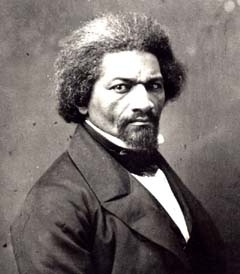
| Honorable Frederick Douglass |
Background
"Once let the black man get upon his person the brass letters, U.S.,
let him get an eagle on his button, and a musket on his shoulder and bullets in his pocket, there is no power on earth that
can deny that he has earned the right to citizenship." Frederick Douglass
Because of prejudice against them, black units were not used in combat as
extensively as white regiments. Nevertheless, the soldiers served with distinction in a number of battles. Black infantrymen
fought gallantly at Milliken's Bend, LA; Port Hudson, LA; Petersburg, VA; and Nashville, TN. The July 1863 assault on Fort
Wagner, SC, in which the 54th Regiment of Massachusetts Volunteers lost two-thirds of their officers and half of their troops,
was memorably dramatized in the film Glory. By war's end, 16 black soldiers had been awarded the Medal of Honor for their
valor.
In February 1862, 800 prisoners of war (officers and enlisted men) arrived
at Camp Chase. Included among the 800 Confederate soldiers were approximately 75 African Americans.**
In addition to the perils of war faced by all Civil War soldiers, African
American troops were confronted with additional difficulties created by racial prejudice. Although many served in the infantry
and artillery, discriminatory practices resulted in large numbers of African American soldiers being assigned to perform non-combat,
support duties as cooks, laborers, and teamsters.
Racial discrimination was prevalent in the North, and discriminatory
practices permeated the U.S. military. African Americans soldiers, referred to as colored troops, were believed to be inferior
and incompetent in commanding and leading troops into the throes of battle. Segregated units, however, were
formed with black enlisted men and typically commanded by white officers and black noncommissioned officers. The 54th Massachusetts
was commanded by Robert Shaw and the 1st South Carolina by Thomas Wentworth Higginson—both white. Black soldiers were
initially paid $10 per month from which $3 was automatically deducted for clothing, resulting in a net pay of $7. In contrast,
white soldiers received $13 per month from which no clothing allowance was drawn. In June 1864 Congress granted equal pay
to the U.S. Colored Troops and made the action retroactive. Black soldiers received the same rations and supplies. In addition,
they received comparable medical care.
This
page includes highlights of the numerous individuals, places and events in African American Civil War History,
as well numerous links to additional African American history, heritage, achievements and accomplishments, with photographs
and pictures, and additional resources and material. This is an extensive website related to "Nineteenth-Century
African American history."
| African Americans in the Civil War |
|
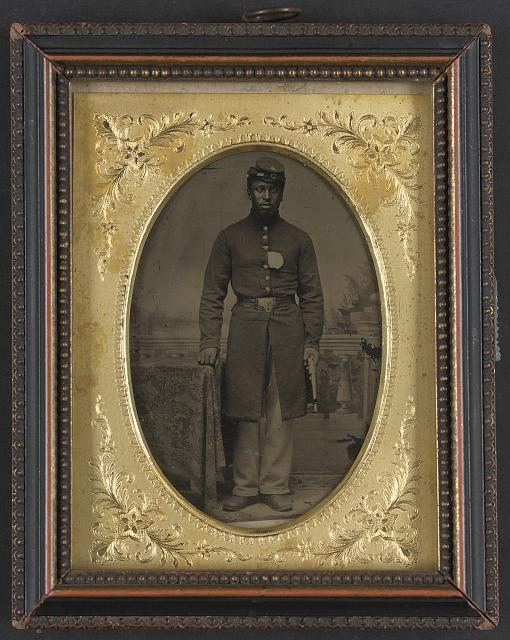
| Sergeant Tom Strawn |
(About) Sergeant Tom Strawn of Company B, 3rd U.S. Colored Troops Heavy
Artillery Regiment, with revolver in front of painted backdrop showing balustrade and landscape. Lacking any formal military
training, field service, and combat experience that was previously available only to white soldiers, the black soldiers demonstrated
during the Civil War that they fought on equal ground to that of the white soldiers. Quick to learn, willing to fight,
and not a bone of cowardliness in the colored soldier, stated one white Union officer who had led them into the thick of the
fray. Although fighting for the Union, the U.S. Colored Troops faced uncertainty on every front, and they were caught between
the known and the unknown: a familiar South that espoused the U.S. Constitution (not Southern constitution) that
protected slavery and even referred to the slave as both property and 3/5th of a person. The North, meanwhile,
was struggling with constitutional amendments and emancipation, war and reconciliation, mass immigration from Europe, and
inequality in a very competitive work environment that favored the status quo.(ca. 1863-1865) Tintype photograph courtesy
Library of Congress.
| African American soldiers in the Civil War |
|
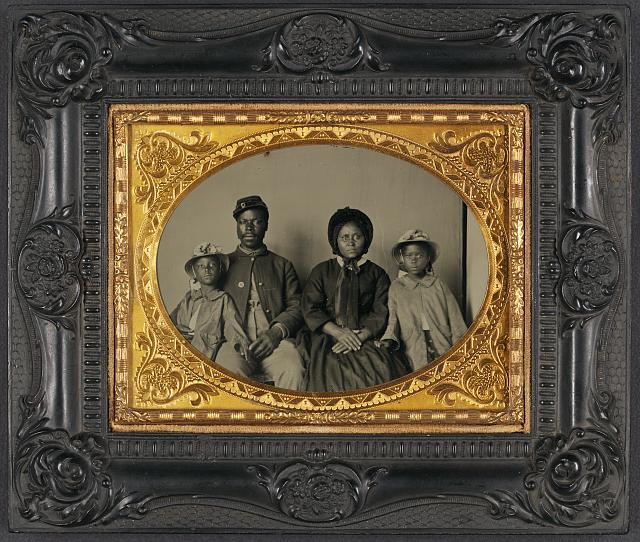
| African American soldier with wife and two daughters |
(About) Photograph of African American family during the
Civil War. Union soldier with wife wearing dress and hat, and two daughters wearing matching coats and hats. Embroiled
in a conflict that had ripped the nation asunder, the black family only wanted the opportunity to enjoy the God-given right
that all men are created equal, that they are endowed by their Creator with certain unalienable Rights, that among these
are Life, Liberty and the pursuit of Happiness. The stalwart colored soldier was willing to sacrifice his life on an alter
of the nation's killing fields while pursuing the elusive American dream for his family. He did not desire the hand out,
nor the hand up, but "just give us the opportunity to fight, and fight we will!" stated many African Americans. In May 1863, U.S. Secretary of War Edwin Stanton issued General
Order No. 143 creating the Bureau of U.S. Colored Troops. This image was found in Cecil County, Maryland, making it likely
that this soldier belonged to one of the seven U.S.C.T. regiments raised in Maryland. (ca. 1863-'65) Tintype photograph
Courtesy Library of Congress.
13th Amendment to the U.S. Constitution
14th Amendment to the U.S. Constitution
15th Amendment to the U.S. Constitution
Missouri Compromise of 1820 (Pivotal Moment
in the Slave Trade)
Compromise of 1850 (Definition, Details and
Viewpoint)
Fugitive Slave Act of 1850 (Impact on Slavery)
The Compromise of 1850 and the Fugitive Slave Law (Proposals, Acts,
Proclamations, Amendments, Debates, and Compromises)
The Compromise of 1850 and the Fugitive Slave
Act
Results of the Fugitive Slave Act: Diary and Memoirs
Kansas-Nebraska Act of 1854 (Significance
and Results)
Bleeding Kansas (aka Bloody Kansas and the
Border War)
Crittenden Compromise (A Pivotal Proposal
in US History)
Abolitionist John Brown (History, Memorials,
Photo)
Freedmen's Bureau History: History Homepage
President Abraham Lincoln (The Northern
and Southern Viewpoints)
President Abraham Lincoln on Race (What did Lincoln really think
about the Black Race?)
Was Lincoln a Racist? (Interview with Henry Louis Gates, Jr., Alphonse Fletcher University
Professor and Director of the W.E.B. Du Bois Institute for African and African American Research at Harvard University)
Turning Points of the American Civil War
Reconstruction Era and Acts 1865-1877 (Timeline, History, Amendments,
Acts, Rules, Codes, Military Rule, Laws, Rights, Freedmen Bureau, 40 Acres and a Mule, Union Readmission, Aftermath)
| African Americans in the Civil War |
|
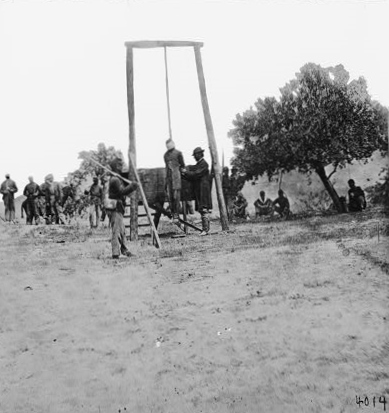
| African American Soldier Hanged |
(About) Narrative: Union soldier William Johnson was accused of
"deserting the Union Army and attempting to rape a white woman." Johnson, on the single "charge of attempted rape," was sentenced
by the Union Army to death by hanging, and, on June 20, 1864, Johnson was hanged in the vicinity of Petersburg, Virginia.
Southern and Northern reporters alike, hoping to capitalize on the hanging,
posted various accounts of the hanging: "Execution of Negro William Johnson for the attempted rape of a Southern lady. The
Negro Johnson, ex-Union soldier, was hanged, June 20, 1864, in vicinity of Petersburg, Va." "A colored soldier, face
covered with cloth, hanging from scaffold. The executioner stands behind body, while white Union soldiers, some in uniform,
stand or sit nearby." "Execution of colored soldier on charge of attempted rape!" exclaimed yet another account.
**Phillip R. Shriver and Donald J. Breen, Ohio's Military Prisons in the
Civil War for the Ohio Historical Society (Columbus, OH: Ohio State University Press, 1964) 12-14.
Recommended Reading: The Sable Arm: Black Troops in the Union Army, 1861-1865 (Modern War Studies). Description: A bona fide classic, The Sable Arm was the first work to fully chronicle the remarkable story of the nearly
180,000 black troops who served in the Union army. This work paved the way for the exploration of the black military experience
in other wars. This edition, with a new foreword by Herman Hattaway and bibliographical essay by the author, makes available
once again a pioneering work that will be especially useful for scholars and students of Civil War, black, and military history.
Civil War Times
Illustrated: "One of the one hundred best books ever written on the Civil War."
Recommended Viewing: "Glory". Description: One of the best films about the Civil War... Fact Based film about a 25-year-old son of Boston abolitionists
who volunteered to command the all-black 54th Massachusetts Volunteer Infantry Regiment. A Stunning history about the heroic
Fighting 54th and its bravery which turned bitter defeat into a symbolic
victory; brought recognition to black soldiers; turned the tide of the war; shifted national attitudes regarding colored
soldiers; and etched a legacy in the annals of American history. Won 3 Oscars: another 9 wins & 10 nominations.
Morgan Freeman, Denzel Washington, Andre Braugher, and Matthew Broderick comprise
an all-star cast and give stirring and emotional performances. "Great for every family, classroom and American."
Five Stars by americancivilwarhistory.org
Recommended Viewing:
Slavery and the Making of America
(240 minutes), Starring: Morgan Freeman; Director: William R. Grant. Description: Acclaimed actor Morgan Freeman narrates this compelling documentary, which features a score by Michael
Whalen. Underscoring how slavery impacted the growth of this country's Southern and Northern states; the series examines issues
still relevant today. The variety of cultures from which the slaves originated provided the budding states with a multitude
of skills that had a dramatic effect on the diverse communities. From joining the British in the Revolutionary War, to fleeing
to Canada, to joining rebel communities in the U.S. the slaves sought freedom in many ways, ultimately having a far-reaching effect
on the new hemisphere they were forced to inhabit. AWARDED 5 STARS by americancivilwarhistory.org
Recommended Reading:
Black Profiles in Courage: A
Legacy of African-American Achievement. Description: With all the flair of his last-second game-winning sky hooks, Kareem
Abdul-Jabbar delivers a well-written and important collection highlighting the lives of America's greatest black heroes. Taking his title cue from John Kennedy's Profiles
in Courage, Abdul-Jabbar brings to life the exploits of a wide variety of African Americans, including Estevanico, a Moorish
slave who discovered Arizona and New Mexico; Cinque, a kidnapped African slave who led a mutiny aboard the slave ship Amistad
and later won his freedom in the U.S.; and Harriet Tubman, who brought hundreds of slaves to freedom on the Underground Railroad.
Continued below...
In a time when
the media beams negative images of African Americans around the world, Black Profiles in Courage is indispensable for young
adults of other races as well as African-American youth, showing that attributes like courage are not coded by color. For
those young blacks who feel distant from America because of racism, books like this are a small but potent antidote against
prejudice, reminding them of the important contributions African Americans have made to their country.
Recommended Reading:
Like Men of War. Description: Although countless books have been written about the Civil War, the role of black troops has been consistently
underrepresented until recently. Nearly 180,000 of them fought--mostly for the North, but a handful even took up arms for
the slaveholding South. Many wanted to serve at the start of the conflict, but a variety of factors kept them on the sidelines.
Until Lincoln's Emancipation Proclamation in 1862, many Union
leaders--including the president--held that the war was not about slavery. Racist views caused some to question further the
value of black soldiers; there was also genuine concern about how Confederates would treat captured blacks. Continued below...
But, as Noah
Andre Trudeau reveals, black soldiers demonstrated bravery and professionalism from the moment they suited up. He recounts
well-known events, such as the 54th Massachusetts' attack on Fort Wagner, as well as less familiar ones, such as blacks' involvement in the war's last
directed combat one month after Lee's surrender. There were atrocities, too: in 1864, Confederates slaughtered black prisoners
of war at Fort Pillow
(historians once disputed this brutal act of cold-blooded murder, but many scholars accept it as true today). Although Trudeau
sometimes sacrifices his narrative drive to excessive detail, Like Men of War remains a compelling book full of strong battle
scenes.
Recommended Reading: Black Confederates and Afro-Yankees in Civil War Virginia
(A Nation Divided : New Studies in Civil War History). Description: Despite its unwieldy title, this stout volume is an invaluable
addition to African American and Civil War history, a meticulously researched and detailed collective portrait of the nonwhite
population of Virginia, the leading state of the Confederacy.
Beginning with a large, capable, and diverse African American population, free as well as slave, Virginia found itself, as
fear warred with the need for labor, both increasing and decreasing restrictions on it. Continued below...
At the same time, that African American population, unanimously in favor of freedom
and better lives, was thoroughly divided (yes!) as to which side it should support in order to achieve these goals. Not easy
reading and clearly most useful to the serious history student, this is an eminently worthwhile candidate for U.S.
history collections, nonetheless.
Recommended Reading: The Negro's Civil War: How American Blacks Felt and Acted During the War for the Union.
Description: In this classic study, Pulitzer Prize-winning
author James M. McPherson deftly narrates the experience of blacks--former slaves and soldiers, preachers, visionaries, doctors,
intellectuals, and common people--during the Civil War. Drawing on contemporary journalism, speeches, books, and letters,
he presents an eclectic chronicle of their fears and hopes as well as their essential contributions to their own freedom.
Continued below...
Through the
words of these extraordinary participants, both Northern and Southern, McPherson captures African-American responses to emancipation,
the shifting attitudes toward Lincoln and the life of black soldiers in the Union army. Above all,
we are allowed to witness the dreams of a disenfranchised people eager to embrace the rights and the equality offered to them,
finally, as citizens of the United States.
Recommended Reading: Freedom for Themselves: North Carolina's
Black Soldiers in the Civil War Era. Description: More than 5,000 North Carolina slaves escaped from their white owners to serve in the Union army during
the Civil War. In Freedom for Themselves, Richard Reid explores the stories of black soldiers from four regiments raised
in North Carolina. Constructing a multidimensional portrait
of the soldiers and their families, he provides a new understanding of the spectrum of 'black experience' during and after
the war. Continued below...
Reid examines the processes by which black men enlisted and were trained,
the history of each regiment, the lives of the soldiers' families during the war, and the postwar experiences of the veterans
and their families living in an ex-Confederate state. By considering four regiments from a single state, Reid presents a cross
section of a wide range of experiences and assesses what experiences proved largely universal among black troops. The full
freedom they fought for and dreamed of having when the war ended did not materialize in their lifetimes, but Reid shows that
many of them found in the army a kind of equality that was denied them in civilian life. The postwar benefits afforded to
white veterans seldom crossed the color line. The accolades African American soldiers received, Reid demonstrates, came not
from a new southern society, but from within their own communities, where black soldiers were seen and recognized as heroes.
"Great read regarding the African American Civil War experience..."
Recommended Reading:
Uncle Tom's Cabin (Wordsworth Classics),
by Harriet Beecher Stowe (Author). Description: Edited and with an Introduction and Notes by Dr Keith Carabine, University of Kent at Canterbury.
Uncle Tom's Cabin is the most popular, influential and controversial book written by an American. Stowe's rich, panoramic
novel passionately dramatizes why the whole of America
is implicated in and responsible for the sin of slavery, and resoundingly concludes that only 'repentance, justice and mercy'
will prevent the onset of 'the wrath of Almighty God!'. "[S]hould be required reading for all Americans...[G]old standard
for studying Black American History."
|
