|
Gettysburg Campaign and Battle of Gettysburg
The Gettysburg Campaign was a series of battles fought in June and July
1863, during the American Civil War. After his victory in the Battle of Chancellorsville, Confederate General Robert E. Lee's
Army of Northern Virginia moved north for offensive operations in Maryland and Pennsylvania. The Union Army of the Potomac, commanded by Maj. Gen. Joseph Hooker and Maj. Gen. George G. Meade (from
June 28), pursued Lee, defeated him at the Battle of Gettysburg, but allowed him to escape and return to Virginia.
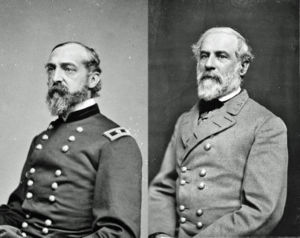
| Commanding generals Meade and Lee |
|
| Commanding generals during Gettysburg Campaign |
Meet the opposing commanding generals during the Gettysburg
Campaign.
Union Major General George Gordon Meade* (December 31, 1815 –
November 6, 1872) was a career United States Army officer and civil engineer involved in coastal construction, including several
lighthouses. George Meade graduated the United States Military Academy
(West Point) in 1835 (graduated 19th in his class of 56 cadets). He fought with distinction
in the Seminole War and Mexican-American War. During the American Civil War he served as a Union general, rising from command
of a brigade to the Army of the Potomac. He is best known for defeating Confederate General
Robert E. Lee at the Battle of Gettysburg in 1863.
Confederate General Robert Edward Lee (January 19, 1807 – October 12, 1870) was a United
States Military Academy
graduate (West Point) in 1829, graduated second in his class of 46 cadets, and received no
demerits during his four years of instruction. Robert E. Lee was a career United States Army officer, a combat engineer, and
among the most celebrated generals in American history, and he was the son of Major
General Henry "Light Horse Harry" Lee III (1756–1818). “Light Horse Harry” also served as
the 9th Governor of Virginia (1791–1794). Robert E. Lee was married to Mary Anna Randolph Custis (1808–1873) who
was the great-granddaughter of Martha Washington.
*Union
Maj. Gen. Joseph Hooker commanded the Army of the Potomac to June 28, and then General George Gordon Meade assumed
command.
Gettysburg Campaign
Why Gettysburg?
The Confederate government wanted Lee to reduce Union pressure threatening
their garrison at Vicksburg, Mississippi, but Lee declined their suggestions to send troops to provide direct aid, arguing
for the value of a concentrated blow in the Northeast.
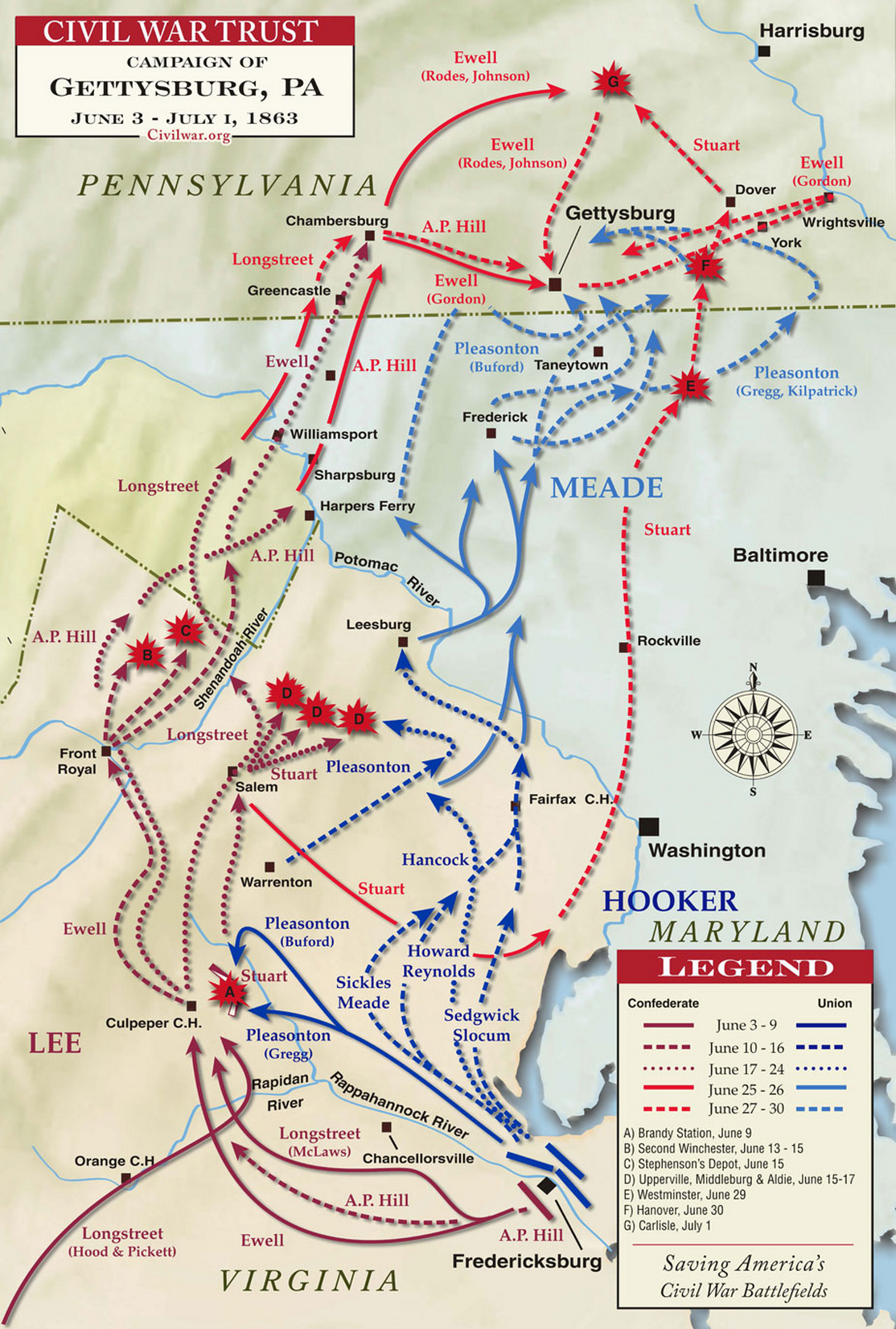
| Gettysburg Campaign Battlefield Map |
|
| Civil War Gettysburg Campaign Map |
Background
| July 1, 1863 |
|
| (Click to Enlarge) |
| Gettysburg Campaign Map |
|
| (Click to Enlarge) |
Lee's army slipped away from Federal
contact at Fredericksburg, Virginia, on June 3, 1863. While they paused
at Culpeper, the largest cavalry battle of the war was fought at Brandy Station on June 9. The Confederates crossed the Blue
Ridge Mountains and moved north through the Shenandoah Valley, capturing the Union garrison at Winchester, Virginia, in the
Second Battle of Winchester, June 13–15.
(Left) Gettysburg Campaign Map
covering Union and Confederate activities from June 3 through June 30.
Crossing the Potomac River,
Lee's Second Corps advanced through Maryland and Pennsylvania,
reaching the Susquehanna River and threatening the state capital of Harrisburg.
However, the Army of the Potomac was in pursuit and had reached Frederick, Maryland,
before Lee realized his opponent had crossed the Potomac. Lee moved swiftly to concentrate
his army around the crossroads town of Gettysburg.
The three-day battle in and around
Gettysburg resulted in the largest number of casualties in the American Civil War—between 46,000 and 51,000. In conjunction
with the Union victory at Vicksburg on July 4, Gettysburg is frequently cited as the war's turning point.
The Battle of Gettysburg was the largest engagement of the war. Starting as a chance meeting engagement
on July 1, 1863, the Confederates were initially successful in driving Union cavalry and two infantry corps from their defensive
positions, through the town, and onto Cemetery Hill.
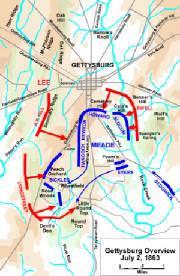
| July 2, 1863 |
|
| (Click to Enlarge) |
The second day, July 2nd, Lee
would press the battle at multiple points in hopes of gaining the advantage. The Army of Northern Virginia would strike from
Little Round Top, the Peach Orchard, Cemetery Hill and Culp's Hill, and move onto the Emmitsburg Road, and both armies
would continue to move and countermove their units into gaps while maneuvering on the flanks, similar to the chess player
trying to check and trap his opponent. The hot Pennsylvania sun had finally retired. Positions had changed very little
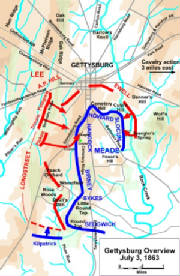
for either side, but casualties were high. On the following morning, the third and final day, Lee
would make history when he pushed Pickett's division onto the field and directly into an ever strengthening Union center.
In what must have felt like an eternity, Lee and a host of Confederate commanders viewed the division as it struggled and
faltered in the direction of the clump of trees, that elusive Union
center. Having been repulsed and severely crippled, the remnants of the once stout division, affectionately referred
to as the flower of Virginia manhood, now limped and crawled toward the location of Marse Lee. Pickett's Charge, as it is
popularly known, would become synonymous with the High Water Mark of the rebellion.
On
July 2, with most of both armies now present, Lee launched fierce assaults on both flanks of the Union defensive line, which
were repulsed with heavy losses on both sides.
On July 3, Lee focused his
attention on the Union center and the defeat of his massive infantry assault, Pickett's Charge, caused Lee to order a retreat
that began the evening of July 4.
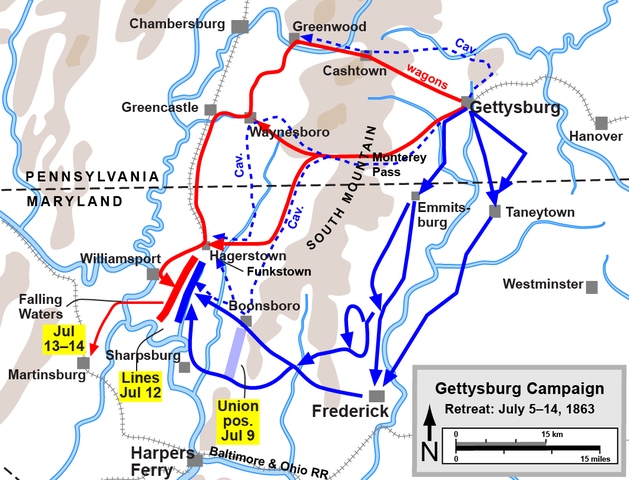
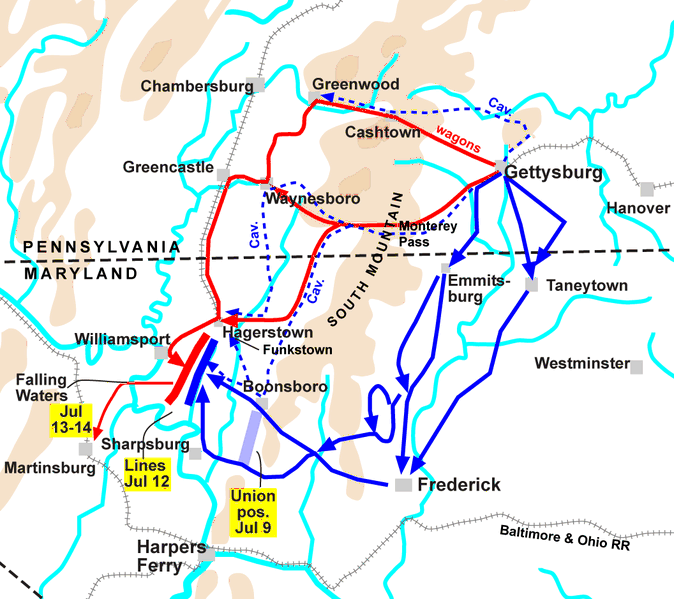
The Confederate retreat to Virginia
was plagued by bad weather, difficult roads, and numerous skirmishes with Union cavalry. However, Meade's army did not maneuver
aggressively enough to prevent the Army of Northern Virginia from crossing the Potomac to
safety on the night of July 13–14.
The battles of the Gettysburg Campaign were fought in the following sequence,
and they are described in the context of logical, sometimes overlapping divisions of the campaign.
Gettysburg Campaign Timeline
| Action |
Dates |
Section of Campaign |
| Battle of Brandy Station |
June 9, 1863 |
Brandy Station |
| Second Battle of Winchester |
June 13–15 |
Winchester |
| Battle of Aldie |
June 17 |
Hooker's pursuit |
| Battle of Middleburg |
June 17–19 |
Hooker's pursuit |
| Battle of Upperville |
June 21 |
Hooker's pursuit |
| Skirmish of Sporting Hill |
June 30 |
Invasion of Pennsylvania |
| Battle of Hanover |
June 30 |
Stuart's ride |
| Battle of Gettysburg |
July 1–3 |
Gettysburg |
| Battle of Carlisle |
July 1 |
Stuart's ride |
| Battle of Hunterstown |
July 2 |
Stuart's ride |
| Battle of Fairfield |
July 3 |
Retreat |
| Battle of Monterey Pass |
July 4–5 |
Retreat |
| Battle of Williamsport |
July 6–16 |
Retreat |
| Battle of Boonsboro |
July 8 |
Retreat |
| Battle of Funkstown |
July 10 |
Retreat |
| Battle of Manassas Gap |
July 23 |
Retreat |
Casualties
The total casualties for
the Battle of Gettysburg were between 46,000 and 51,000. For the entire Gettysburg Campaign, however, the total
casualty count varies greatly. (Battle of Gettysburg : Detailed History and Battle of Gettysburg : Strength of Armies.)
The two armies suffered between 46,000 and 51,000 casualties. Union losses
were 23,055 (3,155 killed, 14,531 wounded, 5,369 captured or missing), while Confederate casualties are more difficult to
estimate. Many authors have referred to as many as 28,000 Confederate casualties, and Busey and Martin's more recent 2005
work, Regimental Strengths and Losses at Gettysburg, documents 23,231 (4,708 killed, 12,693 wounded, 5,830 captured or missing).
Nearly a third of Lee's general officers were killed, wounded, or captured. The casualties for both sides during the entire
campaign were 57,225.
The following generals were either
killed or mortally wounded during the Battle of Gettysburg: (Union) Maj. Gen. John F. Reynolds, Brevet Maj. Gen. Samuel K.
Zook, Brig. Gen. Stephen W. Weed, Brig. Gen. Elon J. Farnsworth, and Brig. Gen. Strong Vincent; (Confederate) Maj. Gen.
William D. Pender, Brig. Gen. William Barksdale, Brig. Gen. Lewis Armistead, Brig. Gen. Richard B. Garnett, and Brig. Gen.
Paul J. Semmes. There were also several generals who were killed or mortally wounded during the Gettysburg Campaign (includes
pursuit of Confederate forces during the “Gettysburg Retreat”). (List of 67 Union Generals at the Battle of Gettysburg and List of 53 Confederate Generals at the Battle of Gettysburg.)
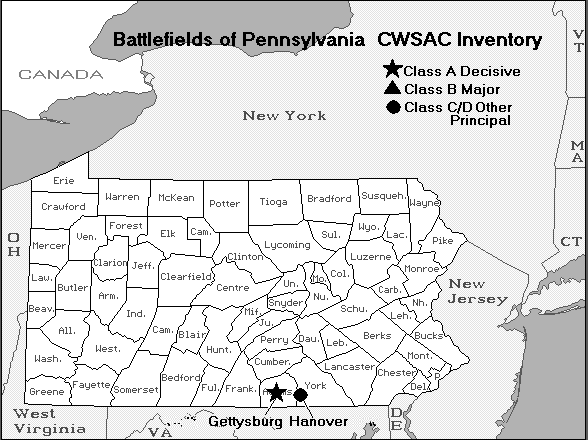
| Gettysburg Campaign and Battle of Gettysburg Map |
|
| Civil War Battle of Gettysburg Campaign Map |
Aftermath
| July 3, 1863 |
|
| (Click to Enlarge) |
The Gettysburg Campaign represented
the final major offensive by Robert E. Lee in the Civil War. Afterwards, all combat operations of the Army of Northern Virginia
were in reaction to Union initiatives. Lee suffered more than 27,000 casualties during the campaign, a price very difficult
for the Confederacy to pay. The campaign met only some of its major objectives: it had disrupted Union plans for a summer
campaign in Virginia, temporarily protecting the citizens and economy of that state, and; it had allowed Lee's men to live
off the bountiful Maryland and Pennsylvania countryside and collect vast amounts of food and supplies that carried back with
them and would allow them to continue the war. However, the myth of Lee's invincibility had been shattered and not a single
Union soldier was removed from the Vicksburg Campaign to react to Lee's invasion of the North. (Vicksburg
surrendered on July 4, the day Lee ordered his retreat.) Union campaign casualties were approximately 30,100.
| Gettysburg Civil War History |
|
| Retreat during the Gettysburg Campaign Map |
| Gettysburg Campaign (July 5-14) |
|
| (Click to Enlarge) |
Meade was severely criticized
for allowing Lee to escape, just as Maj. Gen. George B. McClellan had done after the Battle of Antietam. Under pressure from
Lincoln,
he launched two campaigns in the fall of 1863—Bristoe and Mine Run—that attempted to defeat Lee. Both were failures.
He also suffered humiliation at the hands of his political enemies in front of the Joint Congressional Committee on the Conduct
of the War, questioning his actions at Gettysburg and his failure to defeat Lee during the
retreat to the Potomac.
On November 19, 1863, Abraham
Lincoln spoke at the dedication ceremonies for the national cemetery created at the Gettysburg
battlefield. His Gettysburg Address redefined the war, named the destruction of slavery as a new, specific goal, and called
for a "new birth of freedom" in the nation. The Gettysburg Campaign, furthermore, should be viewed as a Union tactical
victory, while the Confederate defeat at Vicksburg should be viewed as a Federal strategic victory. (Turning Points of the Civil War)
The war, however, would continue
to rage for nearly two more exhaustive years and even witness tens-of-thousands of additional casualties for both the North
and South. (Ten Bloodiest and Costliest Battles of the American Civil War)
(Sources and related reading listed below.)
Recommended Reading: Stars
in Their Courses : The Gettysburg Campaign, June-July 1863 (Hardcover). Description: Shelby Foote,
who cut such a courtly figure in Ken Burns's PBS series The Civil War, is an uncommonly graceful writer as well, and this
careful study of the 1863 Gettysburg campaign assumes the contours of a classical tragedy. Continued below.
Foote positions readers on the field of battle itself, among swirling smoke and clattering grapeshot, and
invites us to feel for ourselves its hellishness: "men on both sides were hollering as they milled about and fired, some cursing,
others praying ... not a commingling of shouts and yells but rather like a vast mournful roar." Foote's fine book is history
as literature, and a welcome addition to any Civil War buff's library.
The Gettysburg Campaign was a series of battles which culminated with the Battle of Gettysburg:
Battle of Winchester II
Battle of Williamsport
Battle of Boonsborough
Battle of Manassas Gap
Recommended Reading: Gettysburg, by Stephen W. Sears (640 pages)
(November 3, 2004). Description: Sears delivers another
masterpiece with this comprehensive study of America’s
most studied Civil War battle. Beginning with Lee's meeting with Davis in May 1863, where he
argued in favor of marching north, to take pressure off both Vicksburg
and Confederate logistics. It ends with the battered Army of Northern Virginia re-crossing the Potomac just two months later
and with Meade unwilling to drive his equally battered Army of the Potomac into a desperate
pursuit. In between is the balanced, clear and detailed story of how tens-of-thousands of men became casualties, and how Confederate
independence on that battlefield was put forever out of reach. The author is fair and balanced. Continued below...
He discusses
the shortcomings of Dan Sickles, who advanced against orders on the second day; Oliver Howard, whose Corps broke and was routed
on the first day; and Richard Ewell, who decided not to take Culp's Hill on the first night, when that might have been decisive.
Sears also makes a strong argument that Lee was not fully in control of his army on the march or in the battle, a view conceived
in his gripping narrative of Pickett's Charge, which makes many aspects of that nightmare much clearer than previous studies.
A must have for the Civil War buff and anyone remotely interested in American history.
Recommended Reading: The Gettysburg Campaign: A Study in Command (928 pages). Description: Coddington's research is one of the most thorough and
detailed studies of the Gettysburg Campaign. Exhaustive in scope and scale, Coddington delivers, with unrivaled research,
in-depth battle descriptions and a complete history of the regiments involved. This
is a must read for anyone seriously interested in American history and what transpired and shaped a nation on those pivotal
days in July 1863.
Recommended Reading: THE COMPLETE GETTYSBURG GUIDE: Walking and Driving
Tours of the Battlefield, Town, Cemeteries, Field Hospital Sites, and other Topics of Historical Interest [Hardcover].
Description: Winner of The Army Historical Foundation Distinguished Writing Award, for Reference, 2009. Some two million people visit the battlefield at Gettysburg each year. It is one of the most
popular historical destinations in the United States. Most visitors tour the field by following the National Park Service's
suggested auto tour. Continued below...
The standard tour, however, skips crucial
monuments, markers, battle actions, town sites, hospital locations, and other hidden historical gems that should be experienced
by everyone. These serious oversights are fully rectified in The Complete Gettysburg Guide, penned by noted Gettysburg historian
J. David Petruzzi and illustrated with the lavish, full-color photography and maps (70) of Civil War cartographer Steven Stanley.
Complete, detailed,
and up-to-date, The Complete Gettysburg Guide: Walking and Driving Tours of the Battlefield, Town, Cemeteries, Field
Hospital Sites, and other Topics of Historical Interest includes: Detailed driving
and walking tours of the entire battlefield (including obscure sites that even veteran visitors miss or never hear about);
A tour of every identified field hospital site for both armies; Tours of the National Cemetery and the town's Evergreen Cemetery;
A tour of the town of Gettysburg, including sites of historical interest before and after the battle; Outlying battlefields
including the June 26, 1863 skirmish site, East Cavalry Field, South Cavalry Field, Hunterstown, Hanover, and Fairfield; And
a special tour of the various rock carvings on the battlefield, many of which were created by returning veterans and pre-date
most of the monuments. Every student of Gettysburg, novice and
expert alike, will want to learn from, enjoy, and treasure The Complete Gettysburg Guide. No visitor to Gettysburg will want
to be without it. About the Authors: J. David
Petruzzi is widely recognized as one of the country's leading Gettysburg experts. In addition to his numerous articles for
a wide variety of publications, he is the author (with Eric Wittenberg) of bestsellers Plenty of Blame to Go Around: Jeb Stuart's
Controversial Ride to Gettysburg (Savas Beatie, 2006) and (with Wittenberg and Michael Nugent) One Continuous Fight: The Retreat
From Gettysburg and the Pursuit of Lee's Army of Northern Virginia, July 4-14, 1863 (Savas Beatie, 2008). Petruzzi is also
a popular speaker on the Civil War Roundtable circuit and regularly conducts tours of Civil War battlefields. Steven Stanley lives in Gettysburg and is a graphic artist specializing in historical
map design and battlefield photography. His maps, considered among the best in historical cartography, have been a longtime
staple of the Civil War Preservation Trust and have helped raised millions of dollars for the Trust through their preservation
appeals and interpretation projects. Steve's maps have appeared in a wide variety of publications. Reviews:
"Together, the text and maps contained in The Complete Gettysburg Guide
create one of the most useful and comprehensive guides of America's largest and bloodiest battlefield available today." Eric
A. Campbell, Park Ranger-Historian, Gettysburg National Military Park. "The
Complete Gettysburg Guide has something for everyone, whether they are a serious student of the battle or visiting the battlefield
for the first time. The easy-to-understand guidebook not only provides readers with a comprehensive history of the battle,
but also enables visitors to see some of the unusual or often overlooked features the National Park has to offer. Further,
the accompanying images and well-researched maps bring the 3-day struggle to life for the modern battlefield traveler." Jim
Campi, Policy and Communications Director, Civil War Preservation Trust (CWPT).
Recommended Reading: The Gettysburg
Companion: A Guide to the Most Famous Battle of the Civil
War (Hardcover). Description: There have
been many books about Gettysburg, but never one to rival this
in scale or authority. Based on extensive research, The Gettysburg Companion describes the battle in detail, drawing on firsthand
accounts of participants on all sides in order to give the reader a vivid sense of what it was like to experience the carnage
at Gettysburg in early July 1863. The many full-color maps--all
specially commissioned for the book--and the numerous photographs, charts, and diagrams make this book a feast for the eyes
and a collector's dream. Includes a massive library of 500 color illustrations.
Recommended Reading: The History Buff's Guide to Gettysburg
(Key People, Places, and Events) (Key People, Places, and Events). Description: While most history books are dry monologues of people, places, events and dates,
The History Buff's Guide is ingeniously written and full of not only first-person accounts but crafty prose. For example,
in introducing the major commanders, the authors basically call Confederate Lt. Gen. Richard S. Ewell a chicken literally.
'Bald, bug-eyed, beak-nosed Dick Stoddard Ewell had all the aesthetic charm of a flightless foul.' Continued below...
To balance
things back out a few pages later, they say federal Maj. Gen. George Gordon Meade looked like a 'brooding gargoyle with an
intense cold stare, an image in perfect step with his nature.' Although it's called a guide to Gettysburg,
in my opinion, it's an authoritative guide to the Civil War. Any history buff or Civil War enthusiast or even that casual
reader should pick it up.
Recommended Reading: ONE CONTINUOUS FIGHT: The Retreat from Gettysburg
and the Pursuit of Lee's Army of Northern Virginia, July 4-14, 1863
(Hardcover) (June 2008). Description:
The titanic three-day battle of Gettysburg left 50,000 casualties
in its wake, a battered Southern army far from its base of supplies, and a rich historiographic legacy. Thousands of books
and articles cover nearly every aspect of the battle, but not a single volume focuses on the military aspects of the monumentally
important movements of the armies to and across the Potomac River. One Continuous Fight:
The Retreat from Gettysburg and the Pursuit of Lee's Army
of Northern Virginia, July 4-14, 1863 is the first detailed military history of Lee's retreat and the Union effort to catch
and destroy the wounded Army of Northern Virginia. Against steep odds and encumbered with thousands of casualties, Confederate
commander Robert E. Lee's post-battle task was to successfully withdraw his army across the Potomac River. Union commander
George G. Meade's equally difficult assignment was to intercept the effort and destroy his enemy. The responsibility for defending
the exposed Southern columns belonged to cavalry chieftain James Ewell Brown (JEB) Stuart. If Stuart fumbled his famous ride
north to Gettysburg, his generalship during the retreat more
than redeemed his flagging reputation. The ten days of retreat triggered nearly two dozen skirmishes and major engagements,
including fighting at Granite Hill, Monterey Pass,
Hagerstown, Williamsport, Funkstown,
Boonsboro, and Falling Waters. Continued below...
President Abraham Lincoln was thankful for the early July battlefield victory, but disappointed that
General Meade was unable to surround and crush the Confederates before they found safety on the far side of the Potomac. Exactly what
Meade did to try to intercept the fleeing Confederates, and how the Southerners managed to defend their army and ponderous
17-mile long wagon train of wounded until crossing into western Virginia
on the early morning of July 14, is the subject of this study. One Continuous Fight draws upon a massive array of documents,
letters, diaries, newspaper accounts, and published primary and secondary sources. These long-ignored foundational sources
allow the authors, each widely known for their expertise in Civil War cavalry operations, to describe carefully each engagement.
The result is a rich and comprehensive study loaded with incisive tactical commentary, new perspectives on the strategic role
of the Southern and Northern cavalry, and fresh insights on every engagement, large and small, fought during the retreat.
The retreat from Gettysburg was so punctuated with fighting
that a soldier felt compelled to describe it as "One Continuous Fight." Until now, few students fully realized the accuracy
of that description. Complimented with 18 original maps, dozens of photos, and a complete driving tour with GPS coordinates
of the entire retreat, One Continuous Fight is an essential book for every student of the American Civil War in general, and
for the student of Gettysburg in particular. About the Authors:
Eric J. Wittenberg has written widely on Civil War cavalry operations. His books include Glory Enough for All (2002), The
Union Cavalry Comes of Age (2003), and The Battle of Monroe's Crossroads and the Civil War's Final Campaign (2005). He lives
in Columbus, Ohio. J. David
Petruzzi is the author of several magazine articles on Eastern Theater cavalry operations, conducts tours of cavalry sites
of the Gettysburg Campaign, and is the author of the popular "Buford's Boys." A long time student of the Gettysburg Campaign,
Michael Nugent is a retired US Army Armored Cavalry Officer and the descendant of a Civil War Cavalry soldier. He has previously
written for several military publications. Nugent lives in Wells, Maine.
Recommended Reading: General Lee's Army: From
Victory to Collapse. Review: You cannot say that University of North Carolina professor Glatthaar
(Partners in Command) did not do his homework in this massive examination of the Civil War–era lives of the men in Robert
E. Lee's Army of Northern Virginia. Glatthaar spent nearly 20 years examining and ordering primary source material to ferret
out why Lee's men fought, how they lived during the war, how they came close to winning, and why they lost. Glatthaar marshals
convincing evidence to challenge the often-expressed notion that the war in the South was a rich man's war and a poor man's
fight and that support for slavery was concentrated among the Southern upper class. Continued below...
Lee's army
included the rich, poor and middle-class, according to the author, who contends that there was broad support for the war in
all economic strata of Confederate society. He also challenges the myth that because Union forces outnumbered and materially
outmatched the Confederates, the rebel cause was lost, and articulates Lee and his army's acumen and achievements in the face
of this overwhelming opposition. This well-written work provides much food for thought for all Civil War buffs.
Recommended Reading: Retreat from Gettysburg: Lee, Logistics, and the Pennsylvania
Campaign (Civil War America)
(Hardcover). Description: In a groundbreaking, comprehensive
history of the Army of Northern Virginia's retreat from Gettysburg
in July 1863, Kent Masterson Brown draws on previously unused materials to chronicle the massive effort of General Robert
E. Lee and his command as they sought to expeditiously move people, equipment, and scavenged supplies through hostile territory
and plan the army's next moves. More than fifty-seven miles of wagon and ambulance trains and tens of thousands of livestock
accompanied the army back to Virginia. Continued below...
The movement
of supplies and troops over the challenging terrain of mountain passes and in the adverse conditions of driving rain and muddy
quagmires is described in depth, as are General George G. Meade's attempts to attack the trains along the South Mountain range and at Hagerstown and Williamsport, Maryland. Lee's deliberate pace, skillful
use of terrain, and constant positioning of the army behind defenses so as to invite attack caused Union forces to delay their
own movements at critical times. Brown concludes that even though the battle of Gettysburg
was a defeat for the Army of Northern Virginia, Lee's successful retreat maintained the balance of power in the eastern theater
and left his army with enough forage, stores, and fresh meat to ensure its continued existence as an effective force.
Recommended Reading: The Maps of Gettysburg: The Gettysburg
Campaign, June 3 - July 13, 1863 (Hardcover). Description: More academic and photographic accounts on the battle of Gettysburg
exist than for all other battles of the Civil War combined-and for good reason. The three-days of maneuver, attack, and counterattack
consisted of literally scores of encounters, from corps-size actions to small unit engagements. Despite all its coverage,
Gettysburg remains one of the most complex and difficult to
understand battles of the war. Author Bradley Gottfried offers a unique approach to the study of this multifaceted engagement.
The Maps of Gettysburg plows new ground in the study of the campaign by breaking down the entire campaign in 140 detailed
original maps. These cartographic originals bore down to the regimental level, and offer Civil Warriors a unique and fascinating
approach to studying the always climactic battle of the war. Continued below...
The Maps of
Gettysburg offers thirty "action-sections" comprising the entire campaign. These include the march to and from the battlefield,
and virtually every significant event in between. Gottfried's original maps further enrich each "action-section." Keyed to
each piece of cartography is detailed text that includes hundreds of soldiers' quotes that make the Gettysburg
story come alive. This presentation allows readers to easily and quickly find a map and text on virtually any portion of the
campaign, from the great cavalry clash at Brandy Station on June 9, to the last Confederate withdrawal of troops across the
Potomac River on July 15, 1863. Serious students of the battle will appreciate the extensive
and authoritative endnotes. They will also want to bring the book along on their trips to the battlefield… Perfect for
the easy chair or for stomping the hallowed ground of Gettysburg,
The Maps of Gettysburg promises to be a seminal work that belongs on the bookshelf of every serious and casual student of
the battle.
Recommended Reading: Hallowed Ground: A Walk at Gettysburg, by James M.
Mcpherson (Crown Journeys) (Hardcover). Review From Publishers Weekly: The country's most distinguished Civil War historian, a Pulitzer Prize winner (for Battle
Cry of Freedom) and professor at Princeton, offers this compact and incisive study of the
Battle of Gettysburg. In narrating "the largest battle ever fought in the Western Hemisphere,"
McPherson walks readers over its presently hallowed ground, with monuments numbering into the hundreds, many of which work
to structure the narrative. They range from the equestrian monument to Union general John Reynolds to Amos Humiston, a New
Yorker identified several months after the battle when family daguerreotypes found on his body were recognized by his widow.
Indeed, while McPherson does the expected fine job of narrating the battle, in a manner suitable for the almost complete tyro
in military history, he also skillfully hands out kudos and criticism each time he comes to a memorial. Continued below...
He praises
Joshua Chamberlain and the 20th Maine, but also the 140th New York
and its colonel, who died leading his regiment on the other Union flank in an equally desperate action. The cover is effective
and moving: the quiet clean battlefield park above, the strewn bodies below. The author's knack for knocking myths on the
head without jargon or insult is on display throughout: he gently points out that North Carolinians think that their General
Pettigrew ought to share credit for Pickett's charge; that General Lee's possible illness is no excuse for the butchery that
charge led to; that African-Americans were left out of the veterans' reunions; and that the kidnapping of African-Americans
by the Confederates has been excised from most history books.
Recommended
Reading:
Lost Triumph: Lee's Real Plan at Gettysburg--And Why It Failed.
Description: A fascinating narrative-and a bold new
thesis in the study of the Civil War-that suggests Robert E. Lee had a heretofore undiscovered strategy at Gettysburg that,
if successful, could have crushed the Union forces and changed the outcome of the war. The Battle of Gettysburg is the pivotal
moment when the Union forces repelled perhaps America's greatest commander-the
brilliant Robert E. Lee, who had already thrashed a long line of Federal opponents-just as he was poised at the back door
of Washington, D.C. It is
the moment in which the fortunes of Lee, Lincoln, the Confederacy, and the Union
hung precariously in the balance. Conventional wisdom has held to date, almost without exception, that on the third day of
the battle, Lee made one profoundly wrong decision. But how do we reconcile Lee the high-risk warrior with Lee the general
who launched "Pickett's Charge," employing only a fifth of his total forces, across an open field, up a hill, against the
heart of the Union defenses? Continued
below...
Most history
books have reported that Lee just had one very bad day. But there is much more to the story, which Tom Carhart addresses for
the first time. With meticulous detail and startling clarity, Carhart revisits the historic battles Lee taught at West Point
and believed were the essential lessons in the art of war-the victories of Napoleon at Austerlitz, Frederick the Great at
Leuthen, and Hannibal at Cannae-and reveals what they can tell us about Lee's real strategy. What Carhart finds will thrill
all students of history: Lee's plan for an electrifying rear assault by Jeb Stuart that, combined with the frontal assault,
could have broken the Union forces in half. Only in the final hours of the battle was the attack reversed through the daring
of an unproven young general-George Armstrong Custer. About the Author: Tom Carhart
has been a lawyer and a historian for the Department of the Army in Washington,
D.C. He is a graduate of West Point, a decorated Vietnam
veteran, and has earned a Ph.D. in American and military history from Princeton
University. He is the author of four books of military history and teaches
at Mary Washington College
near his home in the Washington, D.C.
area.
Recommended Reading: Gettysburg:
A Testing of Courage. Description: America's
Civil War raged for more than four years, but it is the three days of fighting in the Pennsylvania
countryside in July 1863 that continues to fascinate, appall, and inspire new generations with its unparalleled saga of sacrifice
and courage. From Chancellorsville, where General Robert E. Lee launched his high-risk campaign into the North, to the Confederates'
last daring and ultimately-doomed act, forever known as Pickett's Charge, the battle of Gettysburg gave the Union army a victory
that turned back the boldest and perhaps greatest chance for a Southern nation. Continued below...
Now, acclaimed
historian Noah Andre Trudeau brings the most up-to-date research available to a brilliant, sweeping, and comprehensive history
of the battle of Gettysburg that sheds fresh light on virtually every aspect of it. Deftly balancing his own
narrative style with revealing firsthand accounts, Trudeau brings this engrossing human tale to life as never before.
Sources: Several maps contributed by Hal Jespersen, www.posix.com/CW; Brown, Kent Masterson, Retreat from Gettysburg: Lee, Logistics,
and the Pennsylvania Campaign, University of North Carolina Press, 2005; Busey, John W., and Martin, David G., Regimental
Strengths and Losses at Gettysburg, 4th Ed., Longstreet House, 2005; Clark, Champ, and the Editors of Time-Life Books, Gettysburg:
The Confederate High Tide, Time-Life Books, 1985; Coddington, Edwin B., The Gettysburg Campaign; a study in command, Scribner's,
1968; Eicher, David J., The Longest Night: A Military History of the Civil War, Simon & Schuster, 2001; Esposito, Vincent
J., West Point Atlas of American Wars, Frederick A. Praeger, 1959; Gottfried, Bradley M., The Maps of Gettysburg: An Atlas
of the Gettysburg Campaign, June 3 – June 13, 1863, Savas Beatie, 2007; Huntington, Tom, Pennsylvania Civil War Trails:
The Guide to Battle Sites, Monuments, Museums and Towns, Stackpole Books, 2007; Kennedy, Frances H., Ed., The Civil War Battlefield
Guide, 2nd ed., Houghton Mifflin Co., 1998; Longacre, Edward G., The Cavalry at Gettysburg, University of Nebraska Press,
1986; Loosbrock, Richard D., "Battle of Brandy Station", Encyclopedia of the American Civil War: A Political, Social, and
Military History, Heidler, David S., and Heidler, Jeanne T., eds., W. W. Norton & Company, 2000; McPherson, James M.,
Battle Cry of Freedom: The Civil War Era (Oxford History of the United States), Oxford University Press, 1988; Martin, David
G., Gettysburg July 1, rev. ed., Combined Publishing, 1996; Mingus, Scott L., Sr., Flames beyond Gettysburg: The Gordon Expedition,
June 1863, Ironclad Publishing, 2009; Nye, Wilbur S., Here Come the Rebels!, Louisiana State University Press, 1965 (reprinted
by Morningside House, 1984); Salmon, John S., The Official Virginia Civil War Battlefield Guide, Stackpole Books, 2001; Sauers,
Richard A., "Battle of Gettysburg", Encyclopedia of the American Civil War: A Political, Social, and Military History, Heidler,
David S., and Heidler, Jeanne T., eds., W. W. Norton & Company, 2000; Sears, Stephen W., Gettysburg, Houghton Mifflin,
2003; Symonds, Craig L., American Heritage History of the Battle of Gettysburg, HarperCollins, 2001; Wittenberg, Eric J.,
and J. David Petruzzi, Plenty of Blame to Go Around: Jeb Stuart's Controversial Ride to Gettysburg, Savas Beatie, 2006; Wittenberg,
Eric J., J. David Petruzzi, and Michael F. Nugent, One Continuous Fight: The Retreat from Gettysburg and the Pursuit of Lee's
Army of Northern Virginia, July 4-14, 1863, Savas Beatie, 2008; Woodworth, Steven E., Beneath a Northern Sky: A Short History
of the Gettysburg Campaign, SR Books (scholarly Resources, Inc.), 2003; Civil War Preservation Trust (civilwar.org).
To read more about the Battle of Gettysburg, the Gettysburg Campaign, and
the dedication of the National Cemetery at Gettysburg, also consider these books:
Champ Clark, ed.: Gettysburg, The Confederate High Tide, Time-Life Books,
Alexandria, VA, 1985
Gregory A. Coco: Wasted Valor, the Confederate Dead at Gettysburg, Thomas
Publications, Gettysburg, 1990
Gregory A. Coco: "A Strange and Blighted Land", Gettysburg: The Aftermath
of a Battle, Thomas Publications, Gettysburg, 1995
Edwin B. Coddington: The Gettysburg Campaign, A Study in Command, Charles
Scribner's Sons, New York, 1968
William A. Frassanito: Gettysburg, A Journey in Time, Charles Scribner's
Sons, New York, 1975
Earl Hess: Pickett's Charge- The Last Confederate Attack at Gettysburg,
University of North Carolina Press, Chapel Hill, 2001
Philip B. Kunhardt Jr.:A New Birth of Freedom, Lincoln At Gettysburg, Little,
Brown adn Company, Boston, 1983.
Harry W. Pfanz: Gettysburg, The First Day, University of North Carolina
Press, Chapel Hill, 2001
Harry W. Pfanz: Gettysburg, The Second Day, University of North Carolina
Press, Chapel Hill, 1987
Harry W. Pfanz: Gettysburg, Culp's Hill and Cemetery Hill, University of
North Carolina Press, Chapel Hill, 1993
Stephen W. Sears: Gettysburg, Houghton Mifflin Company, Boston & New
York, 2003
George R. Stewart: Pickett's Charge, A Microhistory of the Final Attack
at Gettysburg, July 3, 1863, reprinted by Morningside Bookshop, Dayton, Ohio, 1980
Glenn Tucker: High Tide At Gettysburg, The Campaign in Pennsylvania, Bobbs-Merrill
Co., New York, 1958
Noah Andre Trudeau, Gettysburg, A Testing of Courage, Harper Collins Publishers,
new York, 2002
Jeffrey D. Wert: Gettysburg Day Three, Simon and Schuster, New York, 2001
Gary Wills: Lincoln At Gettysburg, The Words That Remade America, Simon
& Schuster, New York, 1992
|


)