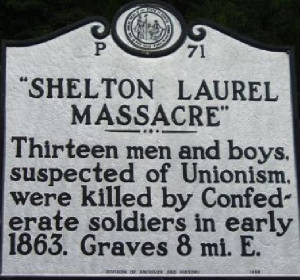
Thirteen men and boys suspected of Unionism
were killed by Confederate soldiers in the Shelton Laurel area of Madison County in January 1863. The incident grew
out of a series of raids on the town of Marshall by fifty to sixty Unionists claiming that Confederate authorities had denied
them salt and other provisions.
(Right) Shelton Laurel Massacre Memorial in Madison County,
North Carolina. Marker photo courtesy North Carolina Office of Archives & History: Department of Cultural Resources.
Shelton Laurel Massacre
Shelton Laurel Historical Marker
Shelton Laurel Massacre
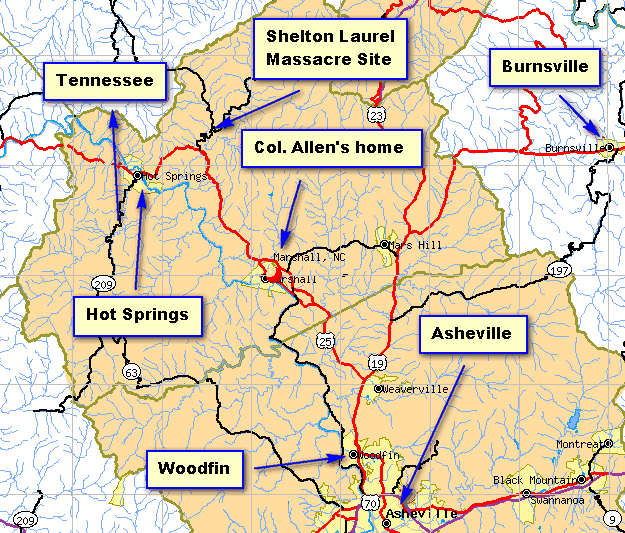
Map and location of Shelton Laurel Massacre
Map of Shelton Laurel Massacre and Key Locations
Foreword
It is well known that the "Shelton Laurel" section of MadisonCounty, bordering on East Tennessee, was infested with bushwhackers
of such fierce audacity and viciousness that only severe and caustic measures would suppress them. In addition to the native
disloyal element, scores and hundreds fled from conscription in Tennessee,
and when hunted in those mountain passages they fought back, retaliated and did many outrageous things. Colonel Keith caught
some of these and punished them severely -- perhaps cruelly. His resignation was called for at the instance of Governor Zebulon
Vance for shooting certain parties accused of having looted the town of Marshall.
When an officer finds himself and men bushwhacked from behind every shrub,
tree or projection on all sides of the road, only severe measures will stop it. Keith and Allen were fighters-soldiers. Their
first duty was self-protection, protection of their people from midnight marauders.
Major W. N. Garrett, promoted to Lieutenant-Colonel later on, was also
a good soldier and of good family, which for many years had lived near Hot Springs.
His father was brutally murdered, shot down on his own door step in the very arms of wife and daughters.
This was only three or four miles from Paint Rock, at the Tennessee
state line, along the borders of which up and down for near two hundred miles were constantly ranging bands of outlaws, murdering
such men as Colonel Walker, of the Eightieth North Carolina Regiment [Walker's Battalion, Thomas' Legion]; Wm. Walker, Cherokee
County; Sheriff Noland, of Haywood County; Colonel Edney, of ______ Regiment, Henderson County; Privates Rice Hyatt,_____.
_____ Hopkins, of the Sixty-ninth Regiment; and Woody and Askew, of MadisonCounty, and many others.
By Captain B. T. Morris, 64 North Carolina, 30 May 1901.
Morris commanded the fragment of the 64th beginning in April 1864 (15
months after the Shelton Laurel tragedy) while the remnant was stationed at Marshall. Morris, like most who served
in the unit, was a fighter, though not looking for a fight, but he refused to retreat although his enemies, the
bushwhackers, enjoyed the same familiarity of terrain, but they preferred to strike and vanish like hordes of elusive
ghosts. Morris, in the unit's history, speaks also out of frustration, stating names of some of the more well-known men
of the region who donned the Confederate uniform and for respite had returned to their homes to be with family only to be
gunned down in cold blood by local Unionists, the alias bushwhackers. While many a good men were spending time with family
in their mountain homes, continues Morris, they were either enjoying a hot cooked meal with family, playing with
their children, or recovering from an illness, then like a thief in the night, the 19th century assassins -- known
as Unionists -- in their planned and coordinated attacks, had singled out specific prominent men and then greeted
each unarmed Confederate, in the presence of his wife and children, with
a hail of gunfire, and then as rabid dogs the murderers howled as they faded quickly from the scene.
Morris wrote the unit's history for
the Old North State on stated date, but his prose, unlike the majority of most regimental histories, may be compared
more to the likes of Shakespeare rather than the writings of a common mountain man turned plodding foot soldier. But
if Morris fought with the poise and grace of his prolific 1901 work, what we did back yonder (not really the title), then
it is just to state that each highlander of the 64th cloaked in Rebel gray could far surpass any man in the mountains vying
for the coveted title of ounce for ounce and pound for pound the biggest badass of rapid recompense. Prior to pen
meeting pad, Morris, when confronted in those days of ruthlessness, may have had the ability to literally turn from
smooth operator to major mayhem Morris without any hesitation. But by all accounts, Morris was indeed a fierce fighter
as well as one the more articulate writers of his time.
Summary
In 1862 Lawrence M. Allen was the commanding colonel of the 64th North Carolina Infantry, a mountain regiment raised in western
North Carolina that had spent much of the war either pursuing or being pursued by the likes of raiders and bushwhackers.
During January 1863, in a bloody conflict that would rage for another 27 months, Colonel Allen's family was
ill and recovering at their mountain abode in Madison County, NC, when local Unionists attacked and plundered the place called home. With retribution in mind, Lt. Col. James
Keith, second in command of the 64th North Carolina, with soldiers from the regiment,
arrived in the Shelton Laurel area and marched three boys, ages thirteen and seventeen, and ten men, ages twenty to fifty-six, from
their homes and into the woods. They were ordered to kneel. Hesitating on Keith’s first command to shoot the
thirteen, the troops complied with the second. Commanding Colonel Allen was never found culpable nor was there any evidence to
indicate that he condoned the murders. (See official correspondence and reports relating to the Shelton Laurel Massacre
below.)
The Massacre was murder, it was mob justice, an act in which
men donned the garb of judge, jury, and executioner, and it was born out of frustration during a war that had brought
all the curses and maledictions a people can pour out.
During the Shelton Laurel tragedy there were hundreds of Confederate
soldiers pursuing what appeared to be an endless influx of bushwhackers and deserters in the mountains, in an area
commonly referred to as Southern Appalachia. (O.R., Series 1, volume 18, pp. 810-811.*) While the events of Madison County in 1863 continue to be remembered
by citizens of the Tar Heel State, media, due largely to the internet, has brought one mountain calamity to an audience
of epic proportion, so while it was an indictment of some, it now serves as a reminder to all that war is cruelty and that
it has the wherewithal to effect everyone in its path. *Official Records of the Union and Confederate Armies
Background
During
the American Civil War anarchy ruled in the Tar Heel State's poorest region known as western North Carolina, and President Jeff Davis, Governor Zeb Vance, and numerous Confederate corps and division
commanding generals heard incessant cries and pleas from the local mountain populace for protection against the emboldened
outliers, deserters, and bushwhackers. The Shelton Laurel Massacre, perhaps more than any other single example in the
State, showed exactly what happens when civilians are sucked into the vortex of Civil War and grinded continually by
a lawless society that has been redefined by greed, lust, and hatred. Anything and everything is just and is good
in the eyes of the doer, but the ending of each story in every community is identical. It is a bitter gut
check that reality is always greeted with the foul harvest that we all must reap, when the core belief,
the common conscious of the once common kin, now claims that it was just an eye for eye, but unfortunately
everyone is now blind.
While marriage and generations of friendship
were the heart, the soul of an aligned mountain community, the once close knit mountain clan now had its heart ripped
out and trampled upon because of a bad case of unchecked mountain madness with a prognosis of sheer vengeance and hatred toward
thy brother and sister. The lawless region had remarried and the bride's name was lawlessness and anarchy. Numerous
counties, including neighboring Cherokee County, were fair game and considered easy targets to pillage and plunder, and Cherokee
County, sparsely populated as was the case in every mountain county, was also one of the bushwhackers' preferred areas
to plunder, pillage, and murder. During a series of raids, when bushwhackers
and deserters roamed said county with impunity (O.R., 53, 313-314), they were overjoyed while anticipating the loot from what was at face value just another family farm. As they approached
the farm, one Unionist, who knew the county well, proclaimed that we are going to make a big mistake here, because this
farm belongs to Captain Willis Parker, and he, his brothers, and family will track
us to the end of the earth for justice. Parker was 6’2” and was a seasoned mounted infantry captain in Thomas’
Legion of Cherokee Indians and Highlanders, and he too, if blood was spilled, was rather accustomed to tracking, along
with his Cherokee company of the finest 100 able-bodied Indians from the region, the responsible men who
roamed daily on the outskirts of what one may refer to as a State absent any city of refuge. Convinced
that Captain Parker and his Cherokee company will exact complete retribution for any harm bestowed upon his family -- and
that there were less hazardous targets of opportunity -- Captain Goldman Bryson's Company detoured and sacked the county seat, Murphy, in October 1863. Goldman's Robbers, the name the local folks called the band, reaped their fate at
the hands of Thomas Legion's Cherokee scouts.
The events leading up to the massacre began in January 1863 when an armed band of
Madison County Unionists ransacked salt stores in Marshall and looted the home of Confederate Colonel Lawrence Allen, commander
of the 64th North Carolina Regiment. In response, General William Davis, stationed at nearby Warm Springs (now Hot Springs),
dispatched the 64th under Lieutenant-colonel Keith (Allen was ill at the time) to the Shelton Laurel Valley to pursue the
looters (Keith, like much of the 64th, was a native of Madison County). In the skirmish that followed, 12 of the looters were
killed and several were captured. Upon hearing of the events, Governor Vance (who grew up in nearby Weaverville) sent orders
not to harm the captured Unionists and dispatched Solicitor Merrimon to monitor the situation.
Massacre
In spite of the governor's orders, Keith, believing a rumor that the Unionist
force was much larger than in reality, began frantically combing the valley for Union supporters. Realizing that the locals
were unlikely to volunteer information, Keith rounded up several Shelton Laurel women and began torturing them in hopes of
forcing them to give up their sons' and husbands' whereabouts. After several days of rounding up alleged supporters, Keith
began marching the captives toward East Tennessee, which at the time was occupied by a substantial Confederate army. However,
after two of the captives escaped, Keith ordered the remaining 13 captives into the woods, and had them shot execution style.
Their bodies were dumped into a nearby trench. Among the executed were three boys, ages 13, 14, and 17.
Merrimon, stunned by the incident, reported it to Governor Vance shortly
thereafter. The governor wrote that the affair was “shocking and outrageous in the extreme,” and ordered a full
investigation. Family members of the slain (mostly Sheltons) moved the bodies to a new cemetery east of the massacre site
and swore revenge against the perpetrators. Keith was ultimately tried for the massacre in civilian court after the war. Captured
by Union forces at the end of the war, Keith was imprisoned, charged with individual counts for each murder and brought to
trial. Acquitted on the first count, he appealed the additional counts on the basis that an 1866 North Carolina amnesty law
voided further prosecution. On Feb. 21, 1869, just days before the state's Supreme Court ruled in his favor, Keith escaped.
In 1871, the state dropped its prosecution. James Keith was the only one ever tried for the murders in Shelton Laurel.
A North Carolina Highway Historical marker recalling the massacre stands
in the vicinity of the massacre site at the present-day intersection of state highways 208 and 212. The graves of the slain
are in a cemetery adjacent Highway 212 and up the valley.
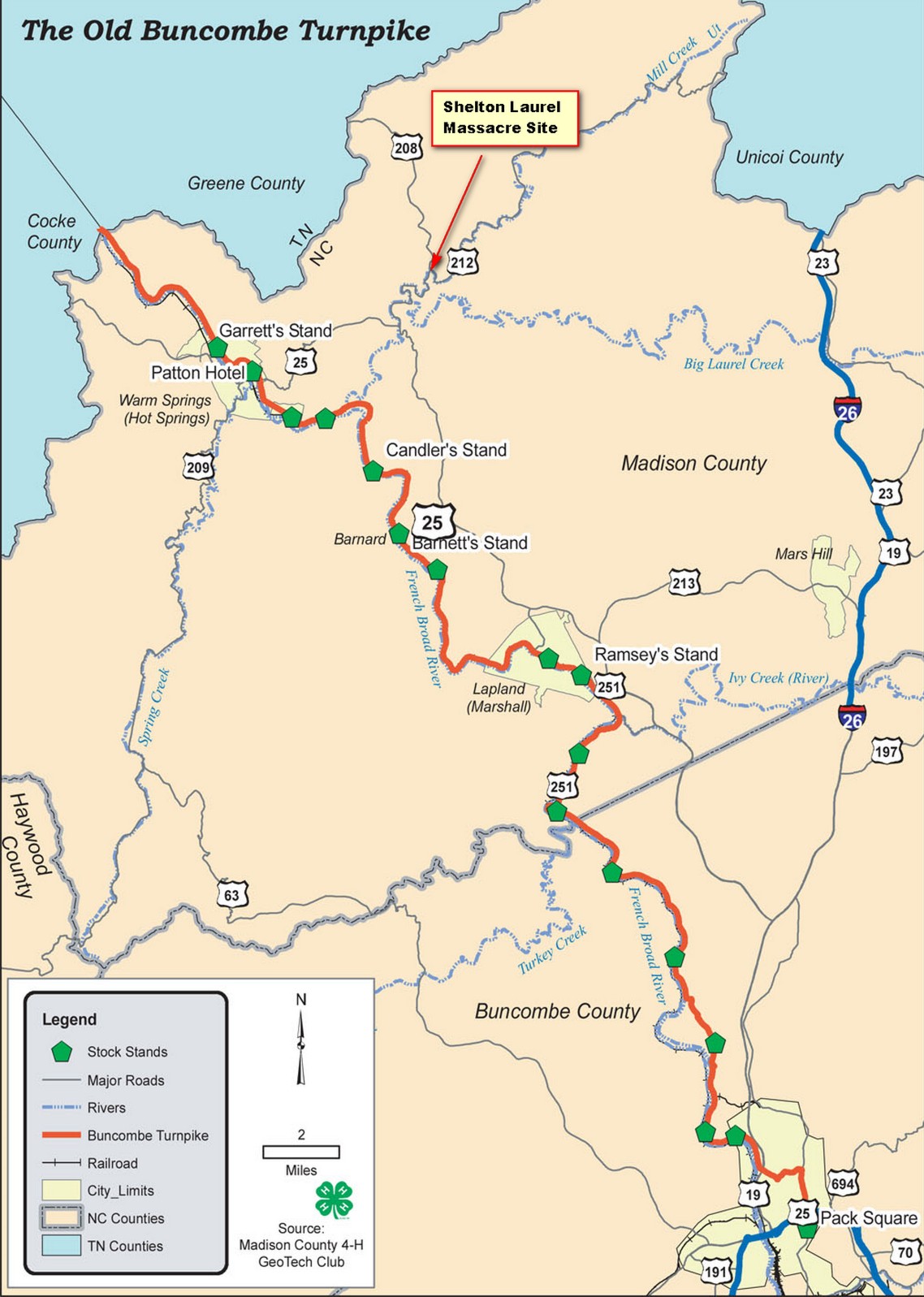
Location of Shelton Laurel Massacre
Map of Greater Shelton Laurel Massacre, Madison County, NC
Analysis
Shelton Laurel is a remote Appalachian town in the western North Carolina
mountains. Despite its location in the Confederacy, there remained a remnant loyal to the Union and because of this it became
a target for both Confederate and Union armies. The people of Shelton Laurel and the Appalachian mountains were simple people.
The area was home to related families and most people were very poor farmers. As in many small areas, what family you belong
to and their actions affect everything. Paludan explained it best when he said, "juries in county seats could and did ignore
the law and evidence to acquit or convict people they liked or disliked, people whose values or whose kin they did or did
not respect," (Paludan, 24).
"The mountain people had a habit of using politics to satisfy personal
vengeance," according to Paludan, however, is incorrect. The majority of mountain folk didn't own a single slave,
they tended their own land, were Christian, and paid little attention to local and national politics. According to Paludan, when the Civil War started, "the Unionism of Western North
Carolina of which we heard so much during the war...was less a love for the Union than a personal hatred of those who went
into the Rebellion. It was not so much an uprising for the government as against a certain ruling class," (Paludan, 62). Again,
not true. The mountaineers or highlanders as they were known, had more in common than not. Most traced their ancestry
to the American Revolution and the vast majority were related by blood or marriage, had amicable relations with their
neighbors, and did not have ties to the so-called ruling class. What occurred during the Civil War must be examined in historical
context. Although Unionism had roots in the mountain region, most supported the Confederacy. What happened in western
North Carolina can be explained in one word: Survival. The Civil War, to a lesser degree, was an opportunity for
people to use their new found power to gain personal revenge.
Paludan's comment that those who were pro-Confederate tended to be
either rich farmers with slaves or "poor whites, profoundly hostile to blacks and most vulnerable to any change in the social
and economic structure," (Paludan, 63), and "pro-Unionists tended to be people who were poor farmers with no slaves or people
who thought secession was treason," is also false. Western North Carolina's slaves comprised 11.3% of the region's total
population, while the slaves composed 33% of the Old North State's population. The
mountain region gave little thought to slavery, but one of the best statements regarding why the highlanders fought for the
Confederacy is rather simplistic and should not be overlooked. "A
great majority of the people were poor and had no interest in slavery, present
or prospective. But most of them had little mountain homes and, be it ever so humble, there is no place like home...but
when the Federal army occupied East Tennessee and threatened North Carolina,"
the clarion call to defend the homeland was heard. Lt. Col. W. W. Stringfield, Histories of the Several Regiments and
Battalions from North Carolina in the Great War 1861-'65, Vol., 3, p. 734.
The people of the mountains used the "opportunity that the war brought
to revenge old debts and to loot, plunder, and terrorize," (Paludan, 77), in part, is true, but most bushwhackers, outliers,
and deserters were fighting and plundering the region for survival and personal gain, while the local populace too was striving
to extinguish the bands and gangs so that they could simply tend to their livelihoods and day-to-day activities during
a time when lawlessness lurked constantly.
The people's terrorism generally took the form of guerrilla warfare; it
was like a mini civil war in the mountains of the Appalachians. The Confederates tried to maintain control of the area and
recruit soldiers for their side, but at the same time the Unionists tried to persuade mountain Unionists to attack the Confederacy.
The tensions were made worse when on April 16, 1862, the Confederate Congress passed a conscription that forced all men 18
to 35 to join the army. This was a huge problem for mountain farmers. Men were needed to plant and harvest crops, without
them many families would go hungry or starve. The "mutual killing, the burning of barns, houses, and fields, the slaughter
of livestock all crippled the productivity of the region's farm," (Paludan, 80).
If this wasn't already enough there was a salt shortage. The shortage
was significant because without salt meat could not be properly stored. These problems soon became too much to bare and in
January of 1863 a group of fifty pro-Union men raided the nearby town of Marshall. Marshall was the county seat of Madison
County and contained Salt storages. These fifty men, mostly deserters from Confederate armies, and some from Shelton Laurel
raided the town stealing salt, blankets, and anything else of value. The Confederate army soon heard of the raid on Marshall.
General Heth sent James Keith, 64th North Carolina, to punish the rebels. Lawrence Allen, commanding colonel of
the 64th, had personal interest in punishing the rebels who raided Marshall. His home was among the buildings that were
looted. His family was terrorized and he wanted revenge. However, there is not one source that implicates Allen in the carnage
to follow and there is not one source that indicates Allen as being complicit.
Thirteen prisoners, ranging from the age of thirteen to fifty-nine,
were taken from the Shelton Laurel area and were shot to death. The problem with this, according to Paludan, is that "international
law said while guerrillas could be killed if engaged in battle and could be denied the right to become prisoners, once they
had been captured they could not be executed without legal proceedings to determine
their status as guerrillas and their guilt for killing or destroying," (Paludan, 87-88). International law, as well as laws
and rules of war, however, were not followed or observed closely by either side. On a grander scale, Union
Gen. Sherman's March to the Sea, which was approved by Abraham Lincoln himself, even included destroying a swath some
50 miles wide across the state of Georgia. The swath did not discriminate between women, children, and combatants. Prior to
his March to the Sea, Sherman would sum his indiscriminate and egregious acts with the following words: "I can make
this march, and I will make Georgia howl!" And indeed, in 1864, Sherman made Georgia howl.
The men Keith killed were
captured from their homes, it was not certain that they were even guerrillas. Even if they were guerrillas they had been taken
prisoner and therefore could not be killed without legal proceedings, according to Paludan. Despite the murders of thirteen
innocent people, there was not much of a public outcry. The people of the Confederacy and the Union were probably beginning
to believe that war was brutal and that very bad things happen to innocent people. They began to except and expect the brutality.
"Less than a month after the North Carolina killings gained national killings, William C. Quantrill and Lawrence, Kansas,
shocked public consciousness with the story of 155 murders," (Paludan, 116). Stories of death and destruction were becoming
common and thus continued murder, mayhem, and mountain madness. See
also Victims: A True Story Of The Civil War, by Phillip S. Paludan
Massacre at Shelton Laurel in the Civil War
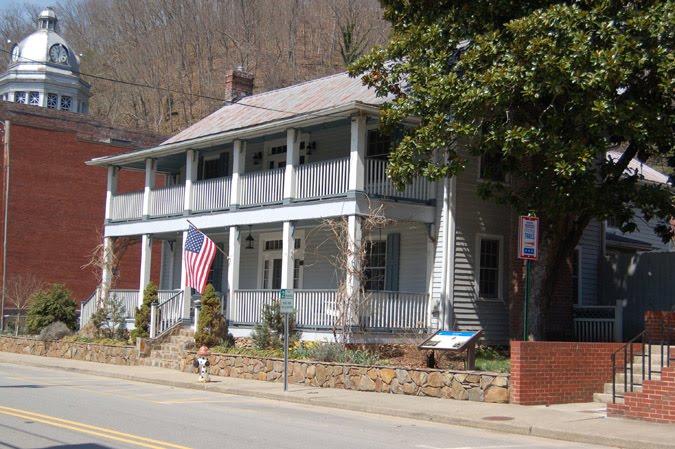
Colonel Lawrence Allen's house in Marshall
Official Correspondence for the Shelton Laurel Massacre
February 16, 1863, Ashville, N.C., Letter from A. S. Merrimon to Governor Vance ASHEVILLE, N.C., February 16, 1863.
GOVERNOR:
Your letter of the 9th instant is just received. I beg to assure you that I shall at the next term of the
court prosecute vigorously such of the prisoners to whom you direct my attention as may be turned over to the civil authorities.
The late expedition to Laurel sent only four prisoners to jail, and one of them was admitted to bail on yesterday by Judge
Bailey. I understand there are no more to send. I have no knowledge of my own touching the shooting of several prisoners in
Laurel. I have learned, however, from a most reliable source that 13 of them were killed; that some of them were not taken
in arms but at their homes; that all the men shot (13, if not more) were prisoners at the time they were shot; that they were
taken off to a secluded cave or gorge in the mountains and then made to kneel down and were thus shot. One man was badly and
mortally shot in the bowels, and while he was writhing in agony and praying to God for mercy a soldier mercilessly and brutally
shot him in the head with his pistol. Several women were whipped; this I learned from one who got his information from some
of the guilty parties. I learned that all this was done by order of Lieut. Col. James A. Keith. I know not what you intend
doing with the guilty parties, but I suggest they are all guilty of murder. I do not suppose they had any order to do so barbarous
a deed; but if they had the order was void absolutely, no matter by whom issued. Such savage and barbarous cruelty is without
a parallel in the State, and I hope in every other. I am gratified that you intend to take the matter in hand. I will
make such investigation as I can, but I have no means of compelling any one to disclose facts to me. It will not be difficult,
I learn, to prove that the prisoners were killed. I assure you that I will prosecute all persons who have committed criminal
offenses in this circuit at the next term of the court, and in the mean time I will do all in my power to suppress crime and
violence. These are fearfully on the increase in this section of the State. A report might be made that would astonish you.
I have done all I could in reference to the complaints made to you from Jackson and Cherokee Counties.
I am, &c., yours, truly,
A. S. MERRIMON.
February 24, 1863, Ashville, N.C., Letter from A.S. Merrimon to Governor Vance ASHEVILLE, N.C., February
24, 1863.
[Hon. ZEBULON B. VANCE:]
GOVERNOR:
In obedience to your directions so to do, I have made inquiries and gathered facts such as I could in reference
to the shooting of certain prisoners in Laurel Creek, in Madison County. I have to report to you that I learned that the militia
troops had nothing to do with what was done in Laurel. Thirteen prisoners, at least, were killed by order of Lieut. Col. J.
A. Keith. Most of them were taken at their homes, and none of them made resistance when taken; perhaps some of them ran. After
they were taken prisoners the soldiers took them off to a secluded place, made them kneel down, and shot them. They were buried
in a trench dug for the purpose. Some two weeks since their bodies were removed to a grave-yard. I learned that probably 8
of the 13 killed were not in the company that robbed Marshall and other places. I suppose they were shot on suspicion. I cannot
learn the names of the soldiers who shot them. Some of them shrank from the barbarous and brutal transaction at first, but
were compelled to act. This is a list of the names of those killed: Elison King (desperate man); Jo Woods (desperate man);
Will Shelton, twenty years old (of Sipus); Aronnata Shelton, fourteen years old (was not at Marshall); James Shelton (old
Jim), about fifty-six years old; James Shelton, jr., seventeen years old; David Shelton, thirteen years old (was not in the
raid); James Madcap, forty years old; Rod Shelton (Stob Rod); David Shelton (brother of Stob Rod); Joseph Cleandon, fifteen
or sixteen years old; Helen Moore, twenty-five or thirty years old; Wade Moore, twenty or twenty-five years old. It is said
that those whose names I have so marked did not go to Marshall. The prisoners were captured on one Friday and killed the next
Monday. Several women were severely whipped and ropes were tied around their necks. It is said Col. L. M. Allen was not in
command and that Keith commanded. Four prisoners are now in jail, sent here, as I learned, by order of General Davis. These
are Sipus Shelton, Isaac Shelton, William Morton, and David Shelton, son of Sipus. I think the facts stated are about true.
One thing is certain, 13 prisoners were shot without trial or any hearing whatever and in the most cruel manner. I have no
means of compelling witnesses to disclose facts to me, and I do not know that I shall be able to make a fuller report to Your
Excellency at any early day. I hope these facts will enable you to take such steps as will result in a more satisfactory development
of the true state of the matter.
I am, &c., yours, truly,
A. S. MERRIMON
February 28, 1863, Raleigh, N.C., Governor Z. B. Vance to Secretary of War James A. Seddon
STATE OF NORTH CAROLINA, EXECUTIVE DEPARTMENT., Raleigh, N.C., February 28, 1863.
Hon. JAMES A. SEDDON, Secretary of War:
SIR: Some six months since a disturbance occurred in Madison County, North Carolina, near the Tennessee
border, by some disloyal persons capturing the little county town and seizing a lot of salt and other plunder. An armed force
was promptly sent from Knoxville, under command of General Davis, to suppress the insurrection, which was accomplished before
the local militia could get there, though ordered out immediately. But in doing so a degree of cruelty and barbarity was displayed,
shocking and outrageous in the extreme, on the part of Lieut. Col. J. A. Keith, Sixty-fourth North Carolina Troops, who seems
to have been in command, and to have acted in this respect without orders from his superiors, so far as I can learn. I beg
leave to ask you to read the inclosed letter (copy) from A. S. Merrimon, State's attorney for that judicial district, which
you will see discloses a scene of horror disgraceful to civilization. I desire you to have proceedings instituted at once
against this officer, who, if the half be true, is a disgrace to the service and to North Carolina. You may depend upon the
respectability and fairness of Mr. Merrimon, who made an investigation officially by my order. I have also written General
Davis.
Very respectfully, your obedient servant,
Z. B. VANCE.
March 5, 1863, Richmond, Va., Secretary of War James A. Seddon to Governor Z. B. Vance WAR DEPARTMENT,
Richmond, March 5, 1863.
His Excellency Z. B. VANCE, Governor of North Carolina, Raleigh, N.C.
SIR: I received your letter of the 28th ultimo in reference to the conduct of Lieut. Col. J. A. Keith, Sixty-fourth
North Carolina Regiment, and have directed General Donelson, commanding at Knoxville, to investigate the matter and report
the facts to the Department.
Very respectfully, your obedient servant,
JAS. A. SEDDON,
Secretary of War.
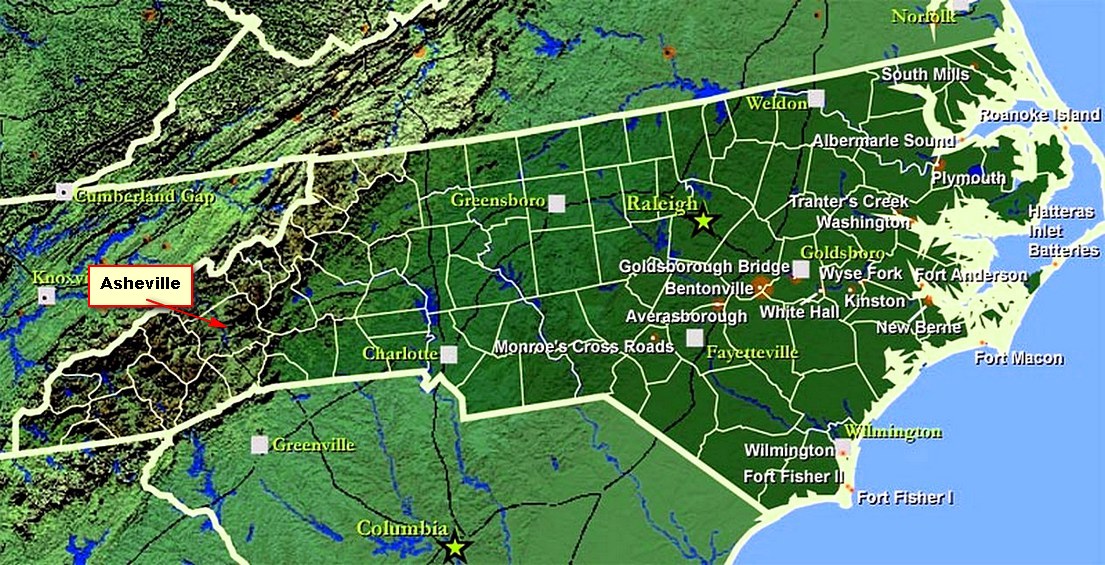
Civil War Battlefield Map for North Carolina
High Resolution Map of Principal Battles Fought in North Carolina
May 18, 1863, Raleigh N.C., Governor Z. B. Vance to Secretary of War James A. Seddon EXECUTIVE DEPARTMENT,
Raleigh, May 18, 1863.
Hon. JAMES A. SEDDON, Secretary of War, Richmond, Va.
SIR: I had the honor to request of you some time since an examination into the case of Lieut. Col. J. A.
Keith, Sixty-fourth North Carolina Troops, charged with the murder of some unarmed prisoners and little boys during the recent
troubles in the mountains of this State. I have heard by rumor only that he was brought before a court-martial and honorably
acquitted by producing an order for his conduct from General Davis, commanding in East Tennessee. I have also been officially
notified of his resignation. Will it be consistent with your sense of duty to furnish me a copy of the proceedings of the
court-martial in his case? Murder is a crime against the common law in this State and he is now subject to that law.
Very respectfully, &c.,
Z. B. VANCE
May 18, 1863, Richmond, Va., Secretary of War James A. Seddon to Governor Z. B. Vance WAR DEPARTMENT,
Richmond, Va., May 23, 1863.
His Excellency Z. B. VANCE, Governor of North Carolina.
SIR: Your letter of the 18th instant has been received. The resignation of Lieutenant-Colonel Keith was
accepted at the office of the Adjutant and Inspector General the 15th instant. No proceedings of court-martial in his case
have been received. His resignation was accepted on the recommendation of Colonel Palmer, commanding the brigade, and Major-General
Maury, the examining board having reported against his competency. The Adjutant and Inspector General was not aware of the
facts of the alleged murder as applying to this officer at the time of his action on the resignation, there being no reference
to the facts in the papers before him. In a communication to the Department by Lieutenant-Colonel Keith he claims that Brigadier-General
Heth gave him a verbal order to this effect: "I want no reports from you about your course at Laurel. I do not want to be
troubled with any prisoners and the last one of them should be killed;" that he went on further to state that he had been
troubled with several prisoners from Laurel, N. C., and he did not want any more brought to Knoxville. This statement is supported
by the deposition of a Doctor Thompson, and Keith states in his letter that he can prove it by another witness. The communication
of Keith and the deposition of Thompson were submitted to General Heth for remarks. He says that he gave written instructions
to Keith which will be found on the books of the Department of East Tennessee. He admits that he told Keith that those found
in arms ought not to be treated as enemies, and in the event of an engagement with them to take no prisoners as he considered
that they had forfeited all such claims, but he denies in strong terms the making use of any remarks which would authorize
maltreatment of prisoners who had been accepted as such or to women and children.
Very respectfully, your obedient servant,
JAMES A. SEDDON,
Secretary of War.
Notes
Captain Parker
served faithfully in Company I, Infantry Regiment, Thomas' Legion. On July 24, 1862, Company I initially mustered
as Company D, Walker's Battalion, at Valleytown, Cherokee County, North Carolina. On September 27, 1862, when the Thomas
Legion officially mustered at Knoxville, it became Company I, Infantry Regiment, Thomas' Legion. The Company was also
involved in the Skirmish at Hanging Dog.
Recommended Reading: Victims: A True Story Of The Civil War.
Description: Victims: A True Story of the Civil War, by Phillip Shaw Paludan, is an excellent book about
the time period surrounding the Civil War. This book mainly focuses on the events leading up to the Shelton Laurel Massacre.
Paludan gives a vivid description of what went on during this time and he gives the reader accurate details describing the
massacre. The Shelton Laurel Massacre was a brutal killing of men and boys from the ages of 13-59 by the Confederate soldiers
in Shelton Laurel, North Carolina. In this book, Laurel gives the reader a vivid picture of how it happened and what really
went on. Continued below...
Review: The book Victims: A True Story of the Civil War by Phillip Shaw
Paludan is about the Shelton Laurel killings. Shelton Laurel is a remote Appalachian town in North Carolina. Despite its location
in the Confederacy, there remained a strong tie to the Union and because of this it became a target for both Confederate and
Union armies. The people of Shelton Laurel and the Appalachian mountains were simple people. The area was home to related
families and most people were very poor farmers. As in many small areas, what family you belong to and their actions affect
everything. Paludan explained it best when he said, "juries in county seats could and did ignore the law and evidence to acquit
or convict people they liked or disliked, people whose values or whose kin they did or did not respect," (Paludan, 24).
The mountain people had a habit of using politics to satisfy personal vengeance. When the Civil War started, "the Unionism
of Western North Carolina of which we heard so much during the war...was less a love for the Union than a personal hatred
of those who went into the Rebellion. It was not so much an uprising for the government as against a certain ruling class,"
(Paludan, 62). The Civil War was an opportunity for people to use their new found power to gain personal revenge. People who
were pro-confederate tended to be either rich farmers with slaves or "poor whites, profoundly hostile to blacks and most vulnerable
to any change in the social and economic structure," (Paludan, 63). Pro-Unionists tended to be people who were poor farmers
with no slaves or people who thought succession was treason. The people of the mountains used the "opportunity that the war
brought to revenge old debts and to loot, plunder, and terrorize," (Paludan, 77). The
people's terrorism generally took the form of guerrilla warfare; it was like a mini civil war in the mountains of the Appalachians.
The Confederates tried to maintain control of the area and recruit soldiers for their side, but at the same time the Unionists
tried to persuade mountain Unionists to attack the Confederacy. The tensions were made worse when on April 16, 1862 the Confederate
Congress passed a conscription that forced all men 18 to 35 to join the army. This was a huge problem for mountain farmers.
Men were needed to plant and harvest crops, without them many families would go hungry or starve. The "mutual killing, the
burning of barns, houses, and fields, the slaughter of livestock all crippled the productivity of the region's farm," (Paludan,
80). If this wasn't already enough there was a salt shortage. The shortage was significant because without salt meat could
not be properly stored. These problems soon became too much to bare and
in January of 1863 a group of fifty mean raided the nearby town of Marshall. Marshall was the county seat of Madison County
and contained Salt storages. These fifty men, mostly deserters from Confederate armies, and some from Shelton Laurel raided
the town stealing salt, blankets, and anything else of value. The confederate army soon heard of the raid on Marshall. General
Heth sent James Keith and Lawrence Allen to punish the rebels. Allen had personal interest in punishing the rebels who raided
Marshall. His home was among the buildings that were looted. His family was terrorized and he wanted revenge. Thirteen prisoners,
ranging from the age of thirteen to fifty-nine, were taken from the Shelton Laurel area and were shot to death. The problem
with this is that "international law said while guerrillas could be killed if engaged in battle and could be denied the right
to become prisoners, once they had been captured they could not be executed without legal proceedings to determine their status
as guerrillas and their guilt for killing or destroying," (Paludan, 87-88). The men Allen and Keith killed were captured from
their homes, it was not certain that they were even guerrillas. Even if they were guerrillas they had been taken prisoner
and therefore could not be killed without legal proceedings. Despite the murders of thirteen innocent people, there was not
much of a public outcry. The people of the Confederacy and the Union were probably beginning to believe that war was brutal
and that very bad things happen to innocent people. They began to except and expect the brutality. "Less than a month after
the North Carolina killings gained national killings, William C. Quantrill and Lawrence, Kansas, shocked public consciousness
with the story of 155 murders," (Paludan, 116). Stories of death and destruction were becoming common.
Recommended Reading:The Secret of War: A Dramatic History of Civil War Crime
in Western North Carolina, by Terrell T. Garren. Description:Civil War crime in westernNorth Carolinais the
subject of The Secret of War, by Terrell T. Garren. Based on the true-life experience of Delia Russell Youngblood, the great-grandmother
of the author, the book "captures what the Civil War was like in the mountains and throughout the south." After hearing his
great-grandmother's story, Garren spent nearly fifteen years researching this story in particular and the Civil War history
of westernNorth Carolinain general. It is the story of Joseph Youngblood and Delia Russell of Hoopers Creek
inHenderson County,North Carolina. Continued below…
The reader will follow Joseph
through his enlistment as a part of Company H, the "Cane Creek Rifles," of the 25th North Carolina Infantry Regiment to the
Battle of Malvern Hill, Virginia, and to battle inSharpsburg,Maryland, where he was captured. Taken to the Union Camp Morton inIndianapolis,Indiana,
he finally escapes and make his way down theOhioandMississippirivers intoMississippi. Attempting to make his way back toNorth Carolina, he is inDalton,Georgia,
in May of 1864 when fourteen Confederate soldiers, including a brother, are executed for "desertion." Ultimately, being recaptured,
he goes back toCampMortonuntil
the end of the war. Told with historical accuracy, names, battles, and places in this story are true to fact. Readers will
recognize place names inHenderson,Jackson, Haywood, Cherokee, Transylvania, Clay,Macon, andBuncombeCountiesinNorth Carolina. Family names mentioned include Fletcher, Carland, Lewis,
Bishop, Bryson, Freeman, Henderson, Fowler, Whitaker, Wheeler, Summey, Russell, Barnwell, Ward, Lanning, Hammond, Garren,
Youngblood, and Blake.What
sets this book apart from many, however, is the story of what happened to the women left behind at home. The story reveals
how the lowest criminal element found its way into the Union Army. Many mountain men motivated by greed and an awareness of
the demise of Confederate authority signed up with no interest in any cause but their own. Union officers who enter the picture
include Generals George Stoneman, Alavan C. Gillem, and William J. Palmer. Palmer enters the story late but emerges as a man
of genuine integrity and selfless bravery opposed to and fighting this element in his own army. About the Author: Terrell
T. Garren is an eighth generation western North Carolinian. He was born inAsheville,North
Carolina, in 1951. He earned his B.S. and M.A. degrees fromWesternCarolinaUniversityinCullowhee,North Carolina. A resident ofHenderson County,North Carolina,
he has been a commercial writer for twenty years.
Dr. Newton Smith of Western
Carolina University says, "The Secret of War" is that rare historical novel that captures both the romance and the grit and
gore of war on the home front without distorting the history. It is about time someone did the story of the Civil War in the
southern mountains right."
Rob Neufeld, writing in
the Asheville (NC) Citizen-Times, has said the book "is a must read" and "as a contribution to our understanding of the most
disturbing passage in our history, it is indelible." He further writes, "Fiction? It really happened; and, if it hadn't, the
author wouldn't be around to tell it....Although Garren has written fiction, he wants you to treat it as history. After all,
at the back of his book, he provides an index."
Recommended Reading:Bushwhackers,
The Civil War in North Carolina: The Mountains
(338 pages). Description: Trotter's book (which could have been titled "Murder, Mayhem, and Mountain Madness") is an
epic backdrop for the most horrific murdering, plundering and pillaging of the mountain communities of western North Carolina
during the state’s darkest hour—the American Civil War. Commonly referred to as Southern Appalachia, the North Carolina and East Tennessee mountains witnessed divided loyalties
in its bushwhackers and guerrilla units. These so-called “bushwhackers” even used the conflict to settle old feuds
and scores, which, in some cases, continued well after the war ended. Continued below...
Some bushwhackers
were highly organized ‘fighting guerrilla units’ while others were a motley group of deserters and outliers,
and, since most of them were residents of the region, they were familiar with the terrain and made for a “very formidable
foe.” In this work, Trotter does a great job on covering the many facets of the bushwhackers, including their: battles,
skirmishes, raids, activities, motives, the outcome, and even the aftermath. This book is also a great source for tracing
ancestors during the Civil War; a must have for the family researcher of Southern Appalachia.
Recommended Reading:Touring
the Carolina's Civil War Sites (Touring the Backroads Series). Description:
Touring the Carolina's Civil War Sites helps travelers find the Carolinas' famous Civil War battlefields, forts, and memorials,
as well as the lesser skirmish sites, homes, and towns that also played a significant role in the war. The book's 19 tours,
which cover the 'entire Carolinas,' combine riveting history with clear, concise directions and maps, creating a book that
is as fascinating to the armchair reader as it is to the person interested in heritage travel. Below are some examples from
this outstanding book:
1.
Fort Fisher - the largest sea fort in the war that protected the vital town of Wilmington N.C., and the blockade runners so
important for supplying Lee's Army of Northern Virginia. 2. Charleston - where the whole shootin'
match started. 3. Bentonville - the last large scale battle of the war. 4.
Outer Banks - early Union victories here were vital to capturing many parts of Eastern North Carolina from which the Union
could launch several offensives. 5. Sherman's March - the destruction of certain towns in both
Carolinas (particularly South Carolina) further weakened the South's will to continue the struggle. I also enjoyed reading
about the locations of various gravesites of Confederate generals and their Civil War service. Indeed, if not for this book,
this native North Carolinian and long-time Civil War buff may never have learned of, and visited, the locations of some of
the lesser-known sites other than those mentioned above. Johnson's writing style is smooth--without being overly simplistic--and
contains several anecdotes (some humorous ones too) of the interesting events which took place during the Civil War years.
Highly recommended!
Recommended
Reading:The Civil War in the Carolinas (Hardcover). Description: Dan Morrill relates the
experience of two quite different states bound together in the defense of the Confederacy, using letters, diaries, memoirs,
and reports. He shows how the innovative operations of the Union army and navy
along the coast and in the bays and rivers of the Carolinas affected the general course of
the war as well as the daily lives of all Carolinians. He demonstrates the "total war" for North Carolina's vital coastal railroads and ports. In the latter
part of the war, he describes how Sherman's operation cut
out the heart of the last stronghold of the South. Continued below...
The author
offers fascinating sketches of major and minor personalities, including the new president and state governors, Generals Lee,
Beauregard, Pickett, Sherman, D.H. Hill, and Joseph E. Johnston. Rebels and abolitionists, pacifists and unionists, slaves
and freed men and women, all influential, all placed in their context with clear-eyed precision. If he were wielding a needle
instead of a pen, his tapestry would offer us a complete picture of a people at war. Midwest Book Review:The Civil War in the Carolinas by civil war expert and historian
Dan Morrill (History Department, University of North Carolina at Charlotte, and Director of the Charlotte-Mecklenburg Historical
Society) is a dramatically presented and extensively researched survey and analysis of the impact the American Civil War had
upon the states of North Carolina and South Carolina, and the people who called these states their home. A meticulous, scholarly,
and thoroughly engaging examination of the details of history and the sweeping change that the war wrought for everyone, The
Civil War In The Carolinas is a welcome and informative addition to American Civil War Studies reference collections.
Recommended Reading:The Life of Johnny Reb: The Common Soldier of the Confederacy (444
pages) (Louisiana State University Press) (Updated edition: November 2007) Description:The
Life of Johnny Reb does not merely describe the battles and skirmishes fought by the Confederate foot soldier. Rather,
it provides an intimate history of a soldier's daily life--the songs he sang, the foods he ate, the hopes and fears he experienced,
the reasons he fought. Wiley examined countless letters, diaries, newspaper accounts, and official records to construct this
frequently poignant, sometimes humorous account of the life of Johnny Reb. In a new foreword for this updated edition, Civil
War expert James I. Robertson, Jr., explores the exemplary career of Bell Irvin Wiley, who championed the common folk, whom
he saw as ensnared in the great conflict of the 1860s. Continued below...
About Johnny Reb:
"A Civil War classic."--Florida Historical Quarterly
"This book deserves to be on the shelf of every Civil War modeler and enthusiast."--Model
Retailer
"[Wiley] has painted with skill a picture of the life of the Confederate
private. . . . It is a picture that is not only by far the most complete we have ever had but perhaps the best of its kind
we ever shall have."--Saturday Review of Literature
Recommended Viewing:Gone with the Wind (Four-Disc Collector's Edition)
1939 (1941) Description: First off, if you're a GWTW fanatic, you must buy this four-disc collection. But then again, you
probably don't need to read this to make that decision. For the rest of us, know that the kitchen-sink approach has been established
here with two full discs of extras. Continued below…
The film's restoration under Warner's
brilliant Ultra-Resolution process is the major contribution to the set. However, the bare-bones version released years ago
isn't bad and the film still doesn't pop off the screen as do films from the headier days of Technicolor (like the earlier
Ultra-Resolution DVD release of Meet Me in St. Louis). That said, the set is worthy of the most popular movie ever made. Rudy
Behlmer's feature-length commentary is dry but an exhaustive reference guide to the entire history of the film. Need more?
There's the excellent full-length documentary The Making of a Legend (1989) narrated by Christopher Plummer, plus two hour-long
older biographies on the two main stars. There are many new vignettes on the rest of the cast, all narrated by Plummer (a
nice touch to tie everything together). The new 30-minute interview/reminisce with Oliva de Havilland will be interesting
to older fans, but tiresome for the younger set. The usual sort of trailers and premiere footage is here along with a curious
short ("The Old South," directed by Fred Zinnemann) that was produced to help introduce the world to the history of the South.
--Doug Thomas
Sources: Official Records of the Union
and Confederate Armies; Vernon H. Crow, Storm in the Mountains: Thomas' Confederate Legion of Cherokee Indians and Mountaineers;
Walter Clark, Histories of the Several Regiments and Battalions from North Carolina in the Great War 1861-1865; ncmarkers.com;
Volume XVI of North Carolina Troops 1861-1865 A Roster: Thomas's Legion (2008), Matthew M. Brown and Michael W. Coffey (editors);
Manly Wellman, The Kingdom of Madison (Chapel Hill, N.C.:
University of North Carolina Press, 1973); William Trotter, Bushwhackers: The Mountains (John F. Blair Publishers, 1991);
Paludan, Philip S. 1981. Victims: A True Story of the Civil War. Knoxville, TN: The University of Tennessee Press; National Park Service: American Civil War; Weymouth T. Jordan
and Louis H. Manarin, North Carolina Troops, 1861-1865; D. H. Hill, Confederate Military History Of North Carolina: North
Carolina In The Civil War, 1861-1865; Christopher M. Watford, The Civil War in North Carolina: Soldiers' and Civilians'
Letters and Diaries, 1861-1865. Volume 2: The Mountains; Library of Congress; National Archives and Records Administration;
State Library of North Carolina; North Carolina Office of Archives and History; North Carolina Museum of History.