|
Second Battle of Kernstown, Virginia
Other Names: None
Location: Frederick County and Winchester
Date(s): July 24, 1864
Principal Commanders: Brig. Gen. George Crook [US]; Lt.
Gen. Jubal Early [CS]
Forces Engaged: 23,000 total (US 10,000; CS 13,000)
Estimated Casualties: 1,800 total (US 1,200; CS 600)
Result(s): Confederate victory
| 2nd Battle of Kernstown Map |

|
| Civil War Battle of Kernstown |
| Gen. Jubal Early |
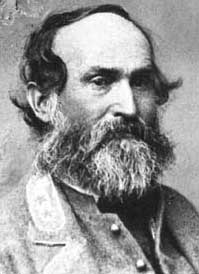
|
| Battle of Kernstown |
Description: Believing that Early’s army was no longer
a threat in the Valley, Maj. Gen. Horatio Wright abandoned his pursuit and ordered the VI and XIX Corps to return to Washington,
where they were to be sent to Grant’s “army group” before Petersburg. Wright left Brig. Gen. George Crook with three divisions and some cavalry to hold Winchester. Under orders to prevent reinforcements
from being sent to Grant, Early marched north on July 24 against Crook. After an hour of stubborn resistance at Pritchard’s
Hill, the Federal line collapsed and Crook’s divisions streamed back in disarray through the streets of Winchester.
Col. James Mulligan commanding Crook’s 3rd Division was mortally wounded. Rutherford B. Hayes commanded a brigade against
John C. Breckinridge’s wing. Crook retreated to the Potomac River and crossed near Williamsport on July 26. As a result
of this defeat and the burning of Chambersburg, Pennsylvania, on July 30, Grant returned the VI and XIX Corps and appointed
Sheridan as commander of Union forces in the Valley. (See Second Battle of Kernstown: A History.)
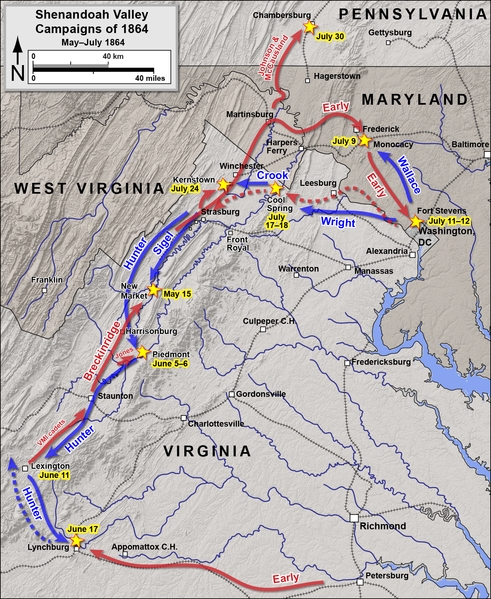
| 2nd Battle of Kernstown Map |
|
| Civil War Second Battle of Kernstown Map |
Early had a good start. He proceeded down the Valley without opposition,
bypassed Harpers Ferry, crossed the Potomac River, and advanced into Maryland. Grant dispatched a corps under Horatio G. Wright and other troops under George Crook to reinforce
Washington and pursue Early.
The Battle of Rutherford's Farm was one of several battles fought during
Early's Raid and Operations against the B&O Railroad (June-August 1864). Early's
Operations against the B&O Railroad, often times referred to as Early's Raid or Early's Maryland Campaign, was
part of the Shenandoah Valley Campaigns of 1864 and was the second of three principal campaigns fought throughout the valley
region.
Early's Raid and Operations
Against the B&O Railroad [June-August 1864], aka Early's Maryland Campaign, comprised the following battles: Monocacy – Fort Stevens – Heaton's Crossroads – Cool Spring – Rutherford's Farm – Kernstown II – Folck's Mill – Moorefield.
On July 19, following a series of unsuccessful Union attacks on his flanks,
General Early decided to withdraw from his precarious position at Berryville to a more secure position near Strasburg. During
the evacuation of the military hospitals and storage depots at Winchester, Union forces under Brig. Gen. William W. Averell
won a rare victory over Confederate forces under Maj. Gen. Stephen D. Ramseur at the Battle of Rutherford's Farm. The poor
Confederate performance at the battle, as well as a series of small cavalry engagements south of Winchester the following
day led Union commanders George Crook and Horatio G. Wright to conclude the Confederates were merely fighting a rearguard
action and that Early was leaving the Valley and heading for Richmond to reinforce the Army of Northern Virginia.
With the threat to Washington, D.C., seemingly over, Wright withdrew the
VI Corps and XIX Corp from the valley to return to the aid of Ulysses S. Grant's siege of Petersburg, Virginia, on July 20,
leaving only the three-division strong Army of West Virginia in the Valley. The following two days were relatively quiet with
both armies resting in their camps some 15 miles (24 km) from each other. On July 23, Confederate cavalry attacked the Union
advanced picket line at Kernstown, leading to a sharp cavalry skirmish. From prisoners caught in the skirmish Early learned
of Wright's departure. In order to continue to be of service to Lee in the Valley, Early realized he had to attack the diminished
force in front of him to ensure that Grant's force at Petersburg would not be reinforced.
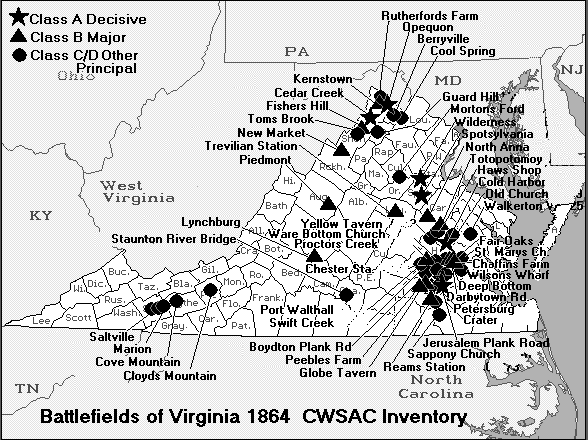
| 2nd Battle of Kernstown Map |
|
| Civil War Kernstown Battlefield Map |
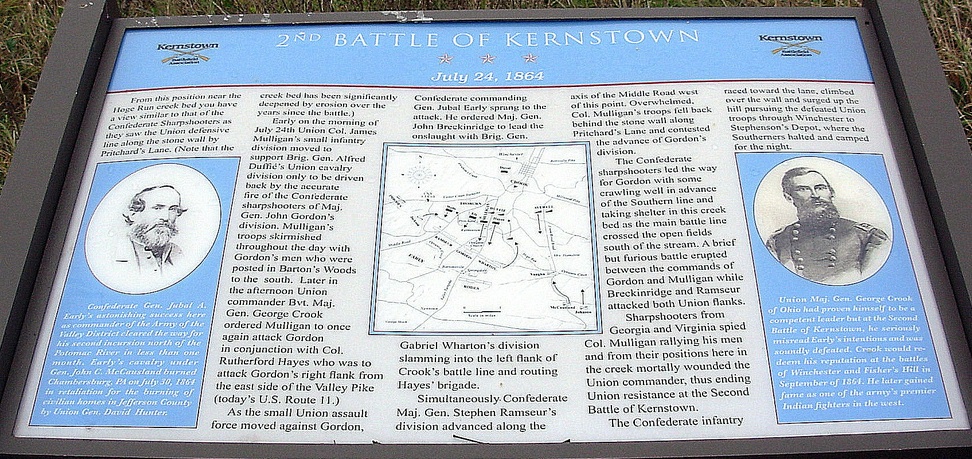
| 2nd Battle of Kernstown Civil War History |
|
| Civil War Second Battle of Kernstown |
| Civil War Battle of Kernstown Battlefield Map |
|
| Second Battle of Kernstown Battlefield Map |
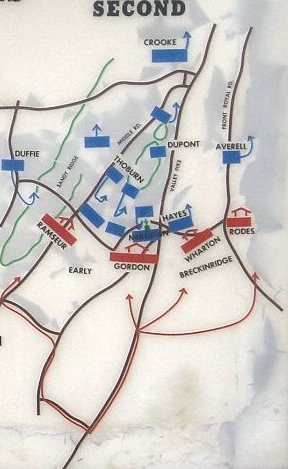
Battle: On the morning of July 24, Early marched his army
north against Crook. Confederate cavalry encountered its Union counterpart south of Kernstown in the morning and heavy skirmishing
broke out. Couriers alerted Crook to the attack. Crook still believed Early's infantry had left the Valley and sent only two
of his division with cavalry support to meet the attack. In the early afternoon the infantry of both armies had arrived on
the field. The Confederate position extended well to each side of the Valley pike south of Kernstown, anchored on each flank
on high ground and screened by cavalry. Maj. Gen. John B. Gordon's division formed the Confederate center along the Valley
Turnpike. Ramseur's division formed on his left with its flank resting on Sandy Ridge to the west of Kernstown, screened by
Col. William "Mudwall" Jackson's cavalry. Brig. Gen. Gabriel C. Wharton's division, led by Maj. Gen. John C. Breckinridge,
formed the Confederate right, with its flank screened by Brig. Gen. John C. Vaughn's cavalry. Early initially concealed his
infantry in a woods, sending out his cavalry and skirmish line of sharpshooters to draw the Federals into battle, thus playing
into Crook's misconception that he the Confederate infantry had left the Valley.
The Union infantry position remained clustered around the Valley Pike in
Kernstown anchored by Col. James A. Mulligan's division on Pritchard's Hill, one of the keys to the Union success at the First
Battle of Kernstown in 1862. To his right, Col. Joseph Thoburn's division formed on Sandy Ridge. To his left, future president
Rutherford B. Hayes's brigade formed east of the Valley turnpike. Crook dispatched cavalry under Averell to ride around the
Confederate right flank and get in its rear. As the two armies skirmishers encountered one another the battle got under way.
It soon became apparent to the Federal divisional commanders that they were facing a superior Confederate force which they
were hesitant to attack and relayed the information to Crook.
Crook quickly became impatient by the lack of his divisional commanders
to attack the Confederate position, and distrusted their report of the Confederate strength. He ordered Mulligan to attack
the Confederates with Hayes's division in support. At 1 p.m. the Union infantry reluctantly moved out, abandoning Pritchard's
Hill. Mulligan's division bitterly held its ground at Opequon Church where its advance was halted by Gordon's men. As Hayes's
brigade advanced in support, Breckinridge marched Wharton's division to the northeast into a deep ravine that ran perpendicular
to the Valley Turnpike. He turned the division into the ravine, which screened his movement from the Federals on the turnpike.
As Hayes came up the road past the ravine, Breckinridge ordered a charge and the Confederates assaulted Hayes's exposed flank
and sent his division reeling in retreat, taking many casualties.
Thoburn was supposed to support Mulligan's right flank in the attack, but
because of the topography of the battlefield, he became separated from Mulligan and saw little action during the battle. Gordon's
Confederates exploited the gap in the Union line to get on Mulligan's right and when Hayes's division broke, Mulligan found
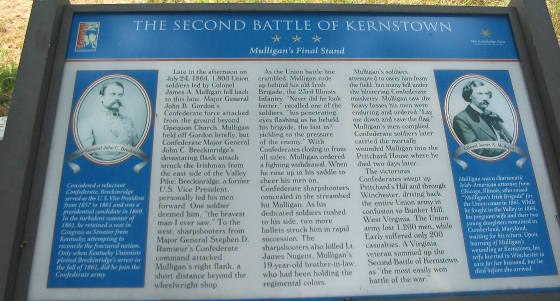
himself caught between two Confederate divisions. Mulligan immediately ordered a withdrawal, and was mortally wounded as he
tried to rally his troops and prevent a full rout during the retreat. The Confederate infantry pressed the fleeing Federals
all the way back through Winchester and the cavalry kept at their heels well into West Virginia.
Averell's cavalry had attempted to flank the Confederates as ordered but
ran headlong into Vaughn's cavalry on the Front Royal Pike. The shock of the unexpected Confederate cavalry attack sent the
Federal cavalry racing towards Martinsburg. When the fleeing cavalry encountered the retreating wagon and artillery trains
north of Winchester it incited a panic among the Federal teamsters, causing many to abandoned their charges as they got caught
up in retreat. Many of the wagons had to be burned to prevent them from falling into Confederate hands. As night fell the
Confederate cavalry swept the countryside looking for Federals who had become lost from their units in retreat. Most of the
Federals spent the night out in the rain, scattered across countryside, trying to evade capture.
| Battle of Kernstown, Virginia |
|
| Civil War Kernstown Battle |
| Frederick County, Virginia, Map |
|
| Battle of Kernstown Map |
Aftermath and Analysis: The Second Battle of Kernstown was fought on July 24, 1864, at Kernstown, Virginia, outside
Winchester, Virginia, as part of the Valley Campaigns of 1864 in the American Civil War. The confederate Army of the Valley
under Lt. Gen. Jubal A. Early soundly defeated the Union Army of West Virginia under Brig. Gen. George Crook and drove it
from the Shenandoah Valley back over the Potomac River into Maryland. As a result, Early was able to launch the Confederacy's
last major raid into northern territory, attacking the Baltimore and Ohio Railroad in Maryland and West Virginia and burning
Chambersburg, Pennsylvania, in retaliation for the burning of some civilian houses and farms earlier in the campaign.
The victory marked the high-water point for the Confederacy in the Valley in 1864. Crook's broken army retreated
to the Potomac River and crossed near Williamsport, Maryland, on July 26. With the Shenandoah Valley clear of Union forces,
Early launched a raid into northern territory, the last made by a substantial Confederate force during the war, burning Chambersburg,
Pennsylvania as retribution for David Hunter's burning of civilian houses and farms earlier in the campaign. (Hunter had also
burned the Virginia Military Institute in Lexington, but Early's orders to his cavalry under John McCausland did not mention
this as a justification.) They also attacked Union garrisons protecting the Baltimore and Ohio Railroad near Cumberland, Maryland.
As a result of this defeat and McCausland's burning of Chambersburg on July 30, Grant returned the VI and XIX Corps to the
Valley and appointed Maj. Gen. Philip Sheridan as commander of Union forces there, turning the tide once and for all against
the Confederates in the Valley. Advance to Second Battle of Kernstown: A History.
Kernstown is an unincorporated community within the independent city of
Winchester, Virginia. Parts of Kernstown also lie within Frederick County.
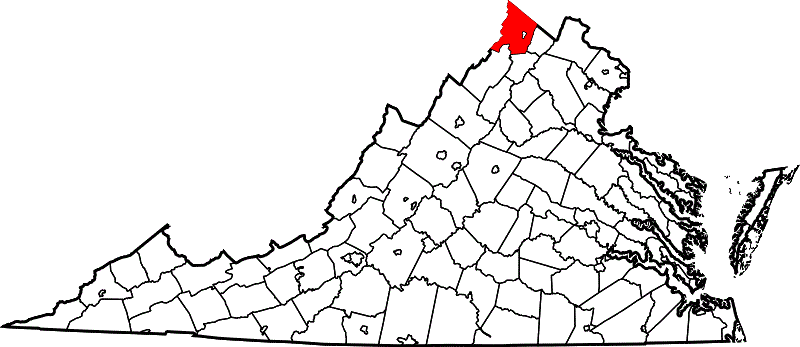
The Second Battle of Kernstown was fought in the greater Winchester area
of Frederick County, Virginia. Frederick County changed hands between the Confederate and Union Armies on average once every
three weeks during the Civil War. Many battles were fought in Frederick County. Some of those battles include:
- First Battle of Kernstown, March 1862
- First Battle of Winchester, May 1862
- Second Battle of Winchester, June 1863
- Second Battle of Kernstown, July 1864
- Third Battle of Winchester, September 1864
- Battle of Cedar Creek, October 1864
The first constitution of West Virginia provided for Frederick County to be
added to the new state if approved by a local election. Unlike those of neighboring Berkeley and Jefferson counties, Frederick
County residents voted to remain in Virginia despite being occupied by the Union Army at the time. Advance
to Shenandoah Valley Campaigns: The Civil War Battles.
(Sources and related reading below.)
Recommended
Reading: Shenandoah Summer: The 1864 Valley Campaign. Description: Jubal A. Early’s disastrous battles in the Shenandoah Valley
ultimately resulted in his ignominious dismissal. But Early’s lesser-known summer campaign of 1864, between his raid
on Washington and Phil Sheridan’s renowned fall campaign, had a significant impact on the political and military landscape
of the time. By focusing on military tactics and battle history in uncovering the facts and events of these little-understood
battles, Scott C. Patchan offers a new perspective on Early’s contributions to the Confederate war effort—and
to Union battle plans and politicking. Patchan details the previously unexplored battles at Rutherford’s Farm and Kernstown
(a pinnacle of Confederate operations in the Shenandoah Valley) and examines the campaign’s
influence on President Lincoln’s reelection efforts. Continued below…
He also provides
insights into the personalities, careers, and roles in Shenandoah of Confederate General John C. Breckinridge, Union general
George Crook, and Union colonel James A. Mulligan, with his “fighting Irish” brigade from Chicago.
Finally, Patchan reconsiders the ever-colorful and controversial Early himself, whose importance in the Confederate military
pantheon this book at last makes clear. About the Author: Scott C. Patchan, a Civil War battlefield guide and historian, is
the author of Forgotten Fury: The Battle of Piedmont, Virginia, and a consultant and contributing writer for Shenandoah, 1862.
Review
"The author's
descriptions of the battles are very detailed, full or regimental level actions, and individual incidents. He bases the accounts
on commendable research in manuscript collections, newspapers, published memoirs and regimental histories, and secondary works.
The words of the participants, quoted often by the author, give the narrative an immediacy. . . . A very creditable account
of a neglected period."-Jeffry D. Wert, Civil War News (Jeffry D. Wert Civil War News 20070914)
"[Shenandoah
Summer] contains excellent diagrams and maps of every battle and is recommended reading for those who have a passion for books
on the Civil War."-Waterline (Waterline 20070831)
"The narrative
is interesting and readable, with chapters of a digestible length covering many of the battles of the campaign."-Curled Up
With a Good Book (Curled Up With a Good Book 20060815)
"Shenandoah
Summer provides readers with detailed combat action, colorful character portrayals, and sound strategic analysis. Patchan''s
book succeeds in reminding readers that there is still plenty to write about when it comes to the American Civil War."-John
Deppen, Blue & Grey Magazine (John Deppen Blue & Grey Magazine 20060508)
"Scott C. Patchan
has solidified his position as the leading authority of the 1864 Shenandoah Valley Campaign with his outstanding campaign
study, Shenandoah Summer. Mr. Patchan not only unearths this vital portion of the campaign, he has brought it back to life
with a crisp and suspenseful narrative. His impeccable scholarship, confident analyses, spellbinding battle scenes, and wonderful
character portraits will captivate even the most demanding readers. Shenandoah Summer is a must read for the Civil War aficionado
as well as for students and scholars of American military history."-Gary Ecelbarger, author of "We Are in for It!": The First
Battle of Kernstown, March 23, 1862 (Gary Ecelbarger 20060903)
"Scott Patchan
has given us a definitive account of the 1864 Valley Campaign. In clear prose and vivid detail, he weaves a spellbinding narrative
that bristles with detail but never loses sight of the big picture. This is a campaign narrative of the first order."-Gordon
C. Rhea, author of The Battle of the Wilderness: May 5-6, 1864 (Gordon C. Rhea )
"[Scott Patchan]
is a `boots-on-the-ground' historian, who works not just in archives but also in the sun and the rain and tall grass. Patchan's
mastery of the topography and the battlefields of the Valley is what sets him apart and, together with his deep research,
gives his analysis of the campaign an unimpeachable authority."-William J. Miller, author of Mapping for Stonewall and Great
Maps of the Civil War (William J. Miller)
Advance to:
Recommended
Reading: The
Shenandoah Valley Campaign of 1864 (Military Campaigns of the Civil War) (416 pages) (The University of North
Carolina Press). Description: The 1864 Shenandoah Valley Campaign
is generally regarded as one of the most important Civil War campaigns; it lasted more than four arduous months and claimed
more than 25,000 casualties. The massive armies of Generals Philip H. Sheridan and Jubal A. Early had contended for immense
stakes... Beyond the agricultural bounty and the boost in morale to be gained with its numerous battles, events in the Valley
would affect Abraham Lincoln's chances for reelection in November 1864. Continued below...
The eleven
essays in this volume reexamine common assumptions about the campaign, its major figures, and its significance. Taking advantage
of the most recent scholarship and a wide range of primary sources, contributors examine strategy and tactics, the performances
of key commanders on each side, the campaign's political repercussions, and the experiences of civilians caught in the path
of the armies. The authors do not always agree with one another, but, taken together, their essays highlight important connections
between the home front and the battlefield, as well as ways in which military affairs, civilian experiences, and politics
played off one another during the campaign.
Recommended
Reading: The
Shenandoah Valley Campaign of 1864 (McFarland & Company). Description: A
significant part of the Civil War was fought in the Shenandoah Valley of Virginia, especially in 1864. Books and articles
have been written about the fighting that took place there, but they generally cover only a small period of time and focus
on a particular battle or campaign. Continued below...
This work covers
the entire year of 1864 so that readers can clearly see how one event led to another in the Shenandoah Valley and turned once-peaceful
garden spots into gory battlefields. It tells the stories of the great leaders, ordinary men, innocent civilians, and armies
large and small taking part in battles at New Market, Chambersburg, Winchester, Fisher’s
Hill and Cedar Creek, but it primarily tells the stories of the soldiers, Union and Confederate,
who were willing to risk their lives for their beliefs. The author has made extensive use of memoirs, letters and reports
written by the soldiers of both sides who fought in the Shenandoah Valley in 1864.
Recommended
Reading: Shenandoah 1862: Stonewall Jackson's Valley Campaign, by Peter Cozzens (Civil War America)
(Hardcover). Description: In the spring of 1862, Federal troops under the command of General George B. McClellan launched
what was to be a coordinated, two-pronged attack on Richmond
in the hope of taking the Confederate capital and bringing a quick end to the Civil War. The Confederate high command tasked
Stonewall Jackson with diverting critical Union resources from this drive, a mission Jackson fulfilled by repeatedly defeating
much larger enemy forces. His victories elevated him to near iconic status in both the North and the South and signaled a
long war ahead. One of the most intriguing and storied episodes of the Civil War, the Valley Campaign has heretofore only
been related from the Confederate point of view. Continued below…
With Shenandoah 1862, Peter Cozzens dramatically and
conclusively corrects this shortcoming, giving equal attention to both Union and Confederate perspectives.
Based on a multitude of primary sources, Cozzens's groundbreaking work offers new interpretations of the campaign and the
reasons for Jackson's
success. Cozzens also demonstrates instances in which the mythology that has come to shroud the campaign has masked errors
on Jackson's
part. In addition, Shenandoah 1862 provides the first detailed appraisal of Union leadership in the Valley Campaign, with
some surprising conclusions. Moving seamlessly between tactical details and analysis of strategic significance, Cozzens presents
the first balanced, comprehensive account of a campaign that has long been romanticized but never fully understood. Includes
13 illustrations and 13 maps. About the Author: Peter Cozzens is an independent scholar and Foreign Service officer with the
U.S. Department of State. He is author or editor of nine highly acclaimed Civil War books, including The Darkest Days of the
War: The Battles of Iuka and Corinth (from the University of North Carolina Press).
Editor's Choice: The Civil War - A Film by Ken Burns. Review: The
Civil War - A Film by Ken Burns is the most successful public-television miniseries in American history. The 11-hour Civil War didn't just captivate a nation,
reteaching to us our history in narrative terms; it actually also invented a new film language taken from its creator. When
people describe documentaries using the "Ken Burns approach," its style is understood: voice-over narrators reading letters
and documents dramatically and stating the writer's name at their conclusion, fresh live footage of places juxtaposed with
still images (photographs, paintings, maps, prints), anecdotal interviews, and romantic musical scores taken from the era
he depicts. Continued below...
The Civil War uses all of these devices to evoke atmosphere and resurrect an event that many knew
only from stale history books. While Burns is a historian, a researcher, and a documentarian, he's above all a gifted storyteller,
and it's his narrative powers that give this chronicle its beauty, overwhelming emotion, and devastating horror. Using the
words of old letters, eloquently read by a variety of celebrities, the stories of historians like Shelby Foote and rare, stained
photos, Burns allows us not only to relearn and finally understand our history, but also to feel and experience it. "Hailed
as a film masterpiece and landmark in historical storytelling." "[S]hould be a requirement for every
student."
Sources: National Park Service; Official Records of the Union and Confederate Armies; Patchan, Scott C.
Shenandoah Summer: The 1864 Valley Campaign. Lincoln: University of Nebraska Press, 2007. ISBN 978-0-8032-3754-4.
|


