|
A North Carolina Civil War Regiment?
| North Carolina Civil War History |
|
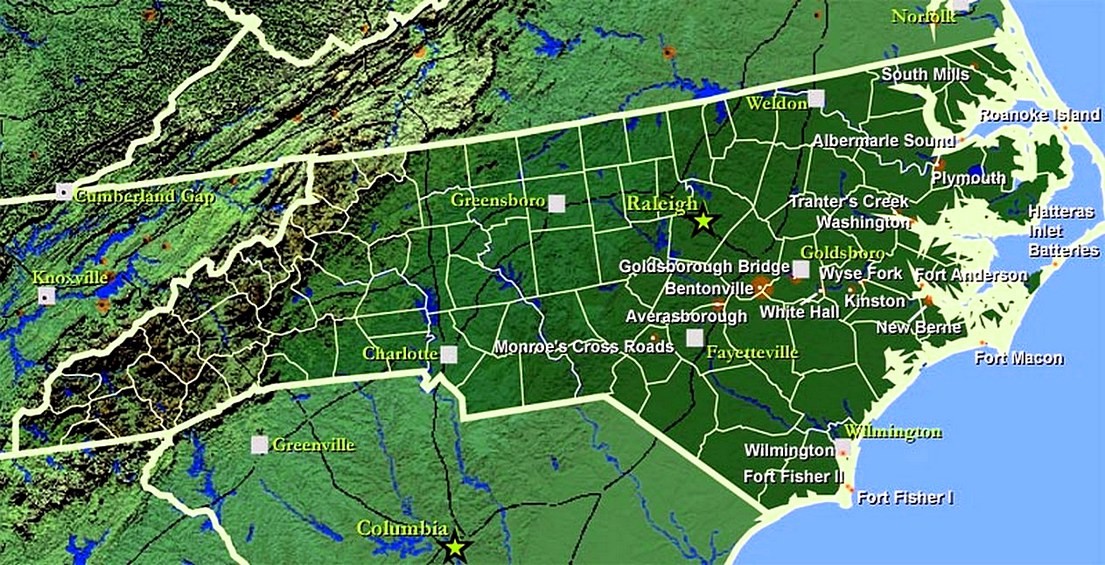
| North Carolina regiments fought in numerous battles on the homefront |
| Thomas' Legion of Indians and Highlanders |
|
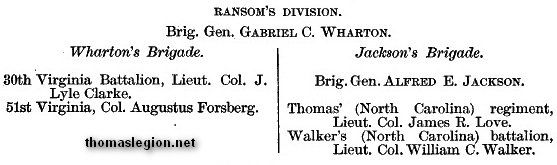
| Official Records of the Union and Confederate Armies, Series 1, Volume 32, part 2, p. 642 |
What's in a Name?
Thomas’
Legion of Indians and Highlanders, or Thomas' North Carolina Legion as it was often called during the Civil War, was
the largest single unit raised in North Carolina during the rebellion. Thomas’ Legion was a single unit consisting of infantry, cavalry,
and artillery, and, on occasion during the war, was known unofficially as Love's Regiment. Whereas Thomas would conclude his recruitment of the Cherokee Battalion in early 1865, it should not be confused with Walker's Battalion of the Thomas Legion, which
had formed earlier in the fight. (See Official Records of the Union and Confederate Armies, Series 1, Volume 49, part
2, p. 754.)
(Right) Thomas' Legion composed Jackson's entire
brigade as stated in this return for the Organization of troops in the Department of East Tennessee, dated January
31, 1864. Official Records of the Union and Confederate Armies, Series 1, Volume 32, part 2, p. 642.
The
Thomas Legion was scattered in numerous locations as it constantly shifted and moved its companies
to meet the exigencies of war. Members of the various elements of this legion would also unofficially adopt numerical
designations to preserve their identities postwar, but no official document
or correspondence exists showing that this had ever occurred during the war. The uniqueness of this organization,
however, was compounded by the fact that its components were known by many names. The
infantry of Thomas' Legion, for example, was often referred to as infantry regiment or Love's Regiment in honor of James R.
Love II, its commanding colonel. Its companies, which were usually raised in the same county, would also assign their
own nom de guerres or names.
From research it is the writer's
opinion that, at the very least, some wartime discussions included separating the infantry regiment from the Thomas
Legion and then designating it as the 69th North Carolina Infantry Regiment. Perhaps it was a fireside chat during
the Civil War and nothing more, because while Love, Stringfield, D. H. Hill, Walter Clark, Byron G. McDowell and many others
would refer to the infantry regiment as the 69th North Carolina Regiment and then interchange it with the Thomas Legion,
it would only occur after the war. Whereas no numerical designation was ever assigned to any element or portion of this
unit, it would exit the four year conflict by its official designation of Thomas' Legion.
During the Civil War there were 75 references to "Thomas' Legion" that
were later transcribed for the Official Records of the Union and Confederate Armies. This unit would also subsequently
be recorded as Thomas' Legion by the National Archives. During the grueling four year rebellion, the Congress
of the Confederate States, Secretary of War James A. Seddon, Adjutant and Inspector General’s Office, North Carolina
Governor Zebulon B. Vance, Confederate President Jefferson Davis, numerous commanding generals and the Thomas Legion's
field officers all referred to the unit as "Thomas' Legion."
In January 1865, the
14th North Carolina Cavalry Battalion was enlarged to 10 companies (a regiment) and was officially designated the
69th North Carolina Regiment-7th Cavalry, Lt. Col. James L. Henry, commanding. There were only two references to the
"Sixty-ninth North Carolina Regiment" in the Official Records of the Union and Confederate Armies (popularly
known as ORs) and both were to Lt. Col. Henry and the cavalry regiment (O.R., 1, 49, 1, pp. 1034-1035). The other references to Henry's Cavalry were the
Sixty-ninth North Carolina and Sixty-ninth North Carolina State Troops. Officially one 69th, Henry's, but unofficially there
were two 69ths that were recorded and referenced by many soldiers and historians for decades after the conflict, meaning one
cavalry and the other infantry. The infantry of course refers to James Love's Regiment of Thomas’ Legion. Walker's Battalion, William C. Walker, commanding, would be known postwar as the 80th North
Carolina Regiment.
In wartime communication most units shortened their designations, so in lieu of “Infantry Regiment” one would often write either
regiment or infantry. After the Civil War, while many a soldier turned writer would unofficially
adopt the 69th North Carolina Regiment
for the Thomas Legion, many would also make Walker's Battalion the 80th North Carolina Regiment. Thomas' Legion, nonetheless, was found 75 times in the Official Records of the Union and Confederate
Armies, while William C. Walker and Battalion were mentioned just once. Walker’s Regiment, 69th North Carolina (Infantry)
Regiment, and 80th Regiment (from North Carolina) were never indicated in said records. In addition, the National Archives, A
Comprehensive List of Confederate Units, catalogued this unit as Thomas’ Legion. There was no honorary mention
of the 69th North Carolina Regiment, 80th North Carolina, or Walker’s Regiment, period.
Whereas James R. Love was attached to Thomas' Legion, William C. Walker, who out ranked
Love, was officially assigned to Walker's Battalion. When the Adjutant and Inspector General’s
Office (A.&I.G.O) in Richmond, Virginia, received the muster rolls in June 1863, Love’s Regiment was commissioned
“Infantry Regiment, Thomas’ Legion” and the battalion became “Walker’s Battalion, Thomas’
Legion." All available official records show William C. Walker with the rank of lieutenant colonel prior to the battalion
commander's murder in 1864, but in some correspondence and communication, he was addressed with the abbreviation of Col. Walker.
During the course of the war, Walker's Battalion was never elevated to a regiment, nor did it ever meet regimental qualifications.
If it had been re-designated or reorganized as a regiment, it would have also been assigned a colonel, which too never happened.
In Clark's Regiments, page 117, the historian of Walker's Battalion, Captain Robert A. Aiken, wrote that "when
it was raised to ten companies in the spring of 1864, W. C. Walker became colonel." While Aiken made the statement 35 years
after hostilities had ended, it just never happened. Over the span of the conflict the battalion would never raise
nor field ten companies on any given date. Whereas Walker had been murdered on January 3, 1864, Aiken (who also noted
the death on page 122) would then posthumously promote him to colonel of the regiment the following springtime.
The
Official Records, nonetheless, further show that on May 13, 1865, which was one month after Lee surrendered
to Grant, it was still listed as a battalion when it surrendered as part of the Thomas Legion.
| North Carolina Facts |
|
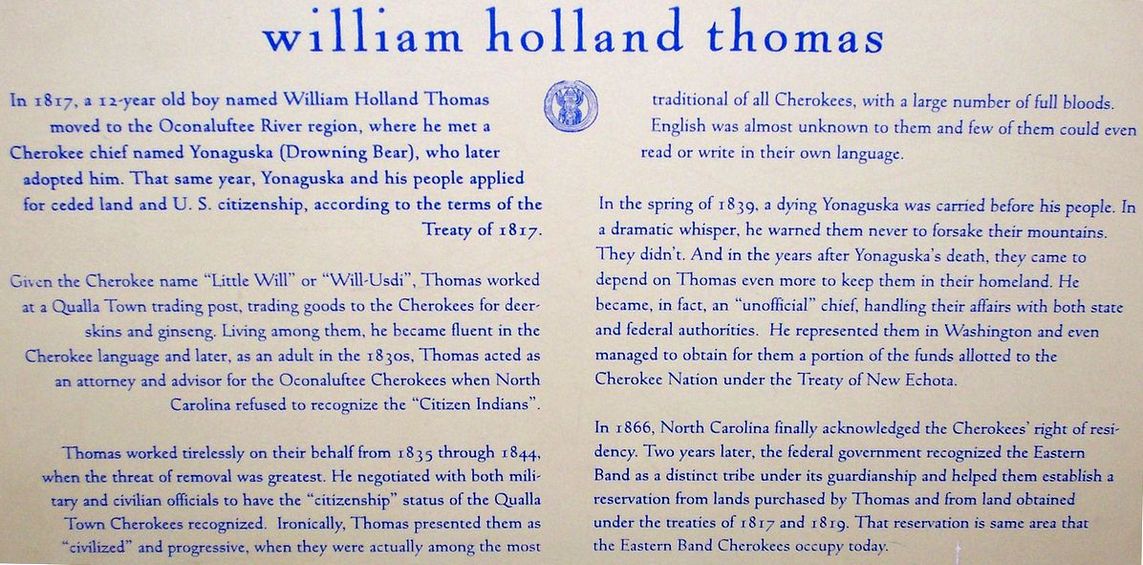
| Some facts about William Holland Thomas |
In Vernon H. Crow's exhaustive study of the Thomas Legion, Storm in
the Mountains: Thomas' Confederate Legion of Cherokee Indians and Mountaineers, he stated on page 146 that Love's Regiment
and 69th Regiment were often interchanged by Lt. Col. W.W. Stringfield in his writings
many years after the war. Crow also said that it was only after the conflict when Captain Robert A. Aiken
(also spelled Akins, Aikins, and Aikens) interchanged Walker's Battalion with 80th Regiment. These are only a few references
showing that some of the soldiers believed that numerical designations had been given to both the infantry regiment and Walker's
Battalion, which Aiken now called the 80th Regiment. But these kind of statements only circulated years
later when they appeared in writings such as personal memoirs and unit histories. Crow would continue to affirm and reaffirm
throughout his fine work that during his 10 year research of the Thomas Legion, he had never seen a single wartime
document or record indicating that Walker's Battalion was also the 80th or that it was increased to regimental
strength.
|
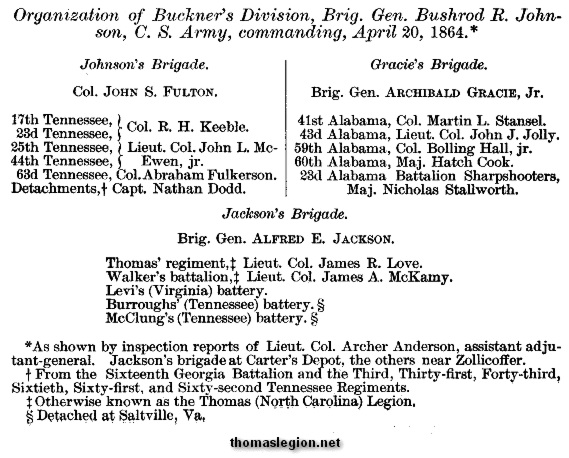
| Official Records of the Union and Confederate Armies, Series 1, Volume 32, part 3, p. 802. |
On page
147, Storm in the Mountains, Crow further states that in papers, letters, diaries—official and unofficial
records—in public and private collections, at universities and specialized archives, this author has not uncovered one
single document to alter the position that, during the war, "the Regiment was never called the Sixty-ninth, nor was the Battalion
ever called the Eightieth Regiment." Crow's "key words" were "during the war."
(Right) As part of a statewide
effort to preserve its history of the Great Civil War, North Carolina would publish the five volume Histories of
the Several Regiments and Battalions from North Carolina, in the Great War 1861-'65, edited by Walter Clark
and published in 1901. Captain Robert A. Aiken, who had commanded
Company H, Walker's Battalion, would write the official history of Walker's Battalion for this grand collaborative effort
now known by the masses as Clark's Regiments. On page 121, Volume IV, Captain Aiken said, "In April, 1864, it [Walker's
Battalion] was still in Jackson's Brigade and at Carter's Depot, but was commanded by Lieutenant-Colonel McKamy, 59 Off.
Rec. Union and Confed. Armies, 802, having been raised to a regiment." According to Official Records, however,
the unit would continue to be recorded as a battalion.
On page 518, Clark's Regiments, Volume III, Lt. Col. B. G. McDowell of the Sixty-second North Carolina Regiment recorded,
"Major W. W. Stringfield with 150 Cherokee Indians and whites of the Sixty-ninth North Carolina." On page 736, Clark's
Regiments, Vol. III,
Lt. Col. W.W. Stringfield, who recorded the history of the elusive Sixty-ninth for the Tar Heel State, wrote, "[S]everal
companies of Walker's Battalion (of our Legion)." Stringfield
continued, "Part of the
Sixty-ninth and most of the Eightieth (Walker's Battalion which had been raised to a regiment)." And on page 662, Clark's Regiments, Vol. III, Captain B. T. Morris
of the 64th North Carolina recorded that "Colonel Walker of the Eightieth North Carolina Regiment." And on pp. 662, 664
and 671, he stated, "Sixty-ninth and Eightieth." While Morris believed, as did many other soldiers postwar, that Walker's
Battalion had been raised to a regiment, he further applied the designation 80th North Carolina Regiment.
On pp. 114 and 161 in Confederate Military History of North Carolina, D. H. Hill, Jr. mentions
80th Battalion twice. On page 220, Hill writes, Sixty-ninth (?) North
Carolina Regiment. Hill clarifies his (?) by stating the believed
that General James Martin counted Thomas' Legion twice in Palmer's Brigade. In 1899, D. H. Hill, however, was unaware that the Fourteenth North
Carolina Battalion had been increased to a regiment and designated the 69th North Carolina Regiment. Martin did
not count the 69th twice, the 69th North Carolina Regiment was referring to the cavalry regiment, and Thomas' Legion was correctly
included in the report (O.R., 1, 49, 1, 1048). Hill makes no reference to the 80th Regiment; he does mention on page 114, Lt. Col. Walker's cavalry battalion,
and on page 161, he wrote Walker's Battalion.
In Clark's Regiments, An Extended Index to the Histories of the Several Regiments and Battalions
from North Carolina in the Great War 1861-65, p. 468, he documented "Walker's Battalion, Thomas' Legion; Col, 80th North Carolina State Troops." Official Records of the Union and Confederate Armies, Series 1, Volume
32, part II, p. 642 recorded, "Thomas' (North Carolina) Regiment, Lieut. Col. James R. Love. Walker's
(North Carolina) Battalion, Lieut. Col. William C. Walker." The National Park Service Index Of Civil War Units recorded,
"Walker's Battalion, Thomas Legion," and it never mentioned Walker’s Regiment or 80th Regiment.
Moreover, during the last months of the Civil War, both Confederate General Martin (O.R., 1, 49, 1, 1048) and Union General Stanley (O.R.,1, 49, 2, 309) referred to the command as Thomas' Legion. This reinforces the fact that
at the end of the war the legion was documented as being intact, meaning the regiment and battalion were not viewed as
separate and distinct units. When its components were detached, as emphasized, they were called by names such as Love's Regiment,
Thomas' Regiment, and Walker's Battalion. And in 1865, in Jefferson
Davis' Letter of Confidence in Thomas' Legion, Davis recognized the entire unit as Thomas' Legion.
|
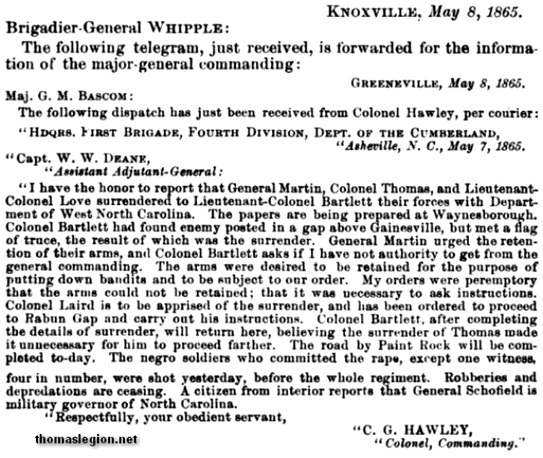
| O.R., 1, 49, 2, pp. 669-670 |
(Right)
Although Lt. Col. James R. Love was selected for the rank of colonel (equal to that of Thomas) during the final month
of the war, the conflict would conclude prior to the promotion. Love was also recommended for promotion to brigadier general,
according to Lt. Col. Stingfield's diary, November
1, 1864. But in a telegram dated May 8, 1865, (O.R., 1, 49, 2, 669), and nearly one month after Lee had capitulated to Grant, Love and Thomas had surrendered
to Union forces and been officially recorded as Colonel Thomas and Lieutenant Colonel Love. In this
report the writer was precise when he documented COLONEL Thomas and LEIUTENANT COLONEL Love. Whereas
Thomas had previously employed his personal Life Guard of Indians, he would
conclude the recruitment of the Cherokee Battalion (O.R., 1, 49, 2, 754) in early 1865.
The Battalion and Regiment of Thomas' Legion were both recorded
many times in the ORs. For authenticity, original spelling remains in the following examples.
Report
of Lieut. C. H. Taylor: Thomas’ Legion C. S. Army.
Murphy,
N.C.
November 1, 1863.
Sir:
on October 27, General Vaughn, with a detachment of his mounted men, overtook Goldman Bryson, with his company of mounted
robbers, in Cherokee County, N.C., attacked him, killing 2 and capturing 17 men and 30 horses.
On
the 28th, I left Murphy with 19 men, taking Bryson’s trail through the mountains; followed him 25 miles, when I came
upon him and fired on him, killing him, and capturing 1 man with him. I found in his possession his orders from General Burnside
and his roll and other papers.
My
men acted nobly; marched two days, and without anything to eat.
Yours
Respectfully,
C.
H. Taylor
Lieutenant,
Comdg, Co. B, Infantry Regt., Thomas’ Legion
Lieutenant
Colonel Walker
Commanding
Battalion, Thomas’ Legion
General
Bragg:
Permit
me, General, to recommend to your notice C. H. Taylor, lieutenant, who commanded the Indians at the killing of Captain Bryson.
You will pardon me, General, in not sending this through the proper channel, we have no mails.
W.
C. Walker,
Lieutenant-Colonel,
Comdg. Battalion, Thomas’ Legion
Quallatown, N.C., February 28, 1864.
TO THE GOVERNOR AND COUNCIL OF SOUTH CAROLINA:
SIRS: At the commencement of the present war I urged
the Carolinians to make preparations for defending the passes in the Smoky Mountain for their common protection, and to aid
as far as I could in keeping back the Northern vandals, by the express permission of President Davis, I raised a Legion of
Indians and Highlanders. Last fall when East Tennessee was unfortunately surrendered to the enemy, I, with the Indians, was ordered
to fall back on the Smoky Mountains to check the progress of the enemy.
Your obedient servant,
WM. H. Thomas
Colonel Thomas’ Legion Indians and Highlanders
O.R., 53, pp. 313-314
In the above letter, the winter of 1864 was said by many to be one
of the severest in the region's history. In the dispatch, Thomas, donning both Confederate colonel and Cherokee chief
hats, also emphasized that his Indians were starving as he pleaded with South Carolina officials to immediately send
the Cherokee Indians provisions of corn, flour, rice, beans, grain, and cotton for clothes. He then offered to pay for these
provisions at his own expense. Should food fail to arrive, Thomas continued, the Indians will certainly die and Thomas’
Legion will lack sufficient force to protect South Carolina’s northwestern region. He next warned that without immediate
aid, the legion will be forced retreat across the “Blue Ridge Line” and Lincoln will have access to subjugate
South Carolina. The neighboring South Carolinians would meet his requests, thus, for many, bringing relief.
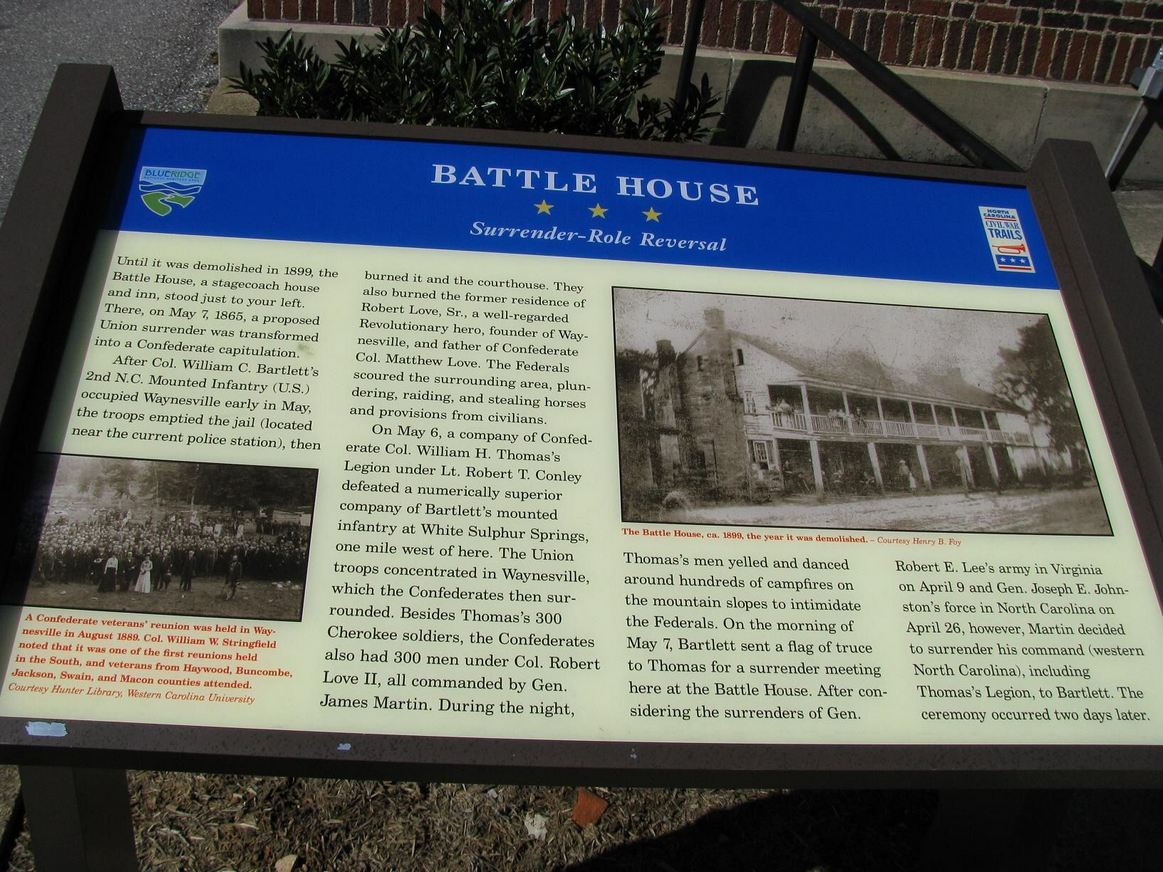
| Final Civil War Surrender Marker |
|
| Thomas Legion and the final surrender during the Civil War |
|
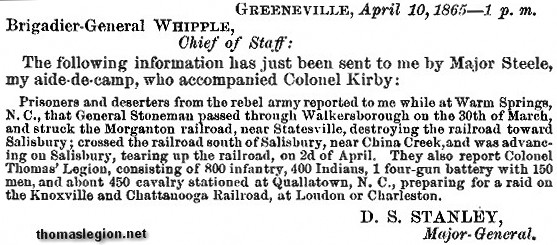
| Official Records of the Union and Confederate Armies, Series 1, Volume 49, part 2, p. 309. |
(Right) The
day following Lee's surrender to Grant, the largest single unit organized in the Old North State was still known
as Thomas' Legion, and, with its faithful components, it was poised for battle.
In
October 1863, Brig. Gen. A. E. Jackson's Brigade consisted of Thomas' Legion only. (See also O.R., 1, 29, 2, 812 and O.R., 1, 33, 1137.) Was the unit now a Legion or a Brigade? This confusing command structure
was highly contested by Col. Thomas and members of his field and staff. The situation was extremely tense between Jackson
and Thomas, insomuch that Jackson had Thomas arrested in June of 1863 and charged with "disobedience of orders."
In the following report, O.R., 1, 32, 3, 802, it stated that Lieut. Col. James R. Love was commanding the regiment of Thomas'
Legion while Lieut. Col. James A. Mckamy was commanding Walker's Battalion. It is followed by a footnote showing, "Otherwise
known as the Thomas (North Carolina) Legion." Earlier
in the war, the ORs recorded Col. William H. Thomas in command of the regiment, but beyond the winter of 1863-64,
Thomas would, until the legion reunited a few months prior to its surrender, lead only the Cherokee Battalion as
it generally performed thankless provost and guard duties in East Tennessee and North Carolina. The following
includes original text, spelling, and footnotes.
Organization
of Buckner’s Division, Brig. Gen. Bushrod R. Johnson, C. S. Army, commanding, April 20, 1864.*
Jackson’s Brigade.
Brig.
Gen. Alfred E. Jackson.
Thomas’
regiment,++ Lieut. Col. James R. Love.
Walker’s battalion,++ Lieut. Col. James
A. Mckamy.
Levi’s
(Virginia)
battery.
Burroughs’
(Tennessee)
battery.
McClung’s
(Tennessee)
battery.
Johnson’s
Brigade.
Col.
John S. Fulton.
17th
Tennessee,
Col. R. H. Keeble.
23rd
Tennessee,
Col. R. H. Keeble.
25th
Tennessee,
Lieut. Col. John L. McEwen, jr.
44th
Tennessee,
Lieut. Col. John L. McEwen, jr.
63d
Tennessee,
Col. Abraham Folkerson.
Detachments,
+ Capt. Nathan Dodd.
Gracie’s
Brigade
Brig.
Gen. Archibald Gracie, Jr.
41st
Alabama,
Col. Martin L. Stansel.
43rd
Alabama,
Lieut. Col. John J. Jolly.
59th
Alabama,
Col. Bolling Hall, jr.
60th
Alabama,
Maj. Hatch Cook.
23rd
Alabama,
Battalion Sharpshooters, Maj. Nicholas Stallworth.
++
Otherwise known as the Thomas (North Carolina) Legion
+
From the Sixteenth Georgia Battalion and the Third, Thirty-first, Forty-third, Sixtieth, Sixty-first, and Sixty-second Tennessee
Regiments.
•
As shown by inspection reports of Lieu. Col. Archer Anderson, assistant adjutant-general. Jackson’s brigade at Carter’s Depot,
the others near Zollicoffer.
There
were some wartime records showing Thomas’ regiment, North
Carolina and Thomas’ regiment, North Carolina Volunteers.
Notice that the Official Records of the Union and Confederate Armies added a footnote when it recorded Thomas’ regiment, North Carolina. This evidence also served to reinforce the command rivalry between Brig. Gen. A. E. Jackson and Col. William H.
Thomas. Lt. Col. William Stringfield later wrote, “It appears that Jackson broke up the Legion in order to make it a brigade
and call it his Brigade.” This had given a strong impression that the organization had demoted the "legion”
by stating “regiment and battalion.” When you view the brigade it includes Thomas' Legion and Thomas' entire Legion.
While in this report the regiment, battalion and artillery battery formed the core of Jackson's Brigade, in other accounts
the brigade consisted of merely the regiment and battalion of the Thomas Legion. So when Jackson's command was formed only
with Thomas' Legion, what were the soldiers supposed to call the unit and to whom do they report? Who commanded this
monster or freak with two heads? If Brig. Gen. Jackson had otherwise called it
a legion, the brigade designation would not have existed and Jackson would have found himself without a command. While it
served as the genesis of the heated arguments between Thomas and Jackson, as well as the poor morale in the ranks, the blame
for this odd formation must be placed squarely on the shoulders of the Confederate Army, which had not only allowed its
creation, but sat idly by as this beast continued to exist.
|
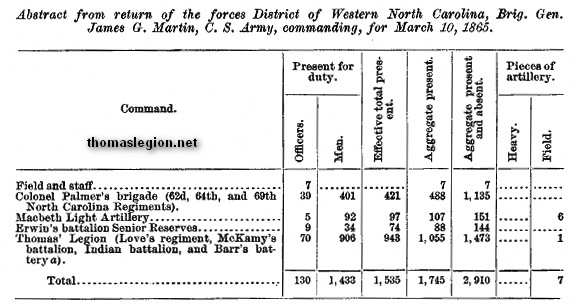
| Official Records of the Union and Confederate Armies, Series 1, Volume 49, part 1, p. 1048 |
(Right)
In this March 10, 1865, report, Thomas' Legion of Indians and Highlanders, which included Love's Regiment, McKamy's Battalion,
Indian Battalion, and Barr's Light Artillery Battery, was now attached to the District of Western North Carolina, under
Brig. Gen. James G. Martin. The 69th North Carolina Cavalry Regiment was also listed in the report as part of Palmer's
Brigade. Barr's Battery has the footnote "a" for No report. Not included.
In
November 1864, the Congress of the Confederate States of America affirmed the organization as Thomas' Legion. The
following, from Library of Congress, includes original spelling and footnotes.
Journal
of the Congress of the Confederate States of America, 1861-1865 [Volume 4]
MONDAY, November 21, 1864.
To
His Excellency Jefferson Davis,
President,
etc.
Executive
Department, Confederate States of America,
Richmond, November 21, 1864.
To
the Senate of the Confederate States:
Agreeably
to the recommendation of the Secretary of War, I nominate James W. Terrell, of North Carolina, to be an assistant quartermaster, with the
rank of captain in the Provisional Army of the Confederate States of America.
JEFFERSON DAVIS.
No.
11.] War Department, Confederate States
of America,
Richmond, November 19, 1864.
Sir:
I have the honor to recommend the nomination of James W. Terrell, of North Carolina, to be an assistant quartermaster, with
rank of captain in the Provisional Army of the Confederate States of America, for duty with Thomas' Legion
(an original vacancy), to date from November 12, 1864.
I
am, sir, respectfully, your obedient servant,
JAMES
A. SEDDON, Secretary of War.
EXECUTIVE
SESSION.
The
following message was received from the President of the Confederate orates, by Mr. B. N. Harrison, his Secretary:
Executive
Department, Confederate States
of America,
Richmond, November 24, 1864.
To
the Senate of the Confederate States:
Agreeably
to the recommendation of the Secretary of War, I nominate Thomas D. Johnston, of North Carolina, to be assistant commissary, with rank of
captain in the Provisional Army of the Confederate States of America.
JEFFERSON DAVIS.
No.
16.] War Department, Confederate States
of America,
Richmond, November 22, 1864.
Sir:
I have the honor to recommend the nomination of Thomas D. Johnston, of North Carolina, to be assistant commissary, with rank
of captain in the Provisional Army of the Confederate States of America, for duty with Thomas' Legion
(an original vacancy), to date from November 21, 1864.
|
| Official Records of the Union and Confederate Armies, Series 1, Volume 49, part 2, pp. 754-755. |
I
am, sir, respectfully, your obedient servant,
JAMES
A. SEDDON,
Secretary
of War.
To
His Excellency Jefferson Davis,
President,
etc.
The
message was read.
Ordered,
That it be referred to the Committee on Military Affairs.
On
motion by Mr. Sparrow,
The
Senate resolved rate open legislative session.
In
early 1864 the Congress of the Confederate States of America recorded:
Journal
of the Congress of the Confederate States of America, 1861-1865 [Volume 3]
FRIDAY, January 15, 1864.
To
His Excellency Jefferson Davis,
President,
etc.
The
message was read.
Ordered,
That it be referred to the Committee on Military Affairs.
(Right)
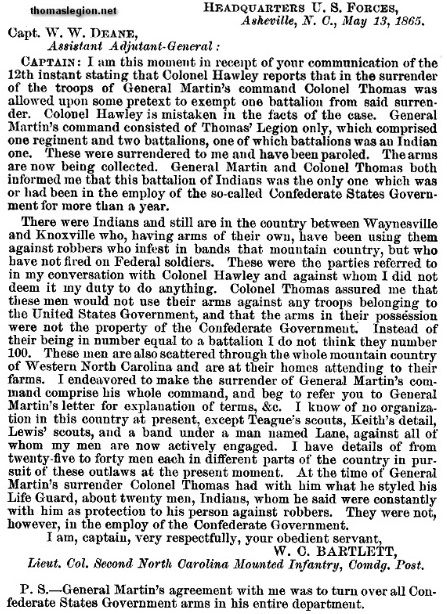
Lt. Col. William C. Bartlett, commanding 2nd N.C. (Federal) Mounted Infantry, submitted his report to headquarters dated May
13, 1865, which was more than one month after Lee's surrender at Appomattox, and he said that "Martin's command consisted
of Thomas' Legion only, which comprised one regiment and two battalions, one of which battalions was an Indian one. These
were surrendered to me and paroled." Bartlett reported that Thomas also had with him what he styled his Life Guard, about
20 men, Indians, whom he said were constantly with him for protection against robbers. They were not, however, employed by
the Confederate government. Bartlett, a Union officer, had just recorded the last word for the battle-hardened men who
had served in the Thomas Legion. Although a determined lot, they had now surrendered to and were paroled by the officer who
had been their antagonist during the deadliest conflict in American history. And Bartlett recorded that there was just one
regiment, meaning infantry, and two battalions that had formed the ole Thomas Legion. The Federal commander had not attached
a single numerical designation to any portion of this unit, because there were not any numbers to document before
the men disbanded and then returned to their homes to enter the next chapter of their lives.
The
following message was received from the President of the Confederate States, by Mr. B. N. Harrison, his Secretary:
Executive
Department, Confederate States
of America,
Richmond, January 14, 1864.
To
the Senate of the Confederate States:
Agreeably
to the recommendation of the Secretary of War, I nominate the officers on the accompanying list to the rank affixed to their
names, respectively.
JEFFERSON DAVIS.
War
Department, Confederate States
of America,
Richmond, January 6, 1864.
Sir:
I have the honor to recommend the following nominations for appointment in the Provisional Army of the Confederate States
of America:
Adjutants--first
lieutenants.
•
E. S. Hammond, of Tennessee, to be adjutant Fourteenth Tennessee Cavalry Regiment, to rank from July 1, 1863.
•
John L. Barksdale, of Tennessee, to be adjutant Fifteenth Tennessee Cavalry Regiment, to rank from August 27, 1863.
•
W. B. Jones, of Tennessee, to be adjutant Sixteenth Tennessee Cavalry Regiment, to rank from August 29, 1863.
•
W. G. Williams, of North Carolina, to be adjutant Sixty-sixth North Carolina Regiment, to rank from November 30, 1863.
•
P. C. Gaston, of North Carolina, to be adjutant Walker's Battalion, Thomas' Legion, to rank from May 20, 1863.
•
D. H. Halsey, of Alabama, to be adjutant Fourth Alabama Cavalry Regiment, to rank from October 1, 1863.
•
C. Wick. Gue, of Alabama, to be adjutant Twenty-fourth Alabama Battalion, to rank from December 16, 1863.
•
W. L. Pike, of Missouri, to be adjutant Seventh Missouri Cavalry Regiment, to rank from December 12, 1863.
•
G. E. Manigault, of South Carolina, to be adjutant Fourth South Carolina Cavalry Regiment, to rank from December 1, 1863.
•
John McRae, of Mississippi, to be adjutant Forty-sixth Mississippi Regiment, to rank from November 17, 1863.
•
C. V. Thompson, of Tennessee, to be adjutant Thirteenth Tennessee Regiment, to rank from December 4, 1863.
•
C. E. Kimball, of Virginia, to be adjutant Sixth Virginia Cavalry Regiment, to rank from October 1, 1863.
•
John Fennelly, of Louisiana, to be adjutant Fourteenth Louisiana Regiment, to rank from December 12, 1863.
•
O. R. Funsten, of Virginia, to be adjutant Eleventh Virginia Cavalry Regiment, to rank from December 7, 1863.
•
A. J. Brooks, of Alabama, to be adjutant Forty-sixth Alabama Regiment, to rank from November 17, 1863.
•
John Law, of Georgia, to be adjutant Thirty-eighth Georgia Regiment, to rank from November 21, 1863.
•
D. A. Hinton, of Virginia, to be adjutant Forty-fourth Virginia Battalion, to rank from December 15, 1863.
•
J. E. H. Post, of Maryland, to be adjutant First Maryland Battalion Cavalry, to rank from December 1, 1863.
I
am, sir, respectfully, your obedient servant,
JAMES
A. SEDDON,
Secretary
of War.
To
His Excellency Jefferson Davis,
President,
etc.
The
message was read.
Ordered,
That it be referred to the Committee on Military Affairs.
On
motion by Mr. Johnson of Arkansas,
The
Senate resolved into open legislative session.
(Additional sources and related reading below.)
Recommended Reading: North Carolina Troops, 1861-1865: A Roster
(Volume XVI: Thomas's Legion) (Hardcover, 537 pages), North Carolina Office of Archives and History (June 26, 2008).
Description: The volume begins with an authoritative 246-page history of Thomas's Legion. The history, including Civil War
battles and campaigns, is followed by a complete roster and service records of the field officers, staff, and troops
that served in the legion. A thorough index completes the volume. Continued below...
Volume XVI
of North Carolina Troops: A Roster contains the history and roster of the most unusual North Carolina Confederate Civil
War unit, significant because of the large number of Cherokee Indians who served in its ranks. Thomas's Legion was the creation
of William Holland Thomas, an influential businessman, state legislator, and Cherokee chief. He initially raised a small
battalion of Cherokees in April 1862, and gradually expanded his command with companies of white soldiers raised in western
North Carolina,
eastern Tennessee, and Virginia.
By the end of 1862, Thomas's Legion comprised an infantry regiment and a battalion of infantry and cavalry. An artillery battery
was added in April 1863. Furthermore, in General Early's Army of the Valley, the Thomas Legion was well-known for its fighting
prowess. It is also known for its pivotal role in the last Civil War battle east of the Mississippi
River. The Thomas Legion mustered more than 2,500 soldiers and it closely resembled a brigade. With troop roster, muster records, and Compiled Military Service Records (CMSR) this volume
is also a must have for anyone interested in genealogy and researching Civil War ancestors. Simply stated, it is an outstanding
source for genealogists.
Recommended Reading: Storm
in the Mountains: Thomas' Confederate Legion of Cherokee Indians and Mountaineers (Thomas' Legion: The Sixty-ninth North
Carolina Regiment). Description: Vernon H. Crow, Storm in the Mountains,
dedicated an unprecedented 10 years of his life to this first yet detailed history of the Thomas Legion. But
it must be said that this priceless addition has placed into our hands the rich story of an otherwise forgotten era of
the Eastern Cherokee Indians and the mountain men of both East Tennessee and western North Carolina who would fill the
ranks of the Thomas Legion during the four year Civil War. Crow sought out every available primary and secondary source by traveling to several states
and visiting from ancestors of the Thomas Legion to special collections, libraries, universities, museums, including
the Museum of the Cherokee, to various state archives and a host of other locales for any material on the unit in
order to preserve and present the most accurate and thorough record of the legion. Crow, during his exhaustive fact-finding, was
granted access to rare manuscripts, special collections, privately held diaries, and never before seen nor published photos
and facts of this only legion from North Carolina. Crow remains absent from the text as he gives a readable
account of each unit within the legion's organization, and he includes a full-length roster detailing each of the men who
served in its ranks, including dates of service to some interesting lesser known facts.
Storm in the Mountains, Thomas' Confederate Legion of Cherokee Indians and
Mountaineers is presented in a readable manner that is attractive to any student and reader of American history, Civil
War, North Carolina studies, Cherokee Indians, ideologies and sectionalism, and I would be remiss without including the
lay and professional genealogist since the work contains facts from ancestors, including grandchildren, some of which
Crow spent days and overnights with, that further complement the legion's roster with the many names,
dates, commendations, transfers, battle reports, with those wounded, captured, and killed, to lesser yet interesting
facts for some of the men. Crow was motivated with the desire to preserve history
that had long since been overlooked and forgotten and by each passing decade it only sank deeper into the annals of obscurity.
Crow had spent and dedicated a 10 year span of his life to full-time research
of the Thomas Legion, and this fine work discusses much more than the unit's formation, its Cherokee
Indians, fighting history, and staff member narratives, including the legion's commander, Cherokee chief and Confederate
colonel, William Holland Thomas. Numerous maps and photos also allow the
reader to better understand and relate to the subjects. Storm
in the Mountains, Thomas' Confederate Legion of Cherokee Indians and Mountaineers is highly commended, absolutely
recommended, and to think that over the span of a decade Crow, for us, would meticulously research the unit and
present the most factual and precise story of the men, the soldiers who formed, served, and died in the famed Thomas
Legion.
Recommended Viewing: The Civil War - A Film by Ken Burns. Review: The
Civil War - A Film by Ken Burns is the most successful public-television miniseries in American history. The 11-hour Civil War didn't just captivate a nation,
reteaching to us our history in narrative terms; it actually also invented a new film language taken from its creator. When
people describe documentaries using the "Ken Burns approach," its style is understood: voice-over narrators reading letters
and documents dramatically and stating the writer's name at their conclusion, fresh live footage of places juxtaposed with
still images (photographs, paintings, maps, prints), anecdotal interviews, and romantic musical scores taken from the era
he depicts. Continued below...
The Civil War uses all of these devices to evoke atmosphere and resurrect an event that many knew
only from stale history books. While Burns is a historian, a researcher, and a documentarian, he's above all a gifted storyteller,
and it's his narrative powers that give this chronicle its beauty, overwhelming emotion, and devastating horror. Using the
words of old letters, eloquently read by a variety of celebrities, the stories of historians like Shelby Foote and rare, stained
photos, Burns allows us not only to relearn and finally understand our history, but also to feel and experience it. "Hailed
as a film masterpiece and landmark in historical storytelling." "[S]hould be a requirement for every
student."
Recommended Reading: Confederate Military History Of North Carolina: North Carolina In
The Civil War, 1861-1865. Description: The author, Prof. D. H. Hill, Jr.,
was the son of Lieutenant General Daniel Harvey Hill (North Carolina
produced only two lieutenant generals and it was the second highest rank in the army) and his mother was General “Stonewall”
Jackson’s wife's sister. In Confederate Military History Of North Carolina,
Hill discusses North Carolina’s massive task of preparing and mobilizing for the conflict; the many regiments and battalions
recruited from the Old North State; as well as the state's numerous contributions during the war. Continued below...
During Hill's Tar Heel State
study, the reader begins with interesting and thought-provoking statistical data regarding the 125,000 "Old North State"
soldiers that fought during the course of the war and the 40,000 that perished. Hill advances with the
Fighting Tar Heels to the first battle at Bethel, through numerous bloody campaigns
and battles--including North Carolina’s contributions at the "High Watermark" at Gettysburg--and concludes with Lee's surrender at Appomattox.
Highly recommended!
Recommended Reading: The Civil War in North Carolina.
Description: Numerous battles and skirmishes were fought in North Carolina during the Civil War, and the campaigns and battles themselves were crucial
in the grand strategy of the conflict and involved some of the most famous generals of the war. Continued below...
John Barrett presents the complete story of military engagements and battles across the state, including
the classical pitched battle of Bentonville--involving Generals Joe Johnston and William
Sherman--the siege of Fort Fisher, the amphibious campaigns on the
coast, and cavalry sweeps such as General George Stoneman's Raid. "Includes cavalry battles, Union Navy
operations, Confederate Navy expeditions, Naval bombardments, the land battles... [A]n indispensable edition." Also
available in hardcover: The Civil War in North Carolina.
Sources: Vernon H. Crow, Storm
in the Mountains: Thomas' Confederate Legion of Cherokee Indians and Mountaineers; Official Records of the Union and Confederate
Armies; Walter Clark, Histories of the Several Regiments and Battalions from North Carolina in the Great War 1861-1865; National
Archives and Records Administration; North Carolina Office of Archives and History; National Park Service: American Civil
War; National Park Service: Soldiers and Sailors System; Weymouth T. Jordan and Louis H. Manarin, North Carolina Troops, 1861-1865; D. H. Hill, Confederate Military History Of North Carolina: North Carolina
In The Civil War, 1861-1865; Christopher M. Watford, The Civil War in North Carolina: Soldiers' and Civilians' Letters
and Diaries, 1861-1865. Volume 2: The Mountains; Library of Congress; William F. Fox, Regimental Losses in the American Civil
War; William Stringfield, Unpublished Memoirs of the Civil War.
|
