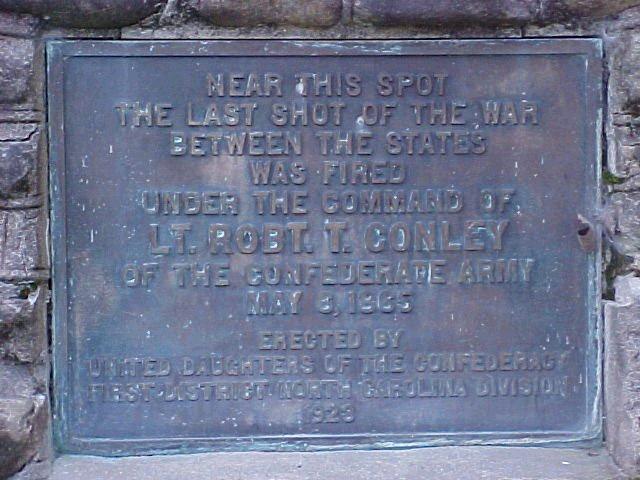
The Thomas Legion fires the last shot of the American Civil War east of the Mississippi River.
On May 6, 1865, Lt. Robert T. Conley and a small company from Thomas' North Carolina Legion clashed with Lt. Col. William C. Bartlett's 2nd North Carolina (Federal) Mounted Infantry in White Sulphur Springs. When Conley's men were passing through the woods they would slam headlong into Bartlett's
unit. Hastily forming a skirmish line, Conley's command then raised their rifles and fired a volley directly into the foe,
forcing the Federals to skedaddle in confusion. One man lay dead, however. East of the Mississippi, and nearly
one month after Lee surrendered to Grant, Union soldier James Arwood became the last man killed in
the Civil War. For years following the conflict, Mr. Conley would often say, "I still have James Arwood's gun as a relic." The
Last Shot should also be defined as the last Union and Confederate forces in combat east of the Mississippi
and should not be viewed or confused with the United States Army fighting bushwhackers and outlaws.
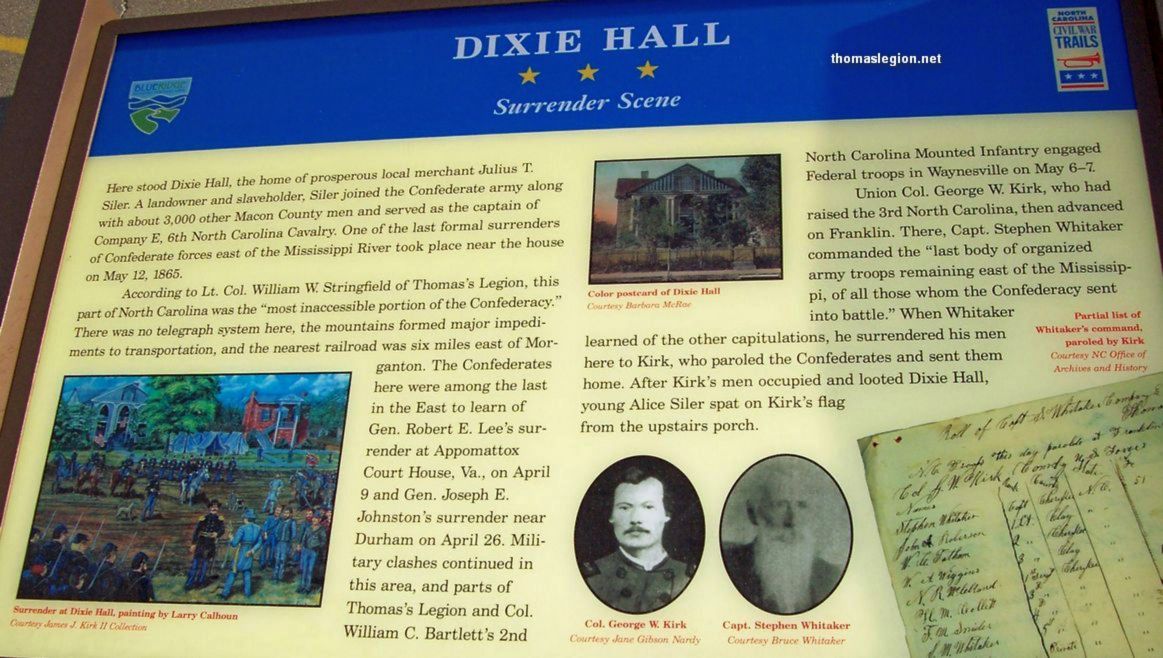
The Final Formal Surrender of the Civil War
| The Last Civil War Surrender |
|
| Final Surrender of the Civil War |
| Final Civil War Surrender Memorial at Franklin, NC |
|
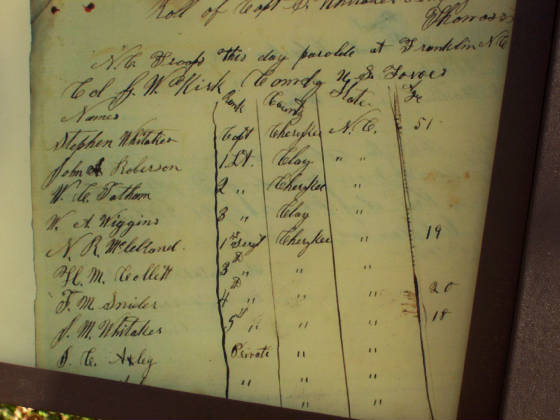
| Parole Signatures of the Final Surrender of the Civil War |
East
of the Mississippi River, Thomas' Legion
of Indians and Highlanders would participate in the Final Surrender of the American Civil War
on May 12, 1865.
The soldiers of Company E, First Battalion, Thomas' Legion,
signed their parole papers beginning on May 12, with the last signature recorded on May 14, 1865. Colonel William H. Thomas, the unit's namesake, had surrendered the rest of the legion a few days earlier on
May 9, near present-day Waynesville, North Carolina. After participating in the Skirmish of Hanging Dog in Cherokee County, Captain Stephen Whitaker and Co. E were moving toward White Sulphur Springs to reinforce Thomas when they were intercepted by the Federals at Franklin. Having been ordered to Franklin by Brig. Gen. Davis Tillson,
Colonel George W. Kirk and the Union 3rd North Carolina Mounted Infantry would now move toward Whitaker, who would instruct his men to form a skirmish line. (O.R., 1, Vol.
49, part II, pp. 689-690.) But once he received word and was convinced of Col.
Thomas and Brig. Gen. James Martin surrendering at Waynesville, Whitaker and his small contingent would also
surrender. On May 14, 1865, when the Thomas Legion soldiers finished signing their paroles, they
viewed Whitaker roll them up, tie them, place them in a Haversack, and give them to Col. Kirk's Courier. "And thus
at 10 o'clock in the morning of May 14, 1865, our Civil War Soldier Life ended and our Every Day Working Life began," wrote
John H. Stewart of the Thomas Legion. The men who surrendered to Kirk, had also become the last Confederates to capitulate
this side of the Mississippi. Returning to their former homes, they would strive to rebuild their communities during the aftermath, an era otherwise known as Reconstruction.
Letter regarding Captain Stephen Whitaker's parole:
Head Quarters 3rd Regt. N.C. Mtd. Infty.
Franklin, N.C. May 12th, 1865
The bearer here of Stephen Whitaker Captain* Co. E 1st Batt. Thomas Legion C.S.A. having given his word of honor not
to take up arms against the United States Government, nor give aid or assistance to its enemies until duly exchanged as a
prisoner of war is paroled and has permission to go to his home and there remain unmolested.
W.W. Rollins Maj
By order of Col. George W. Kirk
3rd N.C. Mtd Infty
Cmg 3rd N.C. Mtd Infty
*Establishes
the fact that when Stephen Whitaker was paroled he was recognized as a captain and not a major. However, William Stringfield,
Robert A. Akin, and others referred to the aforementioned as MAJOR Stephen Whitaker. In reconciling the disparity, this writer
concludes: Captain or Major? A captain was the assigned rank for company commander, and major or lieutenant colonel was the
assigned rank for a battalion commander. The disparity in Whitaker's rank may be due to the fact that for a portion of the
war, Whitaker commanded the entire First Battalion, Thomas' Legion. Again, typically, a major or lieutenant colonel commanded
a "battalion" and therefore, unofficially and respectfully, many referred to Stephen Whitaker as MAJOR. It is also the writer's
view that Stephen Whitaker should have been officially promoted to at least major due to "rank versus responsibility."
The Union Army recruited two mounted Infantry regiments within North Carolina, and both mounted regiments were raised
principally from Western North Carolina counties:
William C. Bartlett, Union's 2nd North Carolina Mounted Infantry Regiment; and George W. Kirk, Union's 3rd North Carolina
Mounted Infantry Regiment. Recruitment of these regiments epitomized the "Brother's War" and the men serving in the two Union
mounted infantry regiments were commonly referred to as "Home Yankees." Approximately 10,000 white North Carolinians served the United States during the war, while more than 5,000 North Carolina African Americans joined the Union Army. These free blacks and escaped slaves served in segregated regiments led by white officers.
Union Major General George
Stoneman's command as it concerns Western North Carolina in 1865: Second North Carolina Mounted Infantry Regiment, Lieut.
Colonel William C. Bartlett; Third North Carolina Mounted Infantry Regiment,
Colonel George W. Kirk; First Brigade, Commanding Colonel Chauncey G. Hawley; Fourth Division,
Department of the Cumberland, Brig. General Davis Tillson; District of East Tennessee, Major General George Stoneman (To view entire Union District of East Tennessee, including 1st and
2nd Brigades, and Brig. Gen. A. C. Gillem's Cavalry Division, please see Stoneman's Cavalry Raid and O.R., 1, 49, Part II, pp. 538-539)
| Date the Civil War ended? |
|
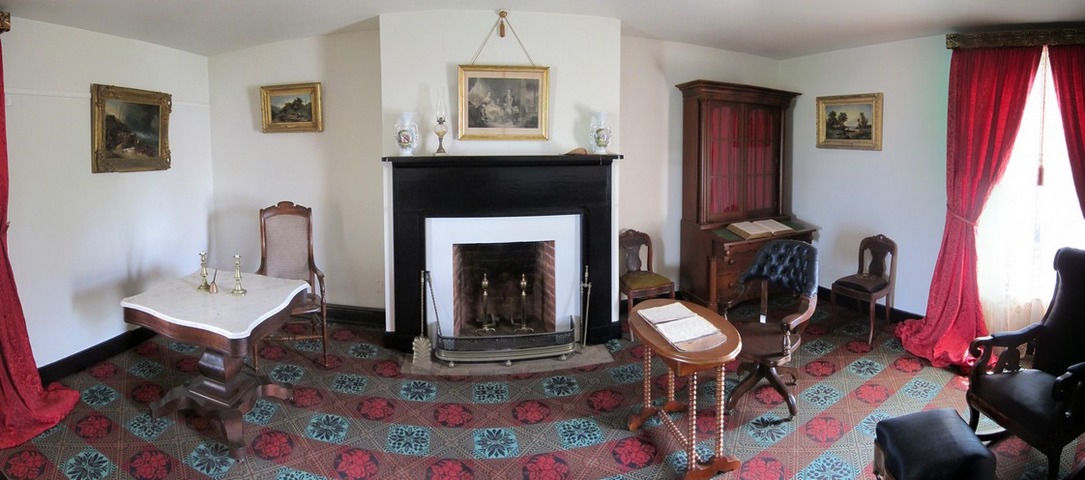
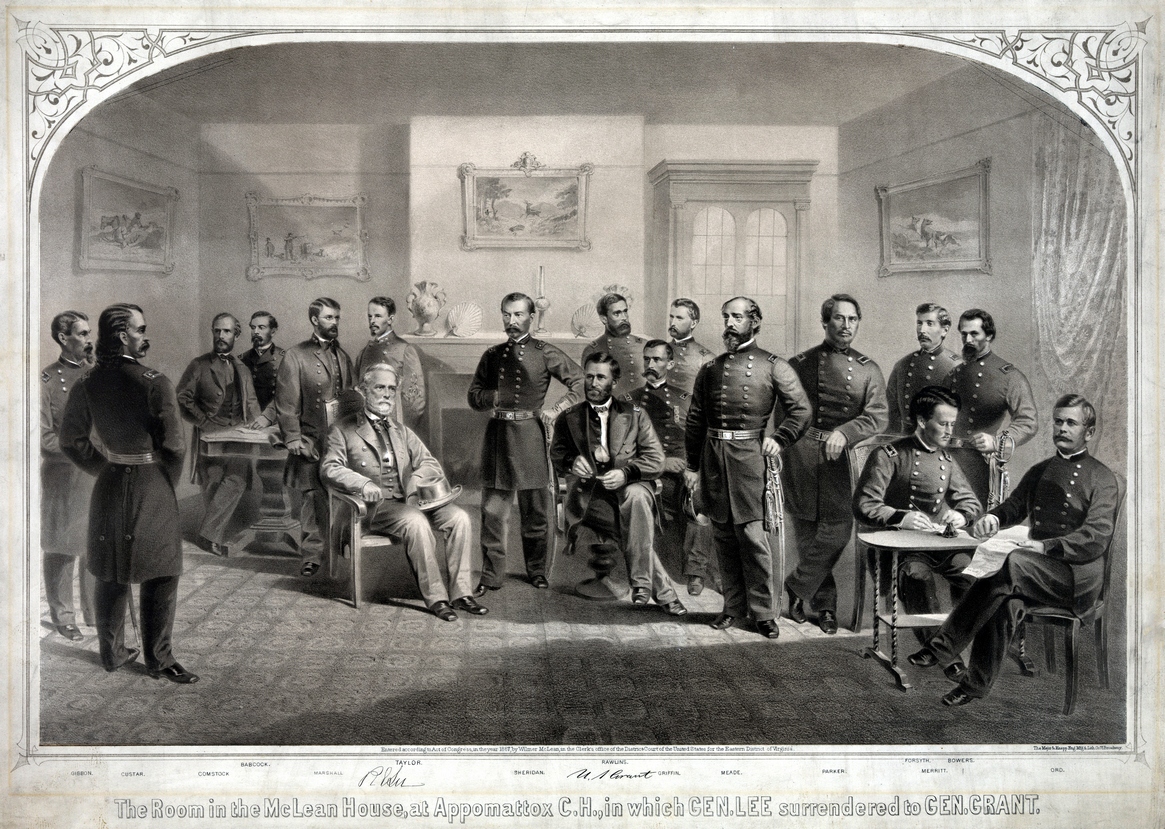
| The parlor in the McLean House where Lee surrendered to Grant on April 9, 1865 |
(About) Surrender at Appomattox. Ely Parker, a Seneca Indian, is third
from right, back row. The Room in the McLean House, at Appomattox C.H., in which Gen. Lee surrendered to Gen. Grant Most written
accounts of Robert E. Lee’s surrender to Ulysses S. Grant at Appomattox on April 9, 1865, noted the difference between
Lee’s stiff dignity and Grant’s more relaxed demeanor. This lithograph of the event, showing the two men as they
waited for the peace terms to be copied, captures that difference better than most. After the surrender, Wilmer McLean, the
owner of the house, lost much of his furniture to soldiers desiring mementos of the historic event. Later, in what proved
to be a futile effort to recoup his losses and raise funds for his needy family, he commissioned this print. Pictured Left
to Right: John Gibbon, George Armstrong Custer, Cyrus B. Comstock, Orville E. Babcock, Charles Marshall, Walter H. Taylor,
Robert E. Lee, Philip Sheridan, Ulysses S. Grant, John Aaron Rawlins, Charles Griffin, unidentified, George Meade, Ely S.
Parker, James W. Forsyth, Wesley Merritt, Theodore Shelton Bowers, Edward Ord. The man not identified in the picture’s
legend is thought to be General Joshua Chamberlain, a hero of Gettysburg who presided over the formal surrender of arms by
Lee’s Army of Northern Virginia on April 12, 1865.
Order of Surrendering Confederate Forces
On April 9, 1865, General Robert E. Lee surrendered the Army of Northern Virginia to Lieutenant General Ulysses S. Grant at the home of Wilmer and Virginia McLean in the town of Appomattox Court House, Virginia. On
April 26, 1865, General Joseph Johnston surrendered to Major General William T. Sherman near Durham, North Carolina (Bennett Place State Historical Park). On
May 4, 1865, General Richard Taylor (son of Zachary Taylor, 12th President of the United States) surrendered at Citronelle, Alabama. On May 12, 1865, Captain
Stephen Whitaker surrendered Walker's Battalion to Colonel Kirk. On May 26, 1865, General Edmund
Kirby Smith surrendered the Confederate Department of the Trans Mississippi to Major General Canby. On June
23, 1865, General and Cherokee Chief Stand Watie surrendered Cherokee forces in Oklahoma. Continued below...
Recommended Reading:
Fields of Honor: Pivotal Battles of the Civil War, by Edwin C. Bearss (Author),
James McPherson (Introduction). Description: Bearss, a former chief historian of the
National Parks Service and internationally recognized American Civil War historian, chronicles 14 crucial battles, including
Fort Sumter, Shiloh, Antietam, Gettysburg, Vicksburg, Chattanooga, Sherman's march through the Carolinas, and Appomattox--the
battles ranging between 1861 and 1865; included is an introductory chapter describing John Brown's raid in October 1859. Bearss describes the terrain, tactics, strategies, personalities,
the soldiers and the commanders. (He personalizes the generals and politicians, sergeants and privates.) Continued below...
The text is augmented by 80 black-and-white photographs and 19 maps. It is like touring the battlefields without leaving
home. A must for every one of America's countless Civil War buffs, this major work will
stand as an important reference and enduring legacy of a great historian for generations to come. Also available in hardcover:
Fields of Honor: Pivotal Battles of the Civil War . .
Advance to:
(Final surrender of Confederate forces "West of the Mississippi")
Recommended Viewing: The Civil War - A Film by Ken Burns. Review: The
Civil War - A Film by Ken Burns is the most successful public-television miniseries in American history. The 11-hour Civil War didn't just captivate a nation,
reteaching to us our history in narrative terms; it actually also invented a new film language taken from its creator. When
people describe documentaries using the "Ken Burns approach," its style is understood: voice-over narrators reading letters
and documents dramatically and stating the writer's name at their conclusion, fresh live footage of places juxtaposed with
still images (photographs, paintings, maps, prints), anecdotal interviews, and romantic musical scores taken from the era
he depicts. Continued below...
The Civil War uses all of these devices to evoke atmosphere and resurrect an event that many knew
only from stale history books. While Burns is a historian, a researcher, and a documentarian, he's above all a gifted storyteller,
and it's his narrative powers that give this chronicle its beauty, overwhelming emotion, and devastating horror. Using the
words of old letters, eloquently read by a variety of celebrities, the stories of historians like Shelby Foote and rare, stained
photos, Burns allows us not only to relearn and finally understand our history, but also to feel and experience it. "Hailed
as a film masterpiece and landmark in historical storytelling." "[S]hould be a requirement for every
student."
Recommended Reading: The Civil War Battlefield Guide: The Definitive
Guide, Completely Revised, with New Maps and More Than 300 Additional Battles (Second Edition) (Hardcover). Description: This new edition of the definitive guide to Civil War battlefields
is really a completely new book. While the first edition covered 60 major battlefields, from Fort Sumter to Appomattox, the
second covers all of the 384 designated as the "principal battlefields" in the American
Civil War Sites Advisory Commission Report. Continued below...
As in the first edition, the essays are authoritative and concise, written by such leading Civil War historians
as James M. McPherson, Stephen W. Sears, Edwin C. Bearss, James I. Robinson, Jr., and Gary W. Gallager. The second edition
also features 83 new four-color maps covering the most important battles. The Civil War Battlefield Guide is an essential
reference for anyone interested in the Civil War. "Reading this book is like being at the bloodiest battles of the
war..."
Recommended Reading: Storm in the Mountains: Thomas' Confederate Legion of Cherokee Indians and Mountaineers (Thomas' Legion: The Sixty-ninth North Carolina Regiment). Description:
Vernon H. Crow, Storm in the Mountains, spent 10 years conducting extensive
Thomas Legion's research. Crow was granted access to rare manuscripts, special collections, and privately held diaries
which add great depth to this rarely discussed Civil War legion. He explores and discusses the unit's formation, fighting
history, and life of the legion's commander--Cherokee chief and Confederate colonel--William Holland Thomas. Continued below...
Numerous maps
and photographs allow the reader to better understand and relate to the subjects discussed. It also contains rosters
which is an added bonus for researchers and genealogists. From the first shot of the Civil War to the last battle east of
the Mississippi River, it allows the reader to experience the life and death of the Confederate foot soldier. Crow,
furthermore, left no stone unturned while examining the many facets of the Thomas Legion and his research is conveyed on a
level that scores with Civil War students and scholars alike.
Recommended Viewing: Indian Warriors - The Untold Story of the Civil War
(History Channel) (2007). Description: Though largely forgotten,
20 to 30 thousand Native Americans fought in the Civil War. Ely Parker was a Seneca leader who found himself in the thick
of battle under the command of General Ulysses S. Grant. Stand Watie--a Confederate general and a Cherokee--was known for his brilliant guerrilla tactics. Continued below...
Also highlighted
is Henry Berry Lowery, an Eastern North Carolina Indian, who became known as the Robin Hood of North Carolina. Respected Civil
War authors, Thom Hatch and Lawrence Hauptman, help reconstruct these most captivating stories, along with descendants like
Cherokee Nation member Jay Hanna, whose great-grandfathers fought for both the Union and the Confederacy. Together, they reveal a new, fresh perspective and the very
personal reasons that drew these Native Americans into the fray.
Recommended Reading: Confederate Military History
Of North Carolina: North Carolina
In The Civil War, 1861-1865. Description: The author, Prof. D. H. Hill,
Jr., was the son of Lieutenant General Daniel Harvey Hill (North Carolina
produced only two lieutenant generals and it was the second highest rank in the army) and his mother was the sister to General
“Stonewall” Jackson’s wife. In Confederate Military History Of North
Carolina, Hill discusses North Carolina’s massive task of preparing and mobilizing for the conflict; the
many regiments and battalions recruited from the Old North State; as well as the state's numerous contributions during
the war. Continued below...
During Hill's Tar
Heel State study, the reader begins with
interesting and thought-provoking statistical data regarding the 125,000 "Old
North State" soldiers that fought
during the course of the war and the 40,000 that perished. Hill advances with the Tar Heels to the first battle at Bethel, through numerous bloody campaigns and battles--including North Carolina’s
contributions at the "High Watermark" at Gettysburg--and concludes with Lee's surrender at
Appomattox.
Recommended Reading: The Civil War in North Carolina. Description: Numerous battles and skirmishes were fought in North Carolina during the Civil War, and the campaigns and battles themselves were crucial
in the grand strategy of the conflict and involved some of the most famous generals of the war. Continued below...
John Barrett presents the complete story of military engagements across the state, including the classical pitched battle
of Bentonville--involving Generals Joe Johnston and William Sherman--the siege of Fort Fisher,
the amphibious campaigns on the coast, and cavalry sweeps such as General George Stoneman's
Raid.
|