|
General Gabriel Colvin Wharton
Compiled Military Service Record
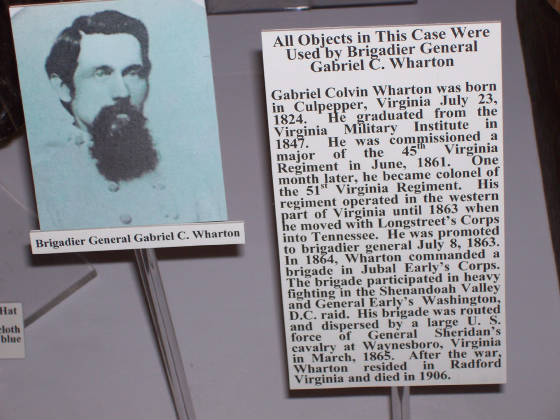
| General Gabriel C. Wharton |
|
| General Gabriel C. Wharton Display at Fort Worth |
Gabriel Colvin Wharton
(Confederate)
Biographical data and notes:
- Born Jul 23 1824 in Culpeper County, VA
- Pre-enlistment
occupation: Engineer
- Gabriel Colvin Wharton died on May 12 1906
- Grad VMI, 1847. Involved in mining business, and
elected to state senate. Buried in family cemetery, Radford, VA
Enlistment:
-
Enlisted on Jul 8 1863 as a General Officer
Mustering information:
- Promoted to Major (Full, Vol)
(date not indicated) (45th VA Inf (est day)
- Commissioned into Field and Staff, 51st Infantry (Virginia) on Jun 17 1861
- Commissioned into Field and Staff, 45th Infantry (Virginia) on Jul 15 1861
- Discharged due to promotion from 45th Infantry (Virginia) on Aug 15 1861 (Estimated day of commission and discharge)
- Commissioned into
51st Infantry (Virginia) on Aug 15 1861
Promotions:
- Promoted to Colonel (Full, Vol) on Aug 15 1861
-
Promoted to Brig-Gen (Full, Vol) on Jul 8 1863
Sources: The Virginia Regimental Histories Series, (1987); Confederate Military History (1987);
National Archives.
Recommended Reading:
Generals in Gray Lives of the Confederate Commanders. Description: When Generals in Gray was published in 1959, scholars
and critics immediately hailed it as one of the few indispensable books on the American Civil War. Historian Stanley Horn,
for example, wrote, "It is difficult for a reviewer to restrain his enthusiasm in recommending a monumental book of this high
quality and value." Here at last is the paperback edition of Ezra J. Warner’s magnum opus with its concise, detailed
biographical sketches and—in an amazing feat of research—photographs of all 425 Confederate generals. Continued
below.
The only exhaustive
guide to the South’s command, Generals in Gray belongs on the shelf of anyone interested in the Civil War. RATED 5 STARS!
Recommended Reading: Four Years in the Stonewall Brigade
(American Civil War Classics) (412 pages) (University of South Carolina Press). Description: From his looting of farmhouses during the Gettysburg campaign and robbing of fallen Union soldiers as
opportunity allowed to his five arrests for infractions of military discipline and numerous unapproved leaves, John O. Casler’s
actions during the Civil War made him as much a rogue as a Rebel. Though he was no model soldier, his forthright confessions
of his service years in the Army of Northern Virginia stand among the most sought after and cited accounts by a Confederate
soldier. First published in 1893 and significantly revised and expanded in 1906, Casler’s Four Years in the Stonewall
Brigade recounts the truths of camp life, marches, and combat. Moreover, Casler’s recollections provide an unapologetic
view of the effects of the harsh life in Stonewall’s ranks on an average foot soldier and his fellows. Continued below.
A native of Gainesboro, Virginia, with an inherent wanderlust and thirst
for adventure, Casler enlisted in June 1861 in what became Company A, 33rd Virginia Infantry, and participated in major campaigns
throughout the conflict, including Chancellorsville and Gettysburg.
Captured in February 1865, he spent the final months of the war as a prisoner at Fort
McHenry, Maryland. His postwar narrative recalls the
realities of warfare for the private soldier, the moral ambiguities of thievery and survival at the front, and the deliberate
cruelties of capture and imprisonment with the vivid detail, straightforward candor, and irreverent flair for storytelling
that have earned Four Years in the Stonewall Brigade its place in the first rank of primary literature of the Confederacy.
This edition features a new introduction by Robert K. Krick chronicling Casler’s origins and his careers after the war
as a writer and organizer of Confederate veterans groups. "A must have for researchers, buffs, and American historians...General
"Stonewall" Jackson and his brigade shall forever have a place in the annals of world history."
Recommended Viewing: The Civil War - A Film by
Ken Burns. Review: The Civil War - A Film by Ken Burns is the most successful public-television miniseries in
American history. The 11-hour Civil War didn't just captivate a nation, reteaching to us our history in narrative
terms; it actually also invented a new film language taken from its creator. When people describe documentaries using the
"Ken Burns approach," its style is understood: voice-over narrators reading letters and documents dramatically and stating
the writer's name at their conclusion, fresh live footage of places juxtaposed with still images (photographs, paintings,
maps, prints), anecdotal interviews, and romantic musical scores taken from the era he depicts. Continued below.
The Civil War uses all of these devices to evoke atmosphere and resurrect an event that many knew
only from stale history books. While Burns is a historian, a researcher, and a documentarian, he's above all a gifted storyteller,
and it's his narrative powers that give this chronicle its beauty, overwhelming emotion, and devastating horror. Using the
words of old letters, eloquently read by a variety of celebrities, the stories of historians like Shelby Foote and rare, stained
photos, Burns allows us not only to relearn and finally understand our history, but also to feel and experience it. "Hailed
as a film masterpiece and landmark in historical storytelling." "[S]hould be a requirement for every
student."
Recommended Reading:
Generals in Blue: Lives of the Union Commanders (Hardcover). Description: More than forty years after its original
publication, Ezra J. Warner’s Generals in Blue is now available in paperback for the first time. Warner’s classic
reference work includes intriguing biographical sketches and a rare collection of photos of all 583 men who attained the
rank of general in the Union Army. Here are the West Point graduates and the political appointees; the gifted, the mediocre,
and the inexcusably bad; those of impeccable virtue and those who abused their position; the northern-born, the foreign-born,
and the southerners who remained loyal to the Union. Continued below.
Warner’s valuable introduction
discusses the criteria for appointment and compares the civilian careers of both Union and Confederate generals, revealing striking differences in the two groups. Generals
in Blue is that rare book—an essential volume for scholars, a prized item for buffs, and a biographical dictionary that
the casual reader will find absorbing.
Recommended
Reading: Civil War High Commands (1040 pages) (Hardcover). Description: Based on nearly five decades
of research, this magisterial work is a biographical register and analysis of the people who most directly influenced the
course of the Civil War, its high commanders. Numbering 3,396, they include the presidents and their cabinet members, state
governors, general officers of the Union and Confederate armies (regular, provisional, volunteers,
and militia), and admirals and commodores of the two navies. Civil War High Commands will become a cornerstone
reference work on these personalities and the meaning of their commands, and on the Civil War itself. Continued below...
Errors of fact and interpretation concerning the high commanders are
legion in the Civil War literature, in reference works as well as in narrative accounts. The present work brings together
for the first time in one volume the most reliable facts available, drawn from more than 1,000 sources and including the most
recent research. The biographical entries include complete names, birthplaces, important relatives, education, vocations,
publications, military grades, wartime assignments, wounds, captures, exchanges, paroles, honors, and place of death and interment.
In addition to its main component, the biographies, the volume
also includes a number of essays, tables, and synopses designed to clarify previously obscure matters such as the definition
of grades and ranks; the difference between commissions in regular, provisional, volunteer, and militia services; the chronology
of military laws and executive decisions before, during, and after the war; and the geographical breakdown of command structures.
The book is illustrated with 84 new diagrams of all the insignias used throughout the war and with 129 portraits of the most
important high commanders. It is the most comprehensive volume to date...name any Union or Confederate general--and it can be
found in here. [T]he photos alone are worth the purchase. RATED FIVE STARS by americancivilwarhistory.org
|
