|
Thomas' Legion of Indians and Highlanders
Thomas' Legion of Indians and Highlanders
Organization of North Carolina's Civil War
Legion
| The Thomas Legion |
|
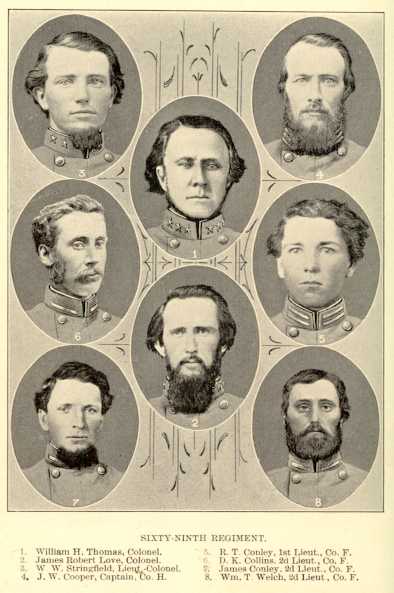
| Selected officers of the Thomas Legion |
Organization
Thomas’ Legion, or Thomas' Legion of
Indians and Highlanders, was the largest single military unit organized in North Carolina during the American Civil War (1861-1865).
This legion, which would initially field some 2,500 soldiers, consisted of an entire command of infantry, cavalry, and artillery, and was sometimes referred to as Love's Regiment or the Sixty-ninth North Carolina Infantry Regiment (though not found or
recorded on any official document).
Thomas' Legion (aka 69th North
Carolina Regiment) should not be confused with the 69th North Carolina Regiment-7th Cavalry (aka 69th North Carolina Cavalry Regiment or 69th North Carolina State
Troops), which was initially known as the 14th North Carolina Cavalry Battalion before being enlarged to a cavalry regiment. Although attributed to grammar,
the Thomas Legion organization was officially designated and recorded as Thomas' Legion (or Thomas' Legion of Indians and Highlanders) and not
Thomas's Legion, so while researching this unit, the different designations will assist the student.
Unlike the Civil War regiment with its 1100 soldiers, the legion was
a much larger and more comprehensive fighting force and resembled a brigade. On February 20, 1863, while at Strawberry Plains, Thomas' Legion recorded
"2556 Aggregate Present and Absent." (Official Records of the Union and Confederate Armies, Series 1,
Volume 23, part 2, p. 644). The unit's two thousand five hundred officers and men, including 400 Cherokees, were distributed in infantry, cavalry, and artillery. Its artillery battery, John T. Levi's Light Artillery Battery (aka Louisiana Tigers or Barr's Battery), formerly served in the Virginia State Line Artillery before being added
to the Thomas Legion on April 1, 1863.
Although it was an independent command, the Thomas Legion would initially
report directly to Brigadier General Henry Heth prior to the exigencies of war requiring its regiment to be detached
and moved into the Shenandoah Valley in May of 1864. (O.R., 1, Vol. 16, pt. II, p. 985, O.R., 1, Vol. 20, pt. II, p. 466, O.R., 1, Vol. 20, pt. II, p. 412, and O.R., 1, Vol. 20, pt. II, p. 415). The unit served in the Army of Tennessee, Department of East Tennessee, Western District of North Carolina (aka District of Western North Carolina), Department of Western Virginia, and its regiment was under Lt. Gen. Jubal
"Old Jube" Early in the Army of the Valley during the Valley Campaigns of 1864.
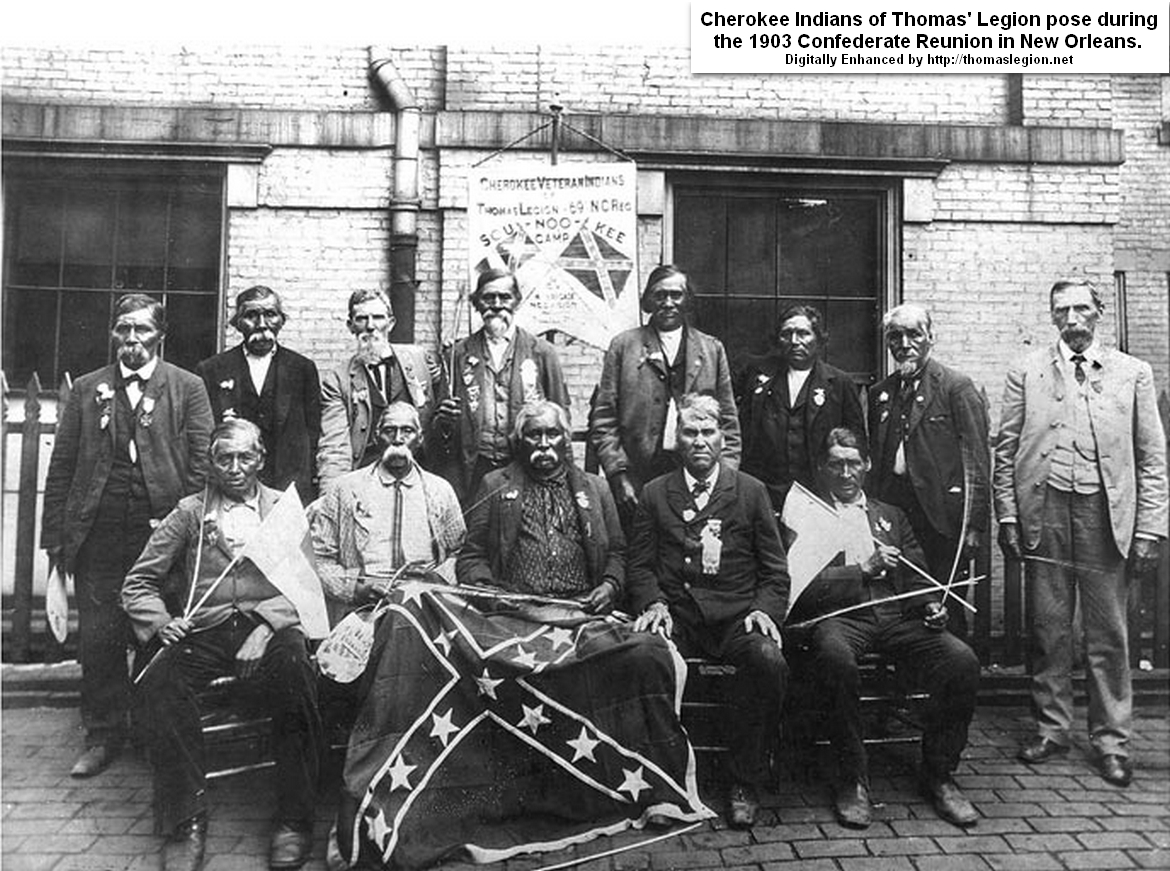
| Thomas Legion's Cherokee Veterans |
|
| 1903 New Orleans Confederate Reunion. NPS. |
(About) The following caption appears under the original image: Above is shown the last photograph ever
taken of the remaining members of the famous Thomas Legion, composed of Cherokee Indians in the Confederate Army. The photograph
was made in New Orleans at the time of the New Orleans Reunion of Confederate Veterans. The inscription on the banner in the
photo is as follows: Cherokee Veteran Indians of Thomas Legion. 69 N. C. Regiment. Suo-Noo-Kee Camp U. C. V. 4th Brigade,
N. C. Division. Reading from left to right, those in the picture are: front row, 1 Young Deer; 2 unidentified; 3 Pheasant;
4 Chief David Reed; 5 Sevier Skitty; back row, 1 the Rev. Bird Saloneta; 2 Dickey Driver; 3 Lieut. Col. W. W. Stringfield
of Waynesville; 4 Lieutenant Suatie Owl; 5 Jim Keg; 6 Wesley Crow; 7 unidentified; 8 Lieutenant Calvin Cagle. All of these
men are now dead with the exception of Sevier Skitty, who lives one mile from Cherokee. Lieut. Col. Stringfield and Lieut.
Cagle were white officers of the legion. Names of the men in the photograph were furnished by James R. Thomas of Waynesville,
son of the late Col. W. H. Thomas, who commanded the Thomas Legion. This band of Indians built the first road across the Great
Smoky Mountains.
During
the course of the conflict, the Thomas Legion served with the following brigade, division and corps generals
General Robert Ransom, Jr.: Graduated the United States Military Academy (West Point) in 1850.
General Gabriel Colvin Wharton: Virginia Military Institute graduate-class of 1847.
General Alfred Eugene Jackson: Unlike "Stonewall" Jackson, Alfred Jackson was nicknamed "Old Mudwall" Jackson. Prior to the war he was a farmer.
On November 23, 1864, "Mudwall" was relieved of his command and served as a staff officer. He had Colonel William H. Thomas
arrested and sought to court-martial him.
General Edmund
Kirby Smith: Commander of the Department of East Tennessee and Western North Carolina. He graduated West
Point in 1845 and was strongly opposed to allowing Thomas' Legion the ability to operate as an independent command.
General Simon
Bolivar Buckner: Graduated West Point 1844, Mexican War veteran, resigned commission in 1855, businessman, and commander of Kentucky State
Guard. Post-war: Governor of Kentucky, Vice-Presidential nominee in 1896.
General James Green Martin: Native North Carolinian, graduated West Point in 1840, and Mexican-American War veteran. He was nicknamed "Old One Wing", because he lost his arm in the Mexican-American
War. At the Battle of Churubusco in Mexico, his right arm was shattered by grapeshot and had to be amputated. Martin
was credited for organizing the Old North State's military prior to the first shot of the Civil War.
General John Crawford Vaughn: Native Tennessean
and Mexican-American War veteran.
General John Porter McCown: Graduated the United
States Military Academy in 1840.
General Daniel Smith Donelson: Native Tennessean,
graduated West Point in 1825, and died of natural causes in April 1863. See O.R., I, 23, II, 621, O.R., I, 23, II, 787, and O.R., I, 23, II, 644.
General John Stuart "Cerro Gordo" Williams. Lawyer, Mexican-American War, and politician.
He received his nom de guerre for heroic actions during the Battle of Cerro Gordo.
General Jubal Anderson "Ole Jube" Early: Graduated West Point in 1837 and was a veteran of the Mexican-American War. He was
affectionately nicknamed "Old Jube."
General Henry Heth: Graduated West Point in 1847. His division made first contact at Gettysburg. As an independent command, Thomas' Legion initially reported directly to Heth.
General Robert Emmet Rodes: VMI graduate-class of 1848. He was killed on September 19, 1864, in the Battle of Opequon.
General John C. Breckinridge: He was the fourteenth Vice President of the United States
and a veteran of the Mexican-American War. In early 1865 General Breckinridge was appointed as Secretary of War in the Cabinet
of the Confederate States of America. He held this post until the end of the war. John Breckinridge was also the cousin to
Mary Todd Lincoln, the wife of President Lincoln.
General William E. "Grumble" Jones: West Point-class of 1848, and classmate of Union General John Buford. General Jones was killed
on 5 June 1864, during the Battle of Piedmont.
General James Longstreet: West Point-class
of 1842. As a major he fought in the Mexican-American War. General Robert E. Lee referred to Longstreet as his "Old War Horse."
General Braxton Bragg: Native North Carolinian. Graduated West Point 1837, fought in the Seminole and Mexican Wars. He remains the most controversial
Confederate general. He instructed Colonel Thomas to raise two additional Cherokee companies in November of 1863,. This allowed
a total of 4 Cherokee companies which would become known as the Cherokee Battalion (O.R., 1, 49, pt. 2, p. 754).
| Thomas' Legion of Indians and Highlanders |
|
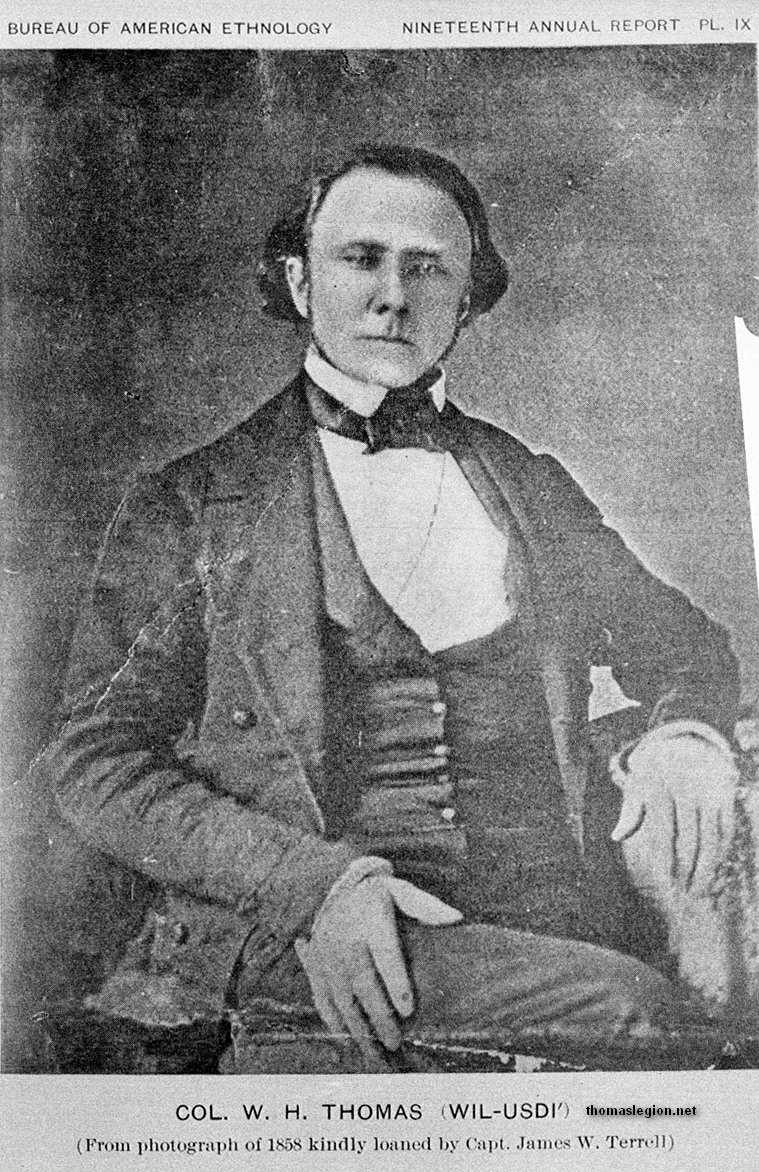
| Senator William Holland Thomas, 1858, retouched. |
The
69th North Carolina Regiment was initially known as the "Highland Rangers" and 1st Regiment, Thomas’ Legion. While there
are 75 references to "Thomas' Legion" in the Official Records of the Union and Confederate Armies, the unit operated under
various official and even unofficial designations. With these various designations came numerous responsibilities.
The following is an incomplete
list of the many official and unofficial designations:
Highland
Rangers, Provost Guards, Provisional Force, Partisan Rangers, Home Guards, Love’s Regiment, 69th North Carolina Infantry
Regiment, 69th North Carolina Regiment, McKamy's Battalion, Thomas' Legion Volunteers, 1st Battalion-Thomas' Legion, Walker's Battalion (80th
Battalion), Walker's Regiment, Thomas’ Regiment-North Carolina, Thomas’ Regiment-North Carolina Volunteers, and
1st Regiment-Thomas’ Legion, Thomas' Legion of Indians and Highlanders, and Thomas' Legion of Indians and Mountaineers.
The
Cherokees of the Thomas Legion also operated under various unofficial designations: Junaluska Zouaves, Cherokee Battalion
(O.R., 1, 49, pt. 2, p. 754), and Cherokee Companies. The sappers were also referred to as the “Pioneer
Companies.” There was also John T. Levi's Light Artillery Battery, which was later referred to as Barr's
Light Artillery Battery. Colonel Thomas even recruited 20 Cherokee Bodyguards, which he had on occasion called his Life Guard.
The constant shifting of the unit's
components makes a complete count of the Thomas Legion rather difficult. Although Companies A and L of the 16th North
Carolina Infantry transferred to Thomas’ Legion, some of the legion’s companies were transferred
to the 39th North Carolina Regiment and to various Tennessee cavalry regiments. Later, many companies were transferred back
to the Thomas Legion. One count has Thomas’ Legion at 2,800, but it is doubtful that on any occasion the legion mustered
more than "2,556."
During the last months of
the Civil War, Confederate General Martin (O.R.,
1, 49, pt. 1, p. 1048), Union General Stanley (O.R.,1, 49,
pt. II, p. 309), and Lt. Col. Stringfield (Histories of the Several Regiments and
Battalions from North Carolina in the Great War 1861-1865, Volume 3, p. 761) recorded almost the exact strength
for the Thomas Legion. Apart wartime attrition
from deaths, diseases, wounds, and imprisonment (prisoners of
war) sources show that most of the Thomas Legion deserters had rejoined the legion. Although desertion wasn't a
major problem in this legion, many of its deserters had returned to Western North Carolina to perform
Home Guard duties, while others had defected the unit in order to return and protect their homes and families during
the area's anarchy. The desertions stemmed mainly due to the legion having been formed with the promise to defend East Tennessee
and the Southern Appalachian Mountains. (See Thomas's Civil War Strategy.)
Its sappers had enlisted as masons,
engineers, carpenters, black smiths and gun smiths, but when Brig. Gen. Alfred E. Jackson, aka "Old Mudwall," demanded that the Pioneer Company take
up arms, it too promoted desertion. James W. Terrell would even write to Governor Zebulon Vance
and state that the desertions were the direct result of General A. E. Jackson’s complete disregard and disrespect for
the Thomas Legion's soldiers. February 22, 1864,
North Carolina Division of Archives and History.
Recommended Reading:
Storm in the Mountains: Thomas' Confederate Legion of Cherokee Indians and Mountaineers (Thomas' Legion: The
Sixty-ninth North Carolina Regiment). Description: Vernon H. Crow, Storm in the Mountains,
dedicated an unprecedented 10 years of his life to this first yet detailed history of the Thomas Legion. But
it must be said that this priceless addition has placed into our hands the rich story of an otherwise forgotten era of
the Eastern Cherokee Indians and the mountain men of both East Tennessee and western North Carolina who would fill the
ranks of the Thomas Legion during the four year Civil War. Crow sought out every available primary and secondary source by traveling to several states
and visiting from ancestors of the Thomas Legion to special collections, libraries, universities, museums, including
the Museum of the Cherokee, to various state archives and a host of other locales for any material on the unit in
order to preserve and present the most accurate and thorough record of the legion. Crow, during his exhaustive fact-finding, was
granted access to rare manuscripts, special collections, privately held diaries, and never before seen nor published photos
and facts of this only legion from North Carolina. Crow remains absent from the text as he gives a readable
account of each unit within the legion's organization, and he includes a full-length roster detailing each of the men who
served in its ranks, including dates of service to some interesting lesser known facts.
Storm in the Mountains, Thomas' Confederate Legion of Cherokee Indians and
Mountaineers is presented in a readable manner that is attractive to any student and reader of American history, Civil
War, North Carolina studies, Cherokee Indians, ideologies and sectionalism, and I would be remiss without including the
lay and professional genealogist since the work contains facts from ancestors, including grandchildren, some of which
Crow spent days and overnights with, that further complement the legion's roster with the many names,
dates, commendations, transfers, battle reports, with those wounded, captured, and killed, to lesser yet interesting
facts for some of the men. Crow was motivated with the desire to preserve history
that had long since been overlooked and forgotten and by each passing decade it only sank deeper into the annals of obscurity.
Crow had spent and dedicated a 10 year span of his life to full-time research
of the Thomas Legion, and this fine work discusses much more than the unit's formation, its Cherokee
Indians, fighting history, and staff member narratives, including the legion's commander, Cherokee chief and Confederate
colonel, William Holland Thomas. Numerous maps and photos also allow the
reader to better understand and relate to the subjects. Storm
in the Mountains, Thomas' Confederate Legion of Cherokee Indians and Mountaineers is highly commended, absolutely
recommended, and to think that over the span of a decade Crow, for us, would meticulously research the unit and
present the most factual and precise story of the men, the soldiers who formed, served, and died in the famed Thomas
Legion.
Recommended Reading:
North Carolina Troops,
1861-1865: A Roster (Volume XVI: Thomas's Legion) (Hardcover, 537 pages), North Carolina Office of Archives and
History (2008). Description: The volume begins with an authoritative 246-page history of Thomas's Legion. The history, including
Civil War battles and campaigns, is followed by a complete roster and service records of the field officers, staff, and
troops that served in the legion. A thorough index completes the volume.
Volume XVI of North Carolina Troops: A Roster contains the history and roster of the most unusual North Carolina
Confederate Civil War unit, significant because of the large number of Cherokee Indians who served in its ranks. Thomas's
Legion was the creation of William Holland Thomas, an influential businessman, state legislator, and Cherokee chief. He initially raised
a small battalion of Cherokees in April 1862, and gradually expanded his command with companies of white soldiers raised in
western North Carolina,
eastern Tennessee, and Virginia.
By the end of 1862, Thomas's Legion comprised an infantry regiment and a battalion of infantry and cavalry. An artillery battery
was added in April 1863. Furthermore, in General Early's Army of the Valley, the Thomas Legion was well-known for its fighting
prowess. It is also known for its pivotal role in the last Civil War battle east of the Mississippi
River. The Thomas Legion mustered more than 2,500 soldiers and it closely resembled a brigade. With troop roster, muster records, and Compiled Military Service Records (CMSR) this volume
is also a must have for anyone interested in genealogy and researching Civil War ancestors. Simply stated, it is an outstanding
source for genealogists.
Recommended
Reading: Storm in the Mountains: Thomas' Confederate Legion of Cherokee Indians and Mountaineers (Thomas' Legion:
The Sixty-ninth North Carolina Regiment). Description: Vernon H. Crow, Storm in the
Mountains, spent 10 years conducting extensive Thomas Legion's research. Crow was granted access to rare
manuscripts, special collections, and privately held diaries which add great depth to this rarely discussed Civil War
legion. He explores and discusses the unit's formation, fighting history, and life of the legion's commander--Cherokee
chief and Confederate colonel--William Holland Thomas. Continued below...
Numerous maps
and photographs allow the reader to better understand and relate to the subjects discussed. It also contains rosters
which is an added bonus for researchers and genealogists. Crow, furthermore, left no stone unturned while examining the
many facets of the Thomas Legion and his research is conveyed on a level that scores with Civil War students and scholars
alike.
Recommended Viewing: The Civil War - A Film by Ken Burns. Review: The
Civil War - A Film by Ken Burns is the most successful public-television miniseries in American history. The 11-hour Civil War didn't just captivate a nation,
reteaching to us our history in narrative terms; it actually also invented a new film language taken from its creator. When
people describe documentaries using the "Ken Burns approach," its style is understood: voice-over narrators reading letters
and documents dramatically and stating the writer's name at their conclusion, fresh live footage of places juxtaposed with
still images (photographs, paintings, maps, prints), anecdotal interviews, and romantic musical scores taken from the era
he depicts. Continued below...
The Civil War uses all of these devices to evoke atmosphere and resurrect an event that many knew
only from stale history books. While Burns is a historian, a researcher, and a documentarian, he's above all a gifted storyteller,
and it's his narrative powers that give this chronicle its beauty, overwhelming emotion, and devastating horror. Using the
words of old letters, eloquently read by a variety of celebrities, the stories of historians like Shelby Foote and rare, stained
photos, Burns allows us not only to relearn and finally understand our history, but also to feel and experience it. "Hailed
as a film masterpiece and landmark in historical storytelling." "[S]hould be a requirement for every
student."
Recommended
Reading: The
Life of Johnny Reb: The Common Soldier of the Confederacy (444 pages) (Louisiana State University Press)
(Updated edition: November 2007) Description: The Life of Johnny Reb does not merely describe the battles and skirmishes fought by
the Confederate foot soldier. Rather, it provides an intimate history of a soldier's daily life--the songs he sang, the foods
he ate, the hopes and fears he experienced, the reasons he fought. Wiley examined countless letters, diaries, newspaper accounts,
and official records to construct this frequently poignant, sometimes humorous account of the life of Johnny Reb. In a new
foreword for this updated edition, Civil War expert James I. Robertson, Jr., explores the exemplary career of Bell Irvin Wiley,
who championed the common folk, whom he saw as ensnared in the great conflict of the 1860s. Continued below...
About Johnny Reb:
"A Civil War
classic."--Florida Historical Quarterly
"This book
deserves to be on the shelf of every Civil War modeler and enthusiast."--Model Retailer
"[Wiley] has
painted with skill a picture of the life of the Confederate private. . . . It is a picture that is not only by far the most
complete we have ever had but perhaps the best of its kind we ever shall have."--Saturday Review of Literature
Recommended Reading: The
History Buff's Guide to the Civil War (400 pages). Description:
Exploring the Civil War can be fascinating, but with so many battles, leaders, issues, and more than 50,000 books on these
subjects, the task can also be overwhelming. Was Gettysburg the most important battle? Were Abraham Lincoln and Jefferson
Davis so different from each other? How accurate is re-enacting? Who were the worst commanding generals? Thomas R. Flagel
uses annotated lists organized under more than thirty headings to see through the powder smoke and straighten Sherman’s
neckties, ranking and clarifying the best, the worst, the largest, and the most lethal aspects of the conflict. Continued
below...
Major sections are fashioned around the following topics:
• Antebellum: Investigates the critical years before the war, in particular
the growing crises, extremists, and slavery.
• Politics: Contrasts the respective presidents and constitutions
of the Union and Confederacy, the most prominent politicians, and the most volatile issues of the times.
• Military Life: Offers insights into the world of the common soldiers,
how they fought, what they ate, how they were organized, what they saw, how they lived, and how they died.
• The Home Front: Looks at the fastest growing field in Civil War
research, including immigration, societal changes, hardships and shortages, dissent, and violence far from the firing lines.
• In Retrospect: Ranks the heroes and heroines, greatest victories
and failures, firsts and worsts.
• Pursuing the War: Summarizes Civil War study today, including films,
battlefield sites, books, genealogy, re-enactments, restoration, preservation, and other ventures.
From the antebellum years to Appomattox and beyond, The History Buff’s
Guide to the Civil War is a quick and compelling guide to one of the most complex and critical eras in American history.
Sources: Vernon H. Crow, Storm in the Mountains: Thomas' Confederate Legion
of Cherokee Indians and Mountaineers;; Official Records of the Union and Confederate Armies; Walter Clark, Histories of the
Several Regiments and Battalions from North Carolina in the Great War 1861-1865; National Archives and Records Administration;
North Carolina Office of Archives and History; National Park Service: American Civil War; National Park Service: Soldiers
and Sailors System; State Library of North Carolina; Moore's
Roster; Weymouth T. Jordan and Louis H. Manarin, North Carolina Troops, 1861-1865; D. H. Hill, Confederate Military
History Of North Carolina: North Carolina In The Civil War, 1861-1865; Christopher M. Watford, The Civil War in North
Carolina: Soldiers' and Civilians' Letters and Diaries, 1861-1865. Volume 2: The Mountains; Library of Congress; North Carolina Museum of History; William F. Fox, Regimental Losses in the American
Civil War; archives.gov; whitehouse.gov; bioguide.congress.gov; senate.gov.
|
