|
Battle of Vicksburg, Mississippi
Civil War Siege of Vicksburg History
Battle
of Vicksburg
Vicksburg
and the Civil War
Other Names: Second Battle of Vicksburg; Second
Vicksburg Campaign; Siege of Vicksburg; Operations Against Vicksburg; Vicksburg Campaign; Grant's Operations Against
Vicksburg
Location: Warren County, Mississippi
Campaign: Grant’s Operations Against Vicksburg (1863)
Date(s): May 18-July 4,
1863, Siege of Vicksburg (47 Days); March 29-July 4, 1863, Grant's Operations Against Vicksburg (97 Days)
Principal Commanders: Maj. Gen. Ulysses S. Grant [US]; Lt. Gen. John C. Pemberton [CS]
Forces Engaged: Army of the Tennessee, including reinforcements (US 77,000); Army of Vicksburg (CS 33,000)
Estimated Casualties May 18th-July 4th: 8,037 total (US
4,835; CS 3,202)
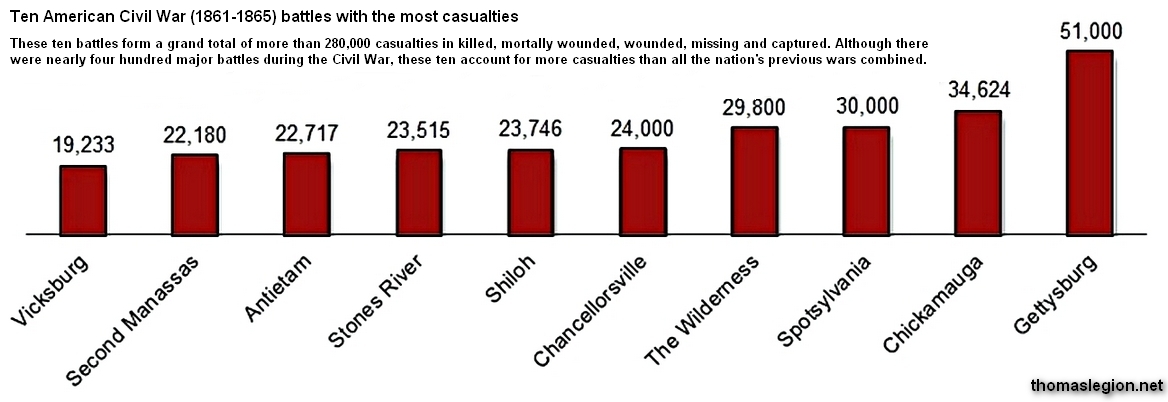
Estimated Casualties March 29th-July 4th: 19,233 total (US 10,142; CS 9,091)
Result(s): Union victory
Introduction:
Union Maj. Gen. Ulysses S. Grant and his command of 35,000 soldiers arrived on the coast of Mississippi and then pushed
his Army of the Tennessee inland and through the battlefields of Port Gibson, Raymond, Jackson, Champion Hill, and Big Black
River Bridge. At each location, as Lt. Gen. John C. Pemberton moved his Army
of Vicksburg in an attempt to check each Federal advance, it was swept from the field by the much larger Federal force. Routed
at each point, the Confederate force had nearly been destroyed at Big Black River Bridge, but with the bridge burned hastily by
the scattering Rebels, Pemberton's beleaguered army managed to limp back to the trenches and bombproofs of Vicksburg,
but Grant, a relentless soldier, pursued rigorously and soon the Siege of Vicksburg began in earnest. Disagreement over
the defense or abandonment of Vicksburg, the Confederacy's last remaining stronghold on the Mississippi River, would
divide the Confederate forces in the area. While one half under Pemberton, the Army of Vicksburg, would stay at
the fortress city for an Alamo style defense, Gen. Joseph Johnston, commanding the Army of the West, would
remain idle some 30 miles distant with a command that would grow to some 31,000 strong. While in the trenches
and bombproofs of the fortress city above the Mississippi, Pemberton now could field only 18,500 effectives from an aggregate
force that had recently numbered 33,000. For the next six weeks, while pleading daily with Richmond for more troops
before he could press any relief effort, Johnston would remain idle and belay any assistance for the besieged
Confederates at Vicksburg. Grant's army of 35,000, meanwhile, was quickly strengthened to 50,000, followed by additional
reinforcements which increased his readiness to some 77,000 effectives during June, thus making any possibility
of a successful move by Johnston an utter impossibility.
| Total Battle of Vicksburg Casualties |
|
| Battle of Vicksburg Total Killed, Wounded, and Missing |
| Battle of Vicksburg Map |
|
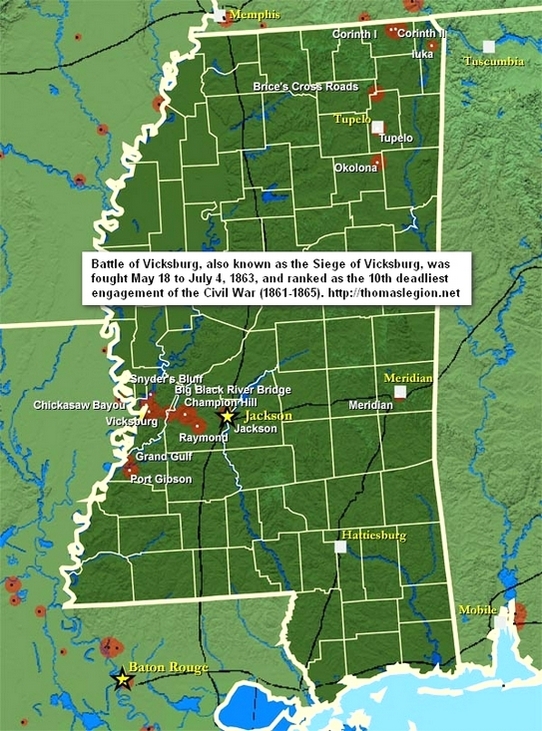
| Map showing location of Vicksburg Battlefield |
| Battle of Vicksburg Killed, Wounded, and Captured |

|
| Battle of Vicksburg Casualties, March 29 to July 4, 1863 |
The Confederate
army had pursued and fought the Union command only to be forced off the fields, and while the Rebel force had bloodied
the nose of the enemy, it had reeled and been crippled by chasing and engaging the larger, stronger Yankee contingent.
The Confederates were routed as they pressed the Federals on five battlefields while moving across Mississippi from May
1 to May 18, and as Jackson, the capital of Mississippi, capitulated during the process, Pemberton would move his
demoralized army into its Alamo, the Fortress of Vicksburg, where the tenth highest casualties of the Civil War would
be numbered. Here, for 47-days, while cannonading was exchanged daily between the armies and as 200-pound shells
soared and screamed across the terrain from both land and river batteries, Grant continued to extend his siege lines, tunnel
beneath the Confederate works and detonate a monstrous 2,200-pound mine, and even force hand-to-hand fighting by ordering
two Union assaults against Stockade Redan, May 19 and 22, which only resulted in staggering Federal losses and without one
inch of ground gained.
During the battle
and siege of Vicksburg, the aggressiveness of
Grant and Union determination were pitted against the stubbornness of Pemberton and sheer Southern mettle. The
worst kind of dog to pick a fight with is an injured, starving, miserable, and cornered dog, and that is exactly what
Grant had created as he rolled onto the scene and punished the Confederate army on five battlefields of Mississippi from
May 1 to May 18, and by forcing the injured enemy into the trenches and fieldworks on the bluffs of Vicksburg on the
18th, and then attacking it, would be like holding the rabid dog by the ears, for you didn't want to do it, but you sure didn't
want to let go.
Vicksburg,
being absent any reinforcements, was an utterly doomed city during Maj. Gen. Ulysses S. Grant's Siege of Vicksburg, May 18--July
4, 1863, which endured for 47-days. The Union siege of the Mississippi port locale was relentless and accompanied with daily
shelling from both land and river. The city was reduced to large heaps of rubble that emanated the pungent odor of a
modern-day trash dump. The inhabitants had transitioned from palatial mansions to living in some 500 bombproofs, caves
and large holes that had been burrowed in the bluffs and hills that laced the ruins, and were living off the
meat of dogs, mules, and snakes, as well as rats and other vermin that occasionally strayed into the trap. There were
so many caves and holes being occupied by the local citizenry that the Union soldiers referred to Vicksburg as Prairie
Dog Village.
"Vicksburg is so strong by nature and so well fortified that sufficient force cannot be brought
to bear against it to carry it by storm against the present Garrison. It must be taken by a regular siege or by starving out
the Garrison." Letter from Grant to Maj. Gen. Stephen A. Hurlbut, May 31, 1863
Grant's campaign was "one of the most brilliant in the world," said Lincoln, as Lee meanwhile
was opening the distance between his army and the entire State of Mississippi, because the Virginian had business
in the North at a familiar location named Gettysburg, a small town that would undoubtedly be unknown had it not
been for the 51,000 casualties that fell among its fields in July of 1863. Vicksburg would not receive assistance from Lee,
nor from any other army, because the commander of the Army of Northern Virginia had hoped that by pushing his massive army
into Union territory it would force Grant to abandon the ruinous port place and pursue him, and the other objective in
Pennsylvania was to forage for food and supplies in the abundant Northern fields and warehouses, and therefore grant
a much needed respite to the depleted crops just south of the Mason-Dixon.
In May and June of 1863, Maj.
Gen. Ulysses S. Grant’s armies converged on Vicksburg , investing the city and entrapping a Confederate army under Lt. Gen. John Pemberton. On July 4, Vicksburg surrendered after
prolonged siege operations. This was the culmination of one of the most brilliant military campaigns of the war. With
the loss of Pemberton’s army and this vital stronghold on the Mississippi, the Confederacy was effectively split in half, therefore fulfilling Gen. Winfield
Scott's Anaconda Plan and further tightening the noose on the Confederacy. Grant's successes in the West boosted
his reputation, leading ultimately to his appointment as General-in-Chief of the Union armies. , investing the city and entrapping a Confederate army under Lt. Gen. John Pemberton. On July 4, Vicksburg surrendered after
prolonged siege operations. This was the culmination of one of the most brilliant military campaigns of the war. With
the loss of Pemberton’s army and this vital stronghold on the Mississippi, the Confederacy was effectively split in half, therefore fulfilling Gen. Winfield
Scott's Anaconda Plan and further tightening the noose on the Confederacy. Grant's successes in the West boosted
his reputation, leading ultimately to his appointment as General-in-Chief of the Union armies.
The Confederate army suffered
3,202 in killed and wounded while Union casualties totaled 4,835 during the 47-day Siege of Vicksburg,
of which 4141, some 85%, of the Union losses occurred on the days of May 19 and 22, respectively. The list
of battles and casualties disclosed on this site for Grant's Operations Against Vicksburg total exactly 10,142
Union losses and 9,091 Confederate casualties, for a grand total of 19,233 casualties, therefore removing the guess work as
to which battles were fought and how many men perished on any given date.
Was it a battle or a siege?
Which dates constitute the Vicksburg Campaign? When was the battle and siege of Vicksburg? There were actually two
principal battles within the siege, such as when Grant moved a portion of his army out of the lines and pressed
the enemy fiercely on both May 19 and 22, which resulted in more than 85% of the Union casualties during the 47-day
siege. While the dates for the Battle of Vicksburg, May 18 to July 4, are generally universally agreed upon, the battles
inclusive of the dates are not, however. Since the battles within the Siege of Vicksburg vary so do the casualty
figures. Whereas the majority of the sources for the killed and wounded vary greatly for the 47-day investment and siege,
most sources seem to agree on the same 97-day timespan for Grant's Operations Against Vicksburg (March 29 to
July 4, 1863) and show the usual Union casualties of 10,142 and Confederate losses of 9,091. For most writers
to reconcile their dates and casualties for all of Grant's Operations, they tally their numbers for the
Siege of Vicksburg (47-days), but only indicate the National Park Service figures and leave it to the reader to imagine which
battles were included and how the respective Union and Confederate casualties were tabulated for the entire 97-days.
| Civil War and Battle of Vicksburg Bluffs |

|
| View of the Mississippi River from the Vicksburg Bluffs |
| Battle of Vicksburg, Mississippi |

|
| Vicksburg Siege Warfare and Life in bombproofs and caves |
| Battle of Vicksburg History |

|
| Union Cannon at Battle of Vicksburg |
On
this site will you receive reliable casualty figures for each battle during the 47-day Siege of
Vicksburg and also the casualty reports for both the Union and Confederate armies by battle, phase,
and operation, and finally the total numbers for all dates specified. An easy to read casualty list is included for quick
reference, which shows the killed, mortally wounded, wounded, missing, and captured for each army and action during the
Battle of Vicksburg and for Grant's Operations Against Vicksburg. Lastly, the final casualty tallies
and grand totals concur with all figures for the battle and operations against Fortress Vicksburg.
Consider the following
questions as you read about the account and capitulation of Vicksburg. How good was Lt. Gen. Grant's generalship? Was Confederate
Lt. Gen. John Pemberton really as inept as we have been led to believe? Which battle of the months-long campaign was decisive
and sealed the fate of the city? Why didn't Gen. Joseph Johnston move his army earlier in an attempt to break the
siege? Did Gen. Robert E. Lee have the authority to reinforce Vicksburg, if so, why didn't he come to the aid
of Vicksburg? How did the civilians deal with the constant bombardment and lack of food and supplies? What were the roles
of infantry, artillery, and cavalry in this critical campaign? How did the capitulation of Vicksburg affect the outcome
of the war? Was there any silver lining for the Confederacy with the loss, such as lessons learned?
| Battle of Vicksburg, Mississippi |

|
| Drawing of siege lines at Vicksburg, Mississippi |
Summary: Whereas Vicksburg was said to be a stronghold that
no army could ever conquer, a determined Ohioan by the name of General U.S. Grant thought otherwise. The Battle
of Vicksburg was a 47-day siege of the city (May 18--July 4, 1863) and was a part of Grant's Operations against
Vicksburg (March 29–July 4, 1863). While the subject is the Battle of Vicksburg, it is important to place
the action in context with its parent Vicksburg Campaign, which was an exhaustive effort to capture the City of Vicksburg,
a fortress city located high on the bluffs of the Mississippi River.
Maj. Gen. U.S. Grant's army of some 35,000 strong would arrive at Vicksburg only to swell its ranks to 77,000
men within weeks. He was opposed by Confederate Lt. Gen. John C. Pemberton's army that had been reduced from some 33,000 soldiers
to an effective fighting force of scarcely 18,500.
Fresh from five victories in the field the Union army converged on Vicksburg on May 18, 1863, encircling
and trapping Gen. John Pemberton's force, and after executing two failed assaults resulting in more than
4,000 Union casualties, the aggressive Grant reluctantly settled into a 47-day siege, which would end with the Confederate
surrender on July 4, 1863. Grant attempted the assaults, May 19 and 22, against Stockade Redan, and even detonated a
large mine under the Third Louisiana Redan, in a brutal attempt to break through the strong Confederate fieldworks. The assault
of May 22 was repulsed with 3,200 Union casualties and without the Federals gaining one inch of ground.
The two attacks accounted for more than 85% of the total Union casualties during the siege.
Failing to take the city by storm, Grant settled down to siege operations which consisted of digging approach
and parallel trenches to the main Confederate fortifications in an effort to destroy them by mining operations. The mines
were quite spectacular upon detonation and the subsequent fighting involved hand-to-hand fighting, hand grenades
being lobbed, and a Confederate push with bayonets to crack the stalemate with the determined Federals. The Union
navy was relentless in its cannonading during the siege, too, but while it assisted in the destruction of the palatial
mansions of Vicksburg, its guns had little effect on the more than 500 bombproofs and shelters that had been called home
to the citizens throughout the now ruinous port city.
Gen. Joseph Johnston,
commanding the Army of the West, would say almost daily for six weeks, in McClellan fashion, that he was collecting
more troops before he could press Gen. Grant in an attempt to relieve Gen. Pemberton and the Army of Vicksburg,
who had been forced and pinned down in the trenches of the port city on the bluffs by Grant. Johnston would send
messages to Pemberton from mid-May 1863 to the day that Pemberton surrendered to Grant on July 4, stating that he
was still raising a larger force to come to his aid, but, while Johnston had already massed an army of some 31,000 men, he
would stay beyond the shadow of Grant until Pemberton and his force of nearly 30,000 Confederates had already surrendered.
Johnston, as commanding general, had
refused to even attempt a feint and was therefore culpable for the fall of Vicksburg. Grant, however, had
successfully besieged the Confederate army, and after six weeks in which the soldiers and civilians of Vicksburg had
no food and supplies, and while their morale was lower than the deepest cave in the bluffs, and after enduring relentless daily
cannonading for six weeks, Pemberton reluctantly surrendered the city and his army on July 4, 1863.
During the Battle of Vicksburg, while engaged with Pemberton in the
siege, Grant remained cautious knowing that another Confederate force could press the rear of his army. He therefore
stationed one division in the vicinity of the Big Black River bridge and another reconnoitered as far north as Mechanicsburg,
both to act as a covering force. By June 10, the IX Corps, under Maj. Gen. John G. Parke, was transferred to Grant's command,
enlarging his army to some 77,000 veteran soldiers. This corps became the genesis of the rear guard whose mission was
to prevent Johnston, who was still gathering his forces at Canton, from interfering with the siege. Sherman was given command
by Grant of the command and Brig. Gen. Frederick Steele replaced him at the XV Corps on June 22.
Johnston began slowly moving in the direction of Vicksburg only to halt
his now 31,000 strong command at Big Black River on July 1, but, in what would now have been a difficult
engagement with Sherman who recently assumed command of the additional troops, Johnston stalled in hopes of further enlarging his
army. But it proved to be too late for the soldiers and civilians who had been reduced to eating rats and even shoe leather
in attempts to assuage the hunger pangs.
The commanders Grant and Pemberton would meet under an oak tree midway between
the lines and discuss surrender terms at 3:00 p.m. on July 3, 1863. The next morning, July 4, the Confederate
defenders marched out of their trenches, stacked their arms, and were paroled. After 47 days, the Siege of Vicksburg was over.
| Vicksburg Fortifications |

|
| Vicksburg Battlefield Map. NPS |
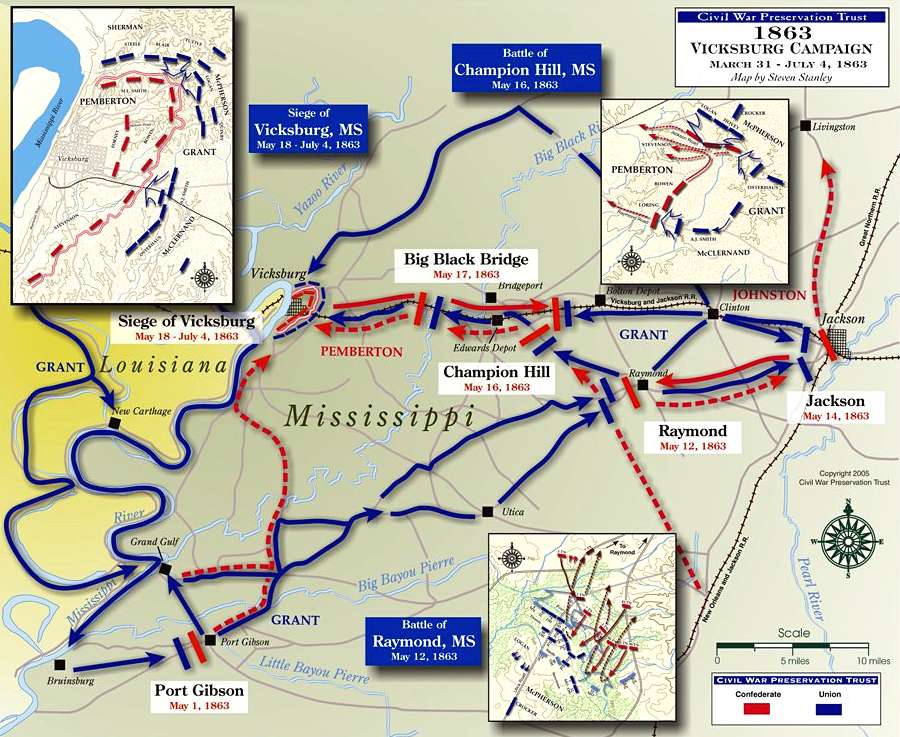
| Vicksburg Campaign Map, Support Civil War Trust |
|
| Vicksburg Campaign, aka Grant's Operations Against Vicksburg. Courtesy Civil War Trust, civilwar.org |
| The Civil War Battle of Vicksburg |
|
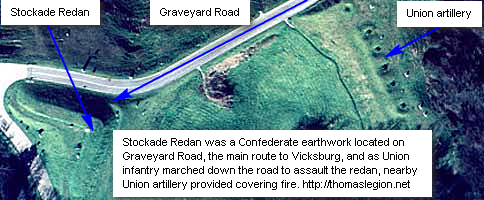
| Stockade Redan, Vicksburg Battlefield |
| Vicksburg Civil War Battlefield |

|
| What is a redoubt, redan, and lunette? |
(Left) What is a redoubt, redan,
and lunette? A redoubt is an enclosed square or rectangular earthwork with four fronts and four angles. A redan
is a triangular earthwork used to cover points to the rear such as bridges or river fords, and had two fronts and three angles.
A lunette was employed in much the same fashion as a redan, with two faces forming a salient angle, two flanks adjoining
the faces, and the rear open to interior lines. (Right) Stockade Redan was the sight
of the bloodiest fighting during the entire Siege of Vicksburg, and its salient, nearly 20-feet thick in places, was
a well-constructed earthwork that had been built for the fighting to come. Stockade Redan was constructed to protect
the Graveyard Road approach to Vicksburg, and the fortification was given its name because of the wall, or 'stockade,' of
poplar logs built across the Graveyard Road. Grant assaulted the redan twice, May 19 and 22, 1863, only to be repulsed with
heavy casualties. While more than 85% of the total Union casualties for the entire siege occurred on those two days, the Confederate
losses were light. Grant was well-known by the soldiers of both armies for
seizing the initiative and ordering the offensive, but while he would reluctantly settle in for a 47-day siege because
of the more than 4,000 casualties sustained at Stockade Redan, he would
soon direct his miners and sappers to tunnel and then to explode a massive mine under the 3rd Louisiana
Redoubt.
Grant's
Vicksburg Strategy: Grant's strategy, up to the capture of Grand Gulf, had been first to secure a base on the river
below Vicksburg and then to cooperate with Maj. Gen. Nathaniel P. Banks in capturing Port Hudson. After this he planned to
move the combined force against Vicksburg. Port Hudson, a Strong point on the Mississippi near Baton Rouge, was garrisoned
by Confederate troops after Farragut's withdrawal the previous summer. At Grand Gulf, Grant learned that Bank's investment
of Port Hudson would be delayed for some time. To follow his original plan would force postponement of the Vicksburg campaign
for at least a month, giving Pemberton invaluable time to organize his defense and receive reinforcements. From this delay
the Union Army could expect the addition of no more than 12,000 men. Grant now came to one of the most remarkable decisions
of his military career.
Information had been received that a new Confederate force was
being raised at Jackson, 45 miles east of Vicksburg. Against the advice of his senior officers, and contrary to orders from
Washington, Grant resolved to cut himself off from his base of supply on the river, march quickly in between the two Confederate
forces, and defeat each separately before they could join against him. Meanwhile, he would subsist his army from the land
through which he marched. The plan was well conceived, for in marching to the northeast toward Edwards Station, on the railroad
midway between Jackson and Vicksburg,
Grant's vulnerable left flank would be protected by the Big
Black River. Moreover, his real objective—Vicksburg or Jackson—would not be revealed immediately and could be
changed to meet events. Upon reaching the railroad, he could also sever Pemberton's communications with Jackson and the East.
It was Grant's belief that, although the Confederate forces would be greater than his own, this advantage would be offset
by their wide dispersal and by the speed and design of his march.
But this calculated risk was accompanied by grave dangers, of
which Grant's lieutenants were acutely aware. It meant placing the Union Army deep in alien country behind the Confederate
Army where the line of retreat could be broken and where the alternative to victory would not only be defeat but complete
destruction. The situation was summed up in Sherman's protest, recorded by Grant, "that I was putting myself in a position
voluntarily which an enemy would be glad to maneuver a year—or a long time—to get me."
The action into which Pemberton was drawn by the Union threat
indicated the keenness of Grant's planning. The Confederate general believed that the farther Grant campaigned from the river
the weaker his position would become and the more exposed his rear and flanks. Accordingly, Pemberton elected to remain on
the defensive, keeping his army as a protective shield between Vicksburg and the Union Army and awaiting an opportunity to
strike a decisive blow—a policy which permitted Grant to march inland unopposed.
With the arrival of Sherman's Corps from Milliken's Bend,
Grant's preparations were complete and, on May 7, the Union Army marched out from Grand Gulf to the northeast. His widely
separated columns moved out on a broad front concealing their objective. Grant's Army alone numbered 35,000 men upon
arrival at Vicksburg, May 18, 1863, but by adding Sherman's command, and the other units arriving almost daily, it increased
and numbered 77,000 strong when Vicksburg capitulated on July 4. To oppose him, Pemberton had available about 50,000
troops, but these were scattered widely to protect important points. On the day of Grant's departure from Grand Gulf, Pemberton's
defensive position was further complicated by orders from President Jefferson Davis that both Vicksburg and Port Hudson must
be held at all cost. The Union Army, however, was already between Vicksburg and Port Hudson and would soon be between Vicksburg
and Jackson. Forced into the already prepared trenches of Vicksburg after the Confederate defeat at the Battle of Big Black
River Bridge, Pemberton's force was reduced to 18,500 effectives.
In comparison with campaigns in the more thickly populated Eastern
Theater, where a more extensive system of roads and railroads was utilized to provide the tremendous quantities of food and
supplies necessary to sustain an army, the campaign of Grant's Western veterans ("reg'lar great big hellsnorters, same breed
as ourselves," said a charitable "Johnny Reb") was a new type of warfare. The Union supply train largely consisted of a curious
collection of stylish carriages, buggies, and lumbering farm wagons stacked high with ammunition boxes and drawn by whatever
mules or horses could be found. (Grant began his Wilderness campaign in Virginia the following year requiring over 56,000
horses and mules for his 5,000 wagons and ambulances, artillery caissons, and cavalry.) Lacking transportation, food supplies
were carried in the soldier's knapsack. Beef, poultry, and pork "requisitioned" from barn and smokehouse enabled the army
which had cut loose from its base to live for 3 weeks on 5 days' rations.
| Vicksburg Battlefield Map |
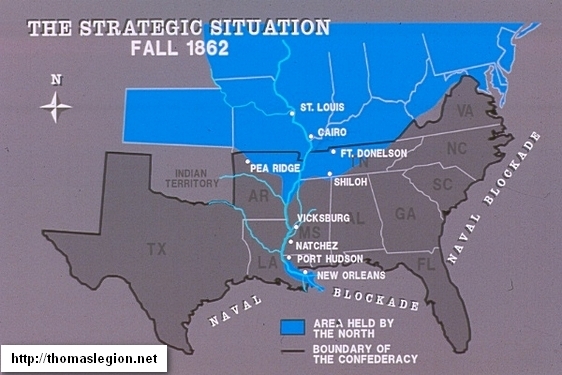
|
| Map of Battle of Vicksburg, Mississippi, and Strategic Situation of the Civil War in 1862 |
| Battle of Vicksburg Interpretive Marker |
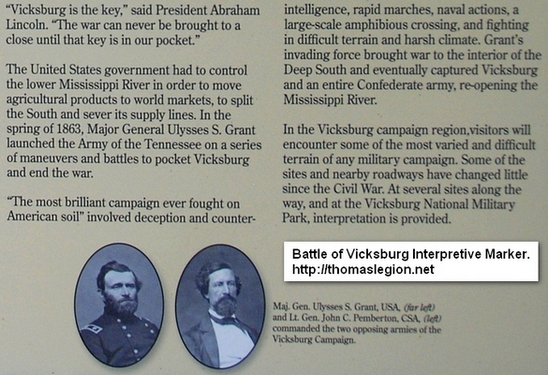
|
| Battle of Vicksburg History Marker |
| Battle of Vicksburg and Union Advance in 1863 |
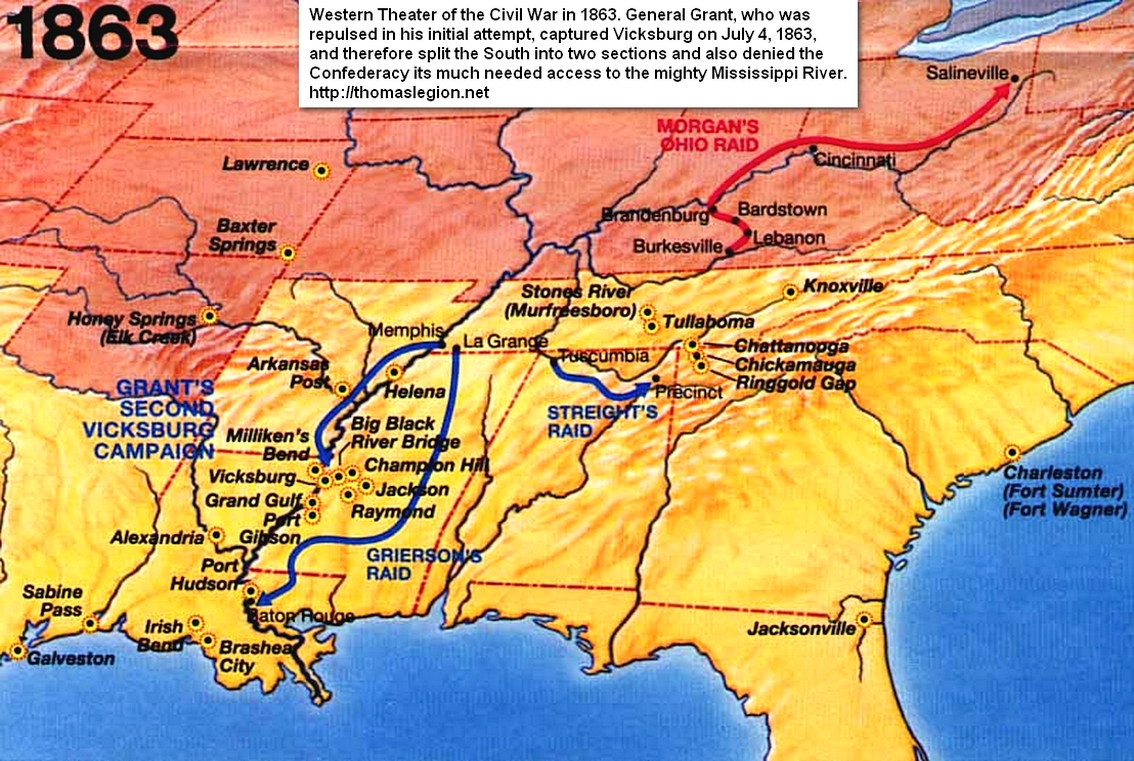
|
| High Resolution Map of Civil War Western Theater 1863, Battle of Vicksburg, and Union advance |
Grant's
Operations Against Vicksburg, March 29--July 4, 1863: On the banks of this, the greatest river in the world, according
to Confederate Brig. Gen. Stephen D. Lee, the most decisive and far-reaching battle of the war was fought. Here at Vicksburg
over one hundred thousand gallant soldiers and a powerful fleet of gunboats and ironclads in terrible earnestness for forty
days and nights fought to decide whether the new Confederate States should be cut in twain; whether the great river should
flow free to the Gulf, or should have its commerce hindered. The Federal army, commanded by Gen. U.S. Grant, and the Union
navy under Admiral Porter were victorious. The Confederate army was under the command of Gen. John Pemberton and numbered some
thirty thousand men. Although Pemberton's army was captured by Grant, the soldiers were soon paroled and returned to operate in other killing fields of the war. The loss on July 4,
1863, was a staggering blow from which the Confederacy never rallied.
Vicksburg was strategically
vital to the Confederates, because while under their control it blocked Union navigation down the Mississippi. Together
with control of the mouth of the Red River and of Port Hudson to the south, it allowed communication with the states west
of the river, upon which the Confederates depended extensively for horses, cattle and reinforcements. The natural defenses
of the city were ideal, earning it the nickname "The Gibraltar of the Confederacy."
Vicksburg was located on a high bluff overlooking a horseshoe-shaped bend
in the river, De Soto Peninsula, making it almost impossible to approach by ship. North and east of Vicksburg was the
Mississippi Delta (sometimes known as the Yazoo Delta), an area 200 miles north to south and up to 50 miles across, which was
an astonishingly complex network of intersecting waterways some of which were navigable by small steamboats. The regions between
modern rivers and bayous formed closed basins called backswamps, of which were, for all practical purposes, untamed wildernesses,
utterly impassable by a man on horseback or by any form of wheeled vehicle, and very difficult even for a man on foot. About
twelve miles up the Yazoo River were Confederate batteries and entrenchments at Haynes Bluff. The Louisiana land west of Vicksburg
was also difficult, with many streams and poor country roads, widespread winter flooding, and it was on the opposite side
of the river from the fortress.
The city had been under Union naval attack before. Admiral David Farragut
moved up the river after he captured New Orleans and on May 18, 1862, demanded the surrender of Vicksburg. Farragut had insufficient
troops to force the issue, and he moved back to New Orleans. He returned with a flotilla in June 1862, but their attempts
(June 26–28) to bombard the fortress into surrender failed. They shelled Vicksburg throughout July and fought some minor
battles with a few Confederate vessels in the area, but their forces were insufficient to attempt a landing, and they abandoned
attempts to force the surrender of the city. Farragut investigated the possibility of bypassing the fortified cliffs by digging
a canal across the neck of the river's bend, the De Soto Peninsula.
On June 28, Brig. Gen. Thomas Williams, attached to Farragut's command,
began digging work on the canal by employing local laborers and some soldiers. Many of the men fell victim to tropical diseases
and heat exhaustion, and the work was abandoned by July 24. Williams was killed two weeks later in the Battle of Baton Rouge.
In the fall of 1862, Maj. Gen. Henry W. Halleck was promoted from command
of the Western Theater to general-in-chief of all Union armies. On November 23, he stated to Grant his preference for
a major move down the Mississippi to Vicksburg. In Halleck's style, he left considerable initiative to design a campaign,
an opportunity that Grant seized. Halleck had received criticism for not moving promptly overland from Memphis, Tennessee,
to seize Vicksburg during the summer when he was in command on the scene. He believed that the Navy could capture the fortress
on its own, not knowing that the naval force was insufficiently manned with ground troops to finish the feat. What might have
achieved success in the summer of 1862 was no longer possible by November because the Confederates had amply reinforced the
garrison by that time.
Grant's army marched south down the Mississippi Central Railroad, making
a forward base at Holly Springs. He planned a two-pronged assault in the direction of Vicksburg. His principal subordinate,
Maj. Gen. William T. Sherman, was to advance down the river with four divisions (about 32,000 men) and Grant would continue
with the remaining forces (about 40,000) down the railroad line to Oxford, where he would wait for developments, hoping to
lure the Confederate army out of the city to attack him in the vicinity of Grenada, Mississippi. On the Confederate side,
forces in Mississippi were under the command of Lt. Gen. John C. Pemberton, an officer from Pennsylvania who chose to fight
for the South. Pemberton had approximately 12,000 men in Vicksburg and Jackson, Mississippi, and Maj. Gen. Earl Van Dorn had
approximately 24,000 at Grenada.
| Battle of Vicksburg Map |
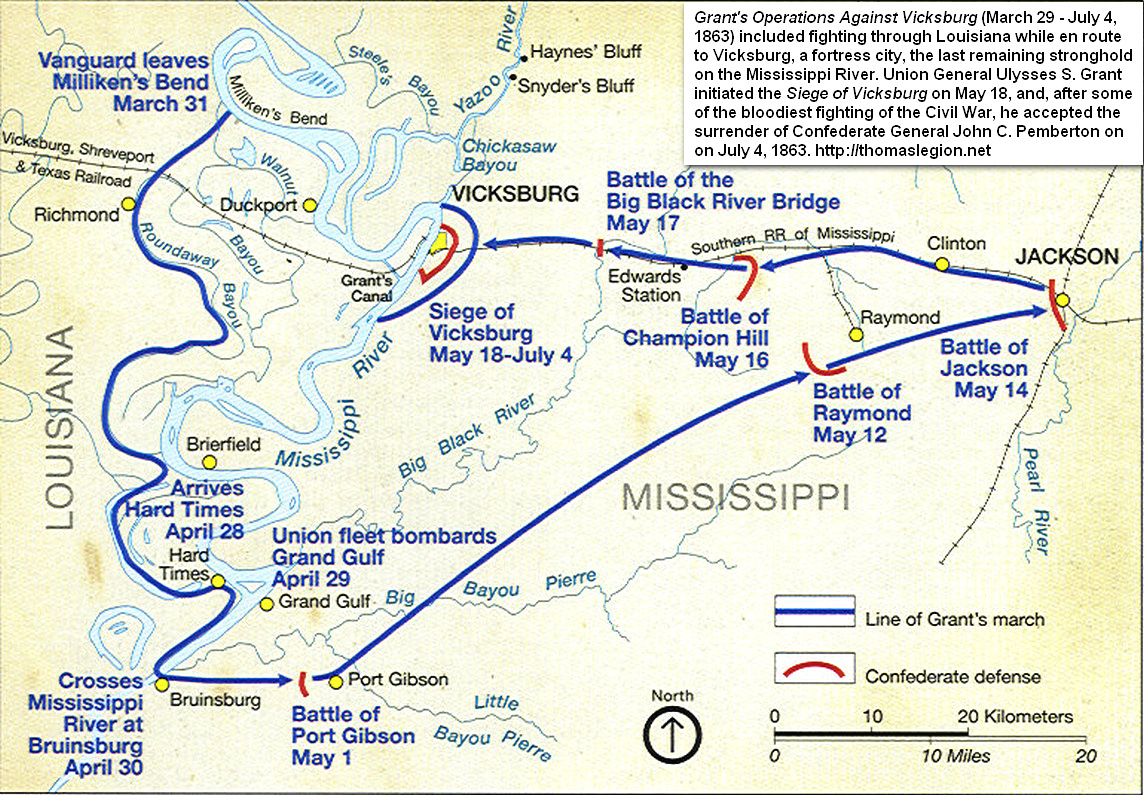
|
| Grant's Operations Against Vicksburg, which spanned 97-days, included the 47-day Siege of Vicksburg |
| Battle of Vicksburg Cannons |

|
| Federal Battery Sherman during Siege of Vicksburg. June 1863 |
| Battle of Vicksburg, Mississippi |

|
| South Fort was on the Confederate right flank below Vicksburg |
(Left) South Fort, overlooking the Mississippi, was located south and
on the flank of the Confederate defenses below Vicksburg. Interior of South Fort, showing the heavy type of Columbiads
and mortars which made up the battery here. The Columbiads, which were being retired by the Union army, were older smoothbore
guns that were found in greater quantity in the Confederate arsenal, and the mortars could lob a 200-pound shell
at a high trajectory making the interior of forts vulnerable. To protect themselves from the mortars, both sides would construct
bombproofs as a defense. As with any weapon of war, both distance and shielding between the soldier and threat is the
objective in the defense. (Right) Battery Sherman, on the Jackson Road,
before Vicksburg. The heavy guns of this Union siege battery were borrowed from the Federal gunboats and used against the
Confederate siege defenses. Settling down to a siege did not mean idleness for Grant’s army. Fortifications had to be
opposed to the formidable one of the Confederates and a constant bombardment kept up to silence their guns, one by one. It
was to be a drawn-out duel in which Pemberton, hoping for the long-delayed relief from Johnston, held out bravely against
starvation and even mutiny. For twelve miles the Federal lines stretched around Vicksburg, investing it to the river bank,
north and south. More than eighty-nine battery positions were constructed by the Federals. Battery Sherman was exceptionally
well built—not merely revetted with rails or cotton-bales and floored with rough timber, as lack of proper material
often made necessary. Gradually the lines were drawn closer and closer as the Federals moved up their guns to silence the
works that they had failed to take in May. At the time of the surrender Grant had more than 220 guns in position, mostly of
heavy caliber. By the 1st of July besieged and besiegers faced each other at a distance of half-pistol shot. Starving and
ravaged by disease, the Confederates had repelled repeated attacks which depleted their forces, while Grant, reinforced to
three times their number, was showered with supplies and ammunition that he might bring about the long-delayed victory which
the North had been eagerly awaiting since Chancellorsville.
Meanwhile, political forces were at work. President Abraham Lincoln had
long recognized the importance of Vicksburg; he wrote "Vicksburg is the key. The war can never be brought to a close until
the key is in our pocket." Lincoln also envisioned a two-pronged offensive, but one up and down the river. Maj. Gen. John
A. McClernand, a War Democrat politician, had convinced Lincoln that he could lead an army down the river and take Vicksburg.
Lincoln approved his proposal and wanted Maj. Gen. Nathaniel P. Banks to advance up river from New Orleans at the same time.
While McClernand began organizing regiments, sending them to Memphis, back
in Washington, D.C., Halleck was nervous about McClernand and gave Grant control of all troops in his own department. McClernand's
troops were split into two corps, one under McClernand, the other under Sherman. McClernand complained but to no avail. Grant
appropriated his troops, one of several maneuvers in a private dispute within the Union Army between Grant and McClernand
that would continue throughout the campaign.
For the Union, the spring of 1863 signaled the beginning of the final and
successful phase of the Vicksburg Campaign as Gen. Grant initiated the march of his Army of the Tennessee down the west side
of the Mississippi River, from Milliken's Bend to Hard Times, Louisiana. Leaving their encampments on March 29, 1863, Federal
soldiers took up the line of march and slogged southward over muddy terrain, building bridges and corduroy roads as they went.
Grant's column pushed first to New Carthage, then to Hard Times, where the infantrymen rendezvoused with the Union navy.
On April 16, while Grant's army marched south through Louisiana, part of the Union fleet,
commanded by Rear Admiral David Dixon Porter, prepared to run by the Vicksburg batteries. At 9:15 p.m., lines were cast off
and the vessels moved away from their anchorage above the city with engines muffled and all lights extinguished to conceal
their movement.
As the boats rounded De Soto Point, they were spotted by Confederate
lookouts who spread the alarm. Bales of cotton soaked in turpentine and barrels of tar lining the shore, were set on fire
by the Southerners to illuminate the river. Although each vessel was hit repeatedly, Porter's fleet successfully fought its
way past the Confederate batteries losing only one transport, and headed downriver to the rendezvous with Grant on the Louisiana
shore south of Vicksburg.
It was Grant's intention to force a crossing of the river at Grand Gulf,
and move on "Fortress Vicksburg" from the south. For five hours on April 29, the Union fleet bombarded the Grand Gulf defenses
in an attempt to silence the Confederate guns and prepare the way for a landing. The fleet, however, sustained heavy damage
and failed to achieve its objective. Admiral Porter declared, "Grand Gulf is the strongest place on the Mississippi." Not
wishing to have his transports loaded with troops attempt a landing in the face of enemy fire, Grant disembarked his command
and continued the march south along the levee.
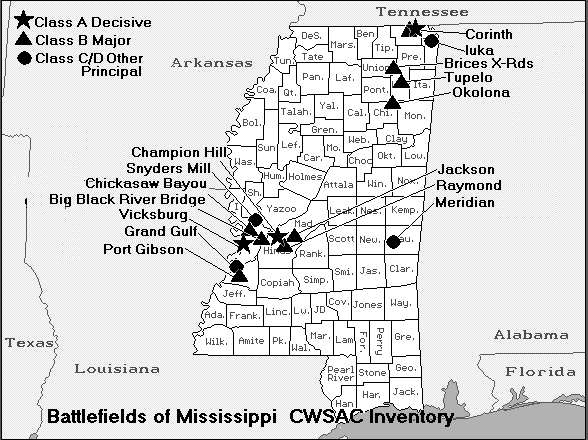
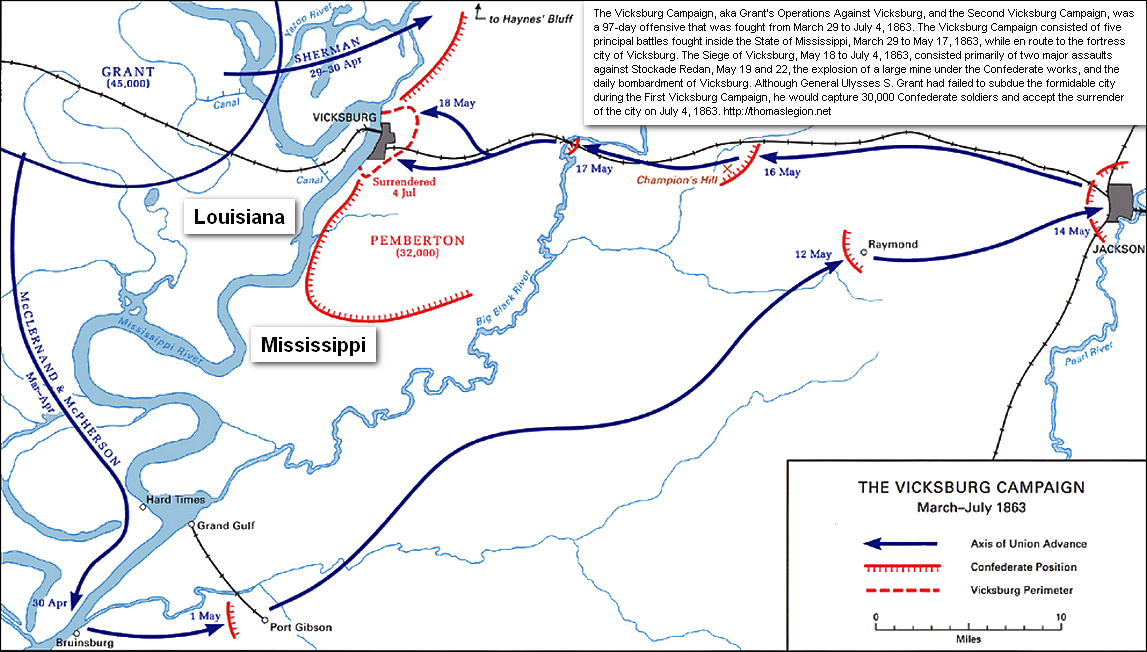
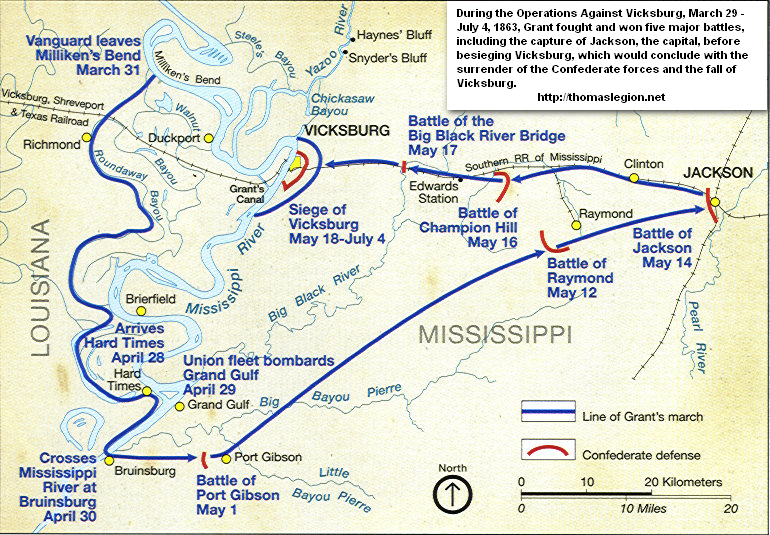
After crossing the Mississippi River south of Vicksburg at Bruinsburg and
driving northeast, Grant won battles at Port Gibson and Raymond and captured Jackson, the Mississippi state capital on May
14, 1863, forcing Pemberton to withdraw westward. Attempts to stop the Union advance at Champion Hill and Big Black River
Bridge were unsuccessful. Pemberton knew that the corps under Maj. Gen. William T. Sherman was preparing to flank him from
the north; he had no choice but to withdraw or be outflanked. Pemberton burned the bridges over the Big Black River and took
everything edible in his path, both animal and plant, as he retreated to the well-fortified, prepared defenses in the city
of Vicksburg.
| Battle of Vicksburg |
|
| Civil War Battle of Vicksburg Map |
| Hand Grenades at the Battle of Vicksburg |

|
| Hand Grenades during the Siege of Vicksburg |
| Siege of Vicksburg and Third Louisiana Redan |

|
| Hand-to-hand fighting at Vicksburg Crater |
| Third Louisiana Redan Mine |

|
| Vicksburg Crater and the Third Louisiana Redan History |
(About) June 25--26, 1863. Explosion of the mine under the Third Louisiana Redan would create a crater
measuring 12 feet deep and 40 feet wide. On June 25, 1863, as the entire Union line opened fire to prevent shifting of reinforcements, a
charge of 2,200 pounds of powder would be exploded beneath the Third Louisiana Redan, creating a large crater into which elements
of the 23rd Indiana and 45th Illinois raced from the approach trench. Anticipating this result, however, Confederate Gen.
Forney had prepared a second line of works in the rear of the fort where survivors of the blast and supporting regiments met
the Union attack to drive it back. More than 30 hours of hand-to-hand fighting would ensue before the Federals,
without gaining an advantage, withdrew on June 26. Because the siege of Vicksburg would continue
beyond the June 25 explosion, Union engineers would construct additional mines, but with no relief in sight or sound,
Gen. John C. Pemberton would commit to surrender, and Gen. Ulysses S. Grant would dine in Vicksburg on July 4, as he
had promised.
| Vicksburg Civil War History |

|
| U.S. Flag raised over Vicksburg Courthouse |
Undaunted by his failure at Grand Gulf, Grant moved farther south in search
of a more favorable crossing point. Looking now to cross his army at Rodney, Grant was informed that there was a good road
ascending the bluffs east of Bruinsburg. Seizing the opportunity, the Union commander transported his army across the mighty
river and onto Mississippi soil at Bruinsburg on April 30—May 1, 1863. In the early morning hours of April 30, infantrymen
of the 24th and 46th Indiana Regiments stepped ashore on Mississippi soil at Bruinsburg. The invasion had begun.
The landing was made unopposed and, as the men came ashore, a band aboard
the U.S.S. Benton struck up "The Red, White, and Blue." The Hoosiers were quickly followed by the remainder of the XIII Union
Army Corps and portions of the XVII Corps — 17,000 men. This landing was the largest amphibious operation in American
military history until the Allied invasion of Normandy during World War II. Elements of the Union army pushed inland and took
possession of the bluffs, thereby securing the landing area. By late afternoon of April 30, 17,000 soldiers were ashore and
the march inland began. Moving away from the landing area at Bruinsburg, the Federal soldiers rested and ate their crackers
in the shade of the trees on Windsor Plantation. Late that afternoon the decision was made to push on that night by a forced
march in hopes of surprising the Confederates and preventing them from destroying the bridges over Bayou Pierre. The Union
columns resumed the advance at 5:30 p.m., but instead of taking the Bruinsburg Road — the most direct road from the
landing area to Port Gibson — Grant's columns swung onto the Rodney Road, passing Bethel Church and marching through
the night.
On April 30, 1863, the Confederate brigades of brigadiers Martin Green and
Edward Tracy marched south along the Bruinsburg Road to contest the Union invasion of Mississippi. The next day, May 1, the
brigades of Brig. Gen. William Baldwin and Col. Francis Cockrell hastened out the Bruinsburg road to reinforce the Confederate
troops then heavily engaged with Grant's forces. Late in the afternoon of May 1, Baldwin's men would retire from the field
along the road into Port Gibson followed by the victorious Union soldiers.
Confederate troops were deployed to block both the Rodney and Bruinsburg
Roads west of Port Gibson. At the point of deployment, an interval of 2,000 yards separated the roads. The brigades of Tracy,
on the right, and Green, on the left, who was strengthened by four guns of the Pettus Flying Artillery, were separated by
a deep cane-choked ravine which prevented one flank from reinforcing the other flank. To do so, the Confederates had to march
back to the road junction. The "Y" intersection of the roads was thus the lateral avenue of movement for the Confederates.
Shortly after midnight the crash of musketry shattered the stillness as
the Federals stumbled upon Confederate outposts near the A. K. Shaifer house. The Battle of Port Gibson had begun. Union troops
immediately deployed for battle, and their artillery, which soon arrived, roared into action. A spirited skirmish ensued which
lasted until 3 a.m, May 1, with the Confederates holding their ground. For the next several hours an uneasy calm settled over
the woods and scattered fields as soldiers of both armies rested on their arms. Throughout the night the Federals gathered
their forces in hand and both sides prepared for the battle which they knew would come with the rising sun.
At dawn, Union troops began to move in force along the Rodney Road
toward Magnolia Church. One division was sent along a connecting plantation road toward the Bruinsburg Road and the Confederate
right flank. With skirmishers well ahead, the Federals began a slow and deliberate advance around 5:30 a.m. The Confederates
contested the thrust and the battle began in earnest.
Most of the Union forces moved along the Rodney Road toward
Magnolia Church and the Confederate line held by Brig. Gen. Martin E. Green's Brigade. Heavily outnumbered and hard-pressed,
the Confederates gave way shortly after 10:00 a.m. The men in butternut and gray fell back a mile and a half. Here the soldiers
of Brig. Gen. William E. Baldwin's and Col. Francis M. Cockrell's brigades, recent arrivals on the field, established a new
line between White and Irwin branches of Willow Creek. Full of fight, these men re-established the Confederate left flank.
The morning hours witnessed Green's Brigade driven from its position by
the principle Federal attack. Brig. Gen. Edward D. Tracy's Alabama Brigade, astride the Bruinsburg Road, also experienced
hard fighting. Although Tracy was killed early in the action, his brigade managed to hold its tenuous line.
It was
clear, however, that unless the Confederates received heavy reinforcements, they would lose the day. Brig. Gen. John S. Bowen,
Confederate commander on the field, wired his superiors: "We have been engaged in a furious battle ever since daylight;
losses very heavy. The men act nobly, but the odds are overpowering." Early afternoon found the Alabamans slowly giving
ground. Green's weary soldiers, having been regrouped, arrived to bolster the line on the Bruinsburg Road.
Even so,
by late in the afternoon on May 1, the Federals had advanced all along the line in superior numbers. As Union pressure built,
Cockrell's Missourians unleashed a vicious counterattack near the Rodney Road, and began to roll up the blue line. The 6th
Missouri also counterattacked, hitting the Federals near the Bruinsburg Road. All this was to no avail, for the odds against
them were too great. The Confederates were checked and driven back, the day lost. At 5:30 p.m., battle-weary Confederates
began to retire from the hard-fought field, and thus the engagement at Port Gibson had
ended.
| Battle of Vicksburg History |

|
| Siege of Vicksburg |
| Map showing Vicksburg Campaign battles |
|
| Vicksburg Campaign battles, Union and Confederate troop movements, and investment of Vicksburg |
| Battle of Vicksburg |

|
| Stockade Redan, Vicksburg, present-day |
(Right) Looking down Graveyard
Road toward Stockade Redan, this is the same vantage point held by the Union soldiers as they moved along
the road and assaulted the redan during May 1863, and it was here that Union troops would advance and force
Grant's investment on target Johnny Reb at Stockade Redan directly to their front. The redan was an inexpensive,
elementary earthwork that must be taken, according to Grant, so Billy Yank's artillery, which was in plain sight of the redan,
had trained its guns and leveled much tonnage into the nearly 20-foot thick salient since the Federal's arrival.
The Union army would assault Stockade Redan twice, initially on May 19 and lastly on May 22, but as the redan demonstrated
that neither iron nor steel could subdue the earthwork, and with Federal casualties now over 4,000, the frustrated
Grant would reluctantly resort to siege activities.
Union losses at the Battle of Port Gibson were 131 killed, 719 wounded,
and 25 missing out of 23,000 men engaged. This victory not only secured his position on Mississippi soil, but enabled him
to launch his campaign deeper into the interior of the state. Union victory at Port Gibson forced the Confederate evacuation
of Grand Gulf and would ultimately result in the fall of Vicksburg.
The Confederates suffered 56 killed, 328
wounded, and 341 missing out of 8,000 men engaged. In addition, 4 guns of the Botetourt (Virginia) Artillery were lost. The
action at Port Gibson underscored Confederate inability to defend the line of the Mississippi River and to respond to amphibious
operations. The Rebel soldiers from these operations were buried at Wintergreen Cemetery in Port Gibson.
To support the army's push inland, Grant established a base on the Mississippi
River at Grand Gulf. Contrary to assertions by modern-day historians, the Union army relied heavily on the Grand Gulf supply
base to sustain its movements in Mississippi. Only after reaching Vicksburg and reestablishing contact with the fleet on the
Yazoo River, did Grant abandon this vital supply line.
On May 2, instead of marching directly on Vicksburg from the
south, Grant marched his army in a northeasterly direction, his left flank protected by the Big Black River. It was his intention
to strike the Southern Railroad of Mississippi somewhere between Vicksburg and Jackson. Destruction of the railroad would
cut Pemberton's supply and communications lines, and isolate Vicksburg. As the Federal force moved inland, McClernand's Corps
was positioned on the left, Sherman's in the center, and McPherson's on the right.
On the morning of May 12, 1863, Maj. Gen. James B. McPherson's XVII
Corps marched along the road from Utica toward Raymond. Shortly before 10:00 a.m., the Union skirmish line crested a ridge,
and moved cautiously through open fields into the valley of Fourteen Mile Creek, southwest of Raymond. Suddenly a deadly volley
ripped into their ranks from the woods lining the nearly dry stream.
As the battle progressed, McPherson massed 22 guns astride the road to support
his infantry, while Confederate artillery also roared into action, announcing the presence of Brig. Gen. John Gregg's battle-hardened
brigade. The ever-combative Gregg decided to strike with his 3,000-man brigade, turn the Federal right flank, and capture
the entire force. Faulty intelligence led Gregg to believe that he faced only a small Union force, when in reality McPherson's
10,000-man corps was on the road before him.
Thick clouds of smoke and dust obscured the field and neither commander
accurately assessed the size of the force in his front. Gregg enjoyed initial success, but as successive Confederate regiments
attacked across the creek to the left, resistance stiffened and it became clear that a much larger Federal force was on the
field. By early afternoon, the Confederate assault was checked and Union forces counterattacked.
Union brigades continued to arrive on the field and deploy in line of battle
on either side of the Utica road. In piecemeal fashion, McPherson's men pushed forward at 1:30 p.m., driving the Confederates
back across Fourteen Mile Creek. The ensuing fight was of the most confused nature, for neither commander knew where their
units were or what they were doing.
However, Union strength of numbers prevailed. The Confederate right flank along
the Utica road broke under renewed pressure, and Gregg had no alternative but to retire from the field. His regiments retreated
through Raymond along the Jackson Road, bivouacking for the night near Snake Creek. There was no Federal pursuit as McPherson's
troops bedded down for the night in and around the town.
The fight at Raymond cost Gregg 73 killed, 251 wounded, and
190 missing, most of whom were from the 3rd Tennessee and the 7th Texas. McPherson's losses totaled 442 of whom 66 were killed,
339 wounded, and 37 missing.
The Battle of Raymond led Grant to change the direction of his army's
march and move on Jackson, the state capital. It was the Union general's intention to destroy the important rail and communications
center in the city, and scatter any Confederate reinforcements which might be moving toward Vicksburg. McPherson's Corps moved
north through Raymond to Clinton on May 13, while Maj. Gen. William T. Sherman pushed northeast through Raymond to Mississippi
Springs. To cover the march on Jackson, Maj. Gen. John A. McClernand's Corps was placed in a defensive position on a line
from Raymond to Clinton.
| Battle and Siege of Vicksburg Map |

|
| The Battle of Vicksburg demonstrated Union determination against Confederate mettle. |
| Battle of Vicksburg and the Civil War |

|
| Battle of Big Black River Bridge resulted in the Confederate move into the trenches of Vicksburg |
Late on the afternoon of May 13, as the Federals were poised to strike at
Jackson, a train arrived in the capital city carrying Confederate Gen. Joseph E. Johnston, ordered to the city by President
Jefferson Davis to salvage the rapidly deteriorating situation in Mississippi. Establishing his headquarters at the Bowman
House, Gen. Johnston was apprised of troop strength and the condition of the fortifications around Jackson. He immediately
wired authorities in Richmond, "I am too late," and instead of fighting for Jackson, ordered the city evacuated.
John Gregg was ordered to fight a delaying action to cover the evacuation.
A heavy rain fell during the night, turning the roads into mud. Advancing
slowly through the torrential downpour, the corps of Sherman and McPherson converged on Jackson by mid-morning of May 14.
Around 9 a.m., the lead elements of McPherson's corps were fired upon by Confederate artillery posted on the O. P. Wright
farm. Quickly deploying his men into line of battle, the Union corps commander prepared to attack. Suddenly, the rain fell
in sheets and threatened to ruin the ammunition of his men by soaking the powder in their cartridge-boxes. The attack was
postponed until the rain stopped around 11:00 a.m. The Federals then advanced with bayonets fixed and banners unfurled. Clashing
with the Confederates in a bitter hand-to-hand struggle, McPherson's men forced the Southerners back into the fortifications
of Jackson.
Meanwhile, Sherman's corps reached Lynch Creek southwest of Jackson at 11 a.m. and was immediately fired
upon by Confederate artillery posted in the open fields north of the stream. Union cannon were hurried into position, and
in short order drove the Confederates back into the city's defenses. The stream was unfordable, forcing Sherman's men to cross
on a narrow wooden bridge. Reforming their lines, the Federals advanced at 2:00 p.m. until they were stopped by canister fire.
Not wishing to expose his men to the deadly fire, Sherman sent one regiment to the right (east) in search of a weak spot in
the defense line. These men reached the works and found them mainly deserted, with only a handful of state troops and civilian
volunteers left to man the guns in Sherman's front.
At 2:00 p.m., Gregg was notified that the army's supply train had left Jackson
and decided to withdraw his command. The Confederates moved quickly to evacuate the city and were well out the Canton Road
to the north when Union troops entered Jackson around 3 p.m., May 14. The "Stars and Stripes" were unfurled atop
the capital by McPherson's men, symbolic of Union victory.
Confederate casualties for the Battle of Jackson were incomplete, but an
initial report indicated 17 killed, 64 wounded, and 118 missing, for a preliminary tally of 199. In
addition, 17 artillery pieces were taken by the Federals. Union casualties totaled 300 men, of whom 42 were killed, 251 wounded,
and 7 missing.
Not wishing to waste foot soldiers on occupation, Grant ordered Jackson neutralized militarily. The
torch was applied to machine shops and factories, telegraph lines were cut, and railroad tracks destroyed. With Jackson's
resources rendered ineffective, and Johnston's force scattered to the winds, Grant turned with confidence toward his objective
to the west — Vicksburg.
Following the Union occupation of Jackson, Mississippi, both Confederate
and Federal forces made plans for future operations. Gen. Joseph E. Johnston retreated, with most of his army, up the Canton
Road, but he ordered Lt. Gen. John C. Pemberton, commanding about 23,000 men, to leave Edwards Station and attack the Federals
at Clinton. Pemberton and his generals felt that Johnston’s plan was dangerous and decided instead to attack the Union
supply trains moving from Grand Gulf to Raymond.
On May 16, though, Pemberton received another order from Johnston reiterating
his former directions. Pemberton had already moved after the supply trains and was on the Raymond-Edwards Road with his rear
at the crossroads one-third mile south of the crest of Champion Hill. Thus, when he ordered a countermarch, his rear, including
his many supply wagons, became the advance of his force. On May 16, at approximately 7:00 am, the Union forces engaged the
Confederates and the Battle of Champion Hill began.
Pemberton’s force drew up into a defensive line along a crest of a
ridge overlooking Jackson Creek. Pemberton was unaware that one Union column was moving along the Jackson Road against his
unprotected left flank. For protection, Pemberton posted Brig. Gen. Stephen D. Lee's men atop Champion Hill where they could
watch for the reported Union column moving to the crossroads. Lee spotted the Union troops and they soon saw him. If this
force was not stopped, it would cut the Rebels off from their Vicksburg base. Pemberton received warning of the Union movement
and sent troops to his left flank.
Union forces at the Champion House moved into action and emplaced artillery
to begin firing. When Grant arrived at Champion Hill, around 10:00 am, he ordered the attack to begin. By 11:30 am, Union
forces had reached the Confederate main line and about 1:00 pm, they took the crest while the Rebels retired in disorder.
The Federals swept forward, capturing the crossroads and closing the Jackson Road escape route. One of Pemberton's divisions
(Bowen’s) then counterattacked, pushing the Federals back beyond the Champion Hill crest before their surge came to
a halt. Grant then counterattacked, committing forces that had just arrived from Clinton by way of Bolton. Pemberton’s
men could check this assault, so he ordered his men from the field to the one escape route still open: the Raymond Road crossing
of Bakers Creek. Brig. Gen. Lloyd Tilghman’s brigade formed the rearguard, and they held at all costs, including the
loss of Tilghman. In the late afternoon, Union troops seized the Bakers Creek Bridge, and by midnight, they occupied Edwards.
The Confederates, now routed, were in full retreat towards Vicksburg. If the Union forces caught these Rebels, they would
destroy them.
Tilghman's Brigade had pulled back from the Coker House to the ridge, known
as Cotton Hill. Company G, 1st Mississippi Light Artillery (Cowan's Battery), straddled the road with two guns to the north
and four guns to the south. Gen. Tilghman, having dismounted, was personally giving directions regarding the sighting
of one of the guns north of the road, when he was struck by a shell fragment and instantly killed. Immediately
following the withdrawal of Confederate forces, Union troops took possession of the ridge. Six guns of the Chicago Mercantile
Battery were positioned between the Raymond Road and the Coker House, which was eventually utilized as a field hospital for
soldiers of both North and South.
The Battle of Champion Hill was costly for both armies. Union casualties
totaled 2,441, with 410 killed, 1,844 wounded, and 187 missing, and Confederate losses were 380 killed, 1,018 wounded,
and 2,453 missing and captured, for a total of 3,851.
| Battle of Vicksburg |

|
| Abraham Lincoln |
| Battle of Vicksburg Map |
|
| Map of Siege of Vicksburg, and Grant's Operations Against Vicksburg |
| Siege and Battle of Vicksburg Map |

|
| Stockade Redan was the earthwork where most Union casualties occurred at Vicksburg |
| Vicksburg Civil War Battlefield |

|
| Stockade Redan Characteristics |
(About) Stockade Redan on May 19 and 22, 1863. Stockade
Redan was the location of the two deadliest days of the 47-day Siege of Vicksburg. The fort, located on Graveyard
Road, was a very thick, strong earthwork that acted as the gatekeeper and defender of Vicksburg, and, knowing that it was
the most likely target of any Union attack on the city, the Confederates had constructed it well. On both flanks were innumerable
natural and manmade obstructions that would force the Union army to attack from Graveyard Road. Nearby Confederate works would
also place any Union assault in a fierce crossfire that resembled Shiloh's "hornets nest." While only few
Confederate reinforcements could be expected, the small, 300-man garrison at Stockade Redan was to the Rebels at
Vicksburg what the Hot Gates was to Leonidas and his 300 against the Persians at the Battle of Thermopylae. The two failed
frontal assaults on the earthen redan (May 19 and 22) produced more than 4,100 Union men in killed, wounded, and
missing, and Grant, with his army now hemorrhaging, reluctantly, but wisely, resigned his army to a siege while
deadlocked before the gates of Vicksburg. Whereas the Siege of Vicksburg lasted from May 18 to July 4, 1863, the siege
operations actually didn't begin until May 23, the day after Grant's second failed assault on the redan. Grant,
who commanded an army of some 35,000 strong, arrived on the outskirts of Vicksburg on May 18, and on the following day he pressed and assaulted the Confederate works with the
objective of sweeping the Rebels from the field and capturing Vicksburg immediately-- but it didn't materialize.
On May 22, Grant, now agitated and more determined to break that redan, massed an even greater number of men for the imminent
advance on the works. Preceding the attack, during the night of the 21st, many of the 220 Union artillery pieces had
been adjusted to fire for effect on Stockade Redan. The cannonading would continue through the night followed by a short respite
before being resumed on the following day. But similar to
his initial, ill-fated attack on the 19th, Grant's units became entangled and delayed by the many obstructions
and mines while en route to the 20-foot high earthwork. Union units were being badly beaten and pushed back. Reform
your men, were the orders to the regimental commanders, and then press and take that redan. The fighting was furious and
with some Federals arriving with scaling ladders now in the ditch below the redan, some progress was observed.
A few ladders and planks were seen rising on the salient-- but they were too short to be of use. Only a few feet separated
the enemies, but now, with the number of blue uniforms increasing in the ditch
below, the gray-clad men began tossing grenades while rolling charges down the embankment and onto the Federals.
The 8-foot wide ditch, which had served its purpose well, was now a welcoming grave to the once persistent Union men
who had fought so bravely to reach it. Stockade Redan remained intact, and it would not be assaulted for the duration
of the siege. Grant, who would later become the 18th U.S. President, received his after battle reports showing 502 killed, 2,550 wounded, and 147 missing,
for a grand total of 3,199 Union casualties. Coupled with the nearly 1,000 casualties that the Union army had sustained on
May 19, Grant made the obvious decision to besiege the city. Grant was a fighter, but in spite of the fact that he knew
that he had been beaten badly at the redan, his only regret was that did not succeed. Although Grant was receiving reinforcements
from Maj. Gen. Halleck almost daily, he knew very well that a Confederate force was gathering nearby in hopes of breaking
the siege and relieving Pemberton's beleaguered Confederates. A Northern army deep in Dixie couldn't remain static, and
Grant understood that. With the sunset on May 22, the
Federals, having licked their wounds, waited for additional orders. The Rebels, however, held the advantage
as long as Grant forwarded his army in piecemeal fashion down the long narrow Graveyard Road, which was lined with many
obstructions on both sides, and headlong into the clutch of well-defended Confederates in and near the redan. As the
redan was attacked several times on those two days of May, the course of the Rebs was merely to aim and then pull
the trigger of their muskets, and then observe the heavily concentrated ranks of Union soldiers collapse and
bottle up the approach. While the Siege of Vicksburg was a proving ground for Grant,
unbeknownst to the general, he would also be engaged in the longest siege of the war during the following summer, against
General Robert E. Lee before Richmond.
| Campaign of Vicksburg Map |

|
| Battle and Siege of Vicksburg Map |
Following the Battle of Champion Hill, the Confederates retreated to Big
Black River Bridge, where Pemberton ordered Bowen's division, and a fresh brigade commanded by Brig. Gen. John Vaughn, to
hold the bridges across Big Black River long enough for Gen. Loring to cross. Unbeknownst to Pemberton, however, Loring was
not marching toward the river, but instead northeast, to join with the forces of Gen. Johnston. Federal troops appeared early
in the morning of May 17, and prepared to storm the defenses, with McClernand's XIII Corps quickly deploying along the
road and Union artillery opening on the Confederate fortifications with solid shot and shell.
The Confederate line was naturally strong, and formed an arc with its left
flank resting on Big Black River and the right flank on Gin Lake. A bayou of waist-deep water fronted a portion of the line,
and 18 cannon were placed to sweep the flat open ground to the east. As both sides prepared for battle, Union troops took
advantage of terrain features and Brig. Gen. Mike Lawler, on the Federal right, deployed his men in a meander scar not far
from the Southern line of defense.
Believing that his men could cover the intervening ground quickly, and with little
loss, Lawler boldly ordered his troops to fix bayonets and charge. With a mighty cheer the Union troops swept across the open
ground, through the bayou, and over the parapets. From beginning to end, the charge lasted three minutes.
Overwhelmed by the charge, Confederate soldiers threw down their rifle-muskets
and began to withdraw across the Big Black on two bridges: the railroad bridge and the steamboat dock moored athwart
the river. As soon as they had crossed, the Confederates set fire to the bridges, preventing close Union pursuit. In the panic
and confusion of defeat, many Confederate soldiers attempted to swim across the river and drowned. Luckily, Pemberton's chief engineer, Major Samuel Lockett, set the bridges on fire, effectively
cutting off pursuit by the victorious Union army. Badly shaken, the Confederates staggered back into the Vicksburg defenses
and prepared to resist the Union onslaught.
Confederate losses at the Battle of Big Black River Bridge, though not
accurately reported, were initially stated as 3 killed, 9 wounded, and 539 missing, making a total of 553 casualties.
A Union after battle report, also incomplete, showed 1,751 total Confederate casualties, with 18 cannon and
5 battle flags captured by the Federals. Union casualties totaled 279 men, of whom 39 were killed, 237 wounded,
and 3 missing. Grant's forces bridged the river at three locations and, flushed with victory, pushed hard toward Vicksburg
on May 18.
The Confederates evacuated Hayne's Bluff, which was occupied by Sherman's
cavalry on May 19, and Union steamboats no longer had to run the guns of Vicksburg, now being able to dock by the dozens up
the Yazoo River. Grant could now receive supplies more directly than by the previous route, which ran through Louisiana, over
the river crossing at Grand Gulf and Bruinsburg, then back up north.
Over three quarters of Pemberton's army had been lost in the two preceding
battles and many in Vicksburg expected Gen. Joseph E. Johnston, in command of the Confederate Department of the West, to relieve
the city—which he never did. Large masses of Union troops were on the march to invest the city, repairing the burned
bridges over the Big Black River; which Grant's forces crossed on May 18. Johnston sent a note to his general, Pemberton,
asking him to sacrifice the city and save his troops, a request that Pemberton would not follow.
Forced Back to Vicksburg: After the Confederate
rout at Big Black River, the Rebels, which had been scattered, regrouped as they fell back to their rally point, Vicksburg, a
natural bulwark with well-prepared defenses making it a fortress on the bluffs. Vicksburg
was some 200-feet above the Mississippi River and its terrain was canvassed was knolls and rolling hills as it stretched inland and into the Mississippi Delta.
It was ideal for defense, and having already proved itself, Vicksburg was the last Southern bastion and holdout
along the Mississippi. The position placed the river to the Confederate rear, the swamp to the north, and the Federals
checked all other directions, including a riverine flotilla which would shell the Rebels daily.
The Confederates who
would now have the gunboats to their back and the large Union army to the front, only had one option, to fight, and that
was exactly why the scattered units had fallen back to the locale. This was it, this was the last stand, and in
Alamo fashion, the Confederates would unleash from their defensive works, one of the most stubborn fights of the entire
war. Ranking as the battle that sustained the tenth highest casualties of the Civil War bears witness to the contest that
would soon ensue.
If Vicksburg was truly the Rebel Alamo, then Stockade Redan served
as its inner room, the quarters that housed the ill-stricken Bowie, but to access it meant that the walls had to first
be breached. The Confederates had been thrashed and routed from
Port Gibson, Raymond, Champion Hill, Big Black River Bridge, and Jackson, the capital, to name just some of the more
recent battles in Mississippi, and having been pushed from field to field, they now rallied at Vicksburg and, although
battered and bloodied, the soldiers were determined that this was the place that they were going to make the Yankees pay.
| Vicksburg Battlefield Map |

|
| Vicksburg Battlefield Map. NPS |
| Siege of Vicksburg |

|
| Battle of Vicksburg and Union Assault on Stockade Redan |
Siege of Vicksburg,
May 18--July 4, 1863: As the Union forces approached Vicksburg, Pemberton could field only 18,500 of his more
than 33,000 troops. Grant had over 35,000 effectives when he arrived at Vicksburg, and shortly after the siege began,
Union forces swelled to more than 50,000, and additional soldiers were arriving almost daily from Memphis. Maj. Gen.
Henry W. Halleck, the Union general-in-chief, began shifting Union troops in the West to assist Grant in the siege. The
first of these reinforcements to arrive along the siege lines was a 5,000 man division from the Department of the Missouri
under Maj. Gen. Francis J. Herron on June 11. Herron's troops, remnants of the Army of the Frontier, were attached to McPherson's
corps and took up position on the far south. Next came a three division detachment from the XVI Corps led by Brig. Gen. Cadwallader
C. Washburn on June 12, assembled from troops at nearby posts of Corinth, Memphis, and LaGrange. The final significant group
of reinforcements to join was the 8,000 man strong IX Corps (two divisions) from the Department of the Ohio, led by Maj.
Gen. John G. Parke, arriving on June 14. With the arrival of Parke, Grant had 77,000
men around Vicksburg.
Confederate Gen. Johnston, meanwhile, would
mass an army of more than 31,000 strong, but his constant delays and inaction had allowed Grant plenty of time to
assemble a rear guard of 36,000 men under the command of Gen. Sherman, thus checking any possible threat to the siege. There
would be no relief for Pemberton's men-- just a grueling and horrid siege followed by surrender.
| Battle of Vicksburg History |

|
| Siege of Vicksburg |
(Right) While many historians group the actions at Vicksburg into
a single campaign lasting from March 29 to July 4, 1863, the dates that the siege portion began and ended vary. Upon his immediate
arrival at Vicksburg, Grant ordered two bloody, ill-fated assaults on May 19 and 22, but, having been
repulsed, the Union general would begin the Siege of Vicksburg on May 23.
President
Abraham Lincoln told his political and military leaders, "See what a lot of land these fellows hold, of which
Vicksburg is the key! The war can never be brought to a close until that key is in our pocket.... We can take all the northern
ports of the Confederacy, and they can defy us from Vicksburg." Lincoln assured his listeners that "I am acquainted
with that region and know what I am talking about, and as valuable as New Orleans will be to us, Vicksburg will be more so."
It was imperative for the administration
in Washington to regain control of the lower Mississippi River, thereby opening that important avenue of commerce enabling
the rich agricultural produce of the Northwest to reach world markets. It would also split the South in two, sever
a vital Confederate supply line, achieve a major objective of the Anaconda Plan, and effectively seal the doom of Richmond.
In the spring of 1863, Major General Ulysses S. Grant moved his massive Army of the Tennessee on a campaign to pocket Vicksburg
and provide Mr. Lincoln with the key to victory.
At the time of the Civil War, the Mississippi River was the single
most important economic feature of the continent-- the very lifeblood of America. Upon the secession of the Southern states,
Confederate forces closed the river to navigation, which threatened to strangle Northern commercial interests.
The prize of Mississippi was thought to be impregnable by most strategists
of the war. By 1863, Vicksburg was the last major Confederate stronghold on the Mississippi River, controlling the transport
of troops, supplies and arms along a significant stretch of the river. The city was well defended on three sides by topography
— 200-foot bluffs mounted with guns overlooking the river to the west, impassable swamps and bayous to the north and
south — and on the east by a fortification-lined ridge. The Vicksburg
Campaign consisted of many important naval operations, troop maneuvers, failed initiatives, and eleven distinct battles from
December 26, 1862, to July 4, 1863. Military historians divide the campaign into two formal phases: Operations Against Vicksburg
(December 1862—January 1863) and Grant's Operations Against Vicksburg (March-–July 1863).
The Siege of Vicksburg (May 18–-July 4, 1863) was the final major
military action in the Vicksburg Campaign of the Civil War. In a series of maneuvers, Union Maj. Gen. Ulysses S. Grant
and his Army of the Tennessee crossed the Mississippi River and drove the Confederate Army of Vicksburg, led by Lt. Gen. John
C. Pemberton, into the defensive lines surrounding the fortress city of Vicksburg, Mississippi. When
two major assaults (May 19 and 22, 1863) against the Confederate fortifications were repulsed with heavy casualties, Grant
decided to besiege the city beginning on May 25. Without reinforcements, supplies nearly gone, and after holding out for more
than forty days, the garrison finally surrendered on July 4. This action, combined with the surrender of Port Hudson to Maj.
Gen. Nathaniel P. Banks on July 9, yielded command of the Mississippi River to the Union forces, who would hold it for the
rest of the conflict.
Grant had absolutely no desire of relaxing in trenches and bombproofs during a siege, for his campaign was
based on speed—speed, and light rations foraged off the country, and no baggage, nothing at the front but men and guns
and ammunition, and no rear; no slackening of effort, no respite for the enemy until Vicksburg itself was invested and
fell. To remain idle invites complacency. To stay in one place very deep in the South brings the opportunity of reinforcements
for the Rebels, so Grant, being a fighter, was going to press the fight, even if the Confederates stayed in their holes.
Grant’s offensive in the siege of Vicksburg,
Mississippi, began in late 1862 with setbacks. Confederate cavalry captured Grant's
supply base at Holly Springs, and William
T. Sherman's premature assault on Vicksburg failed. After
a winter of frustration, Grant's supporting fleet ran past the batteries and landed troops south of Vicksburg. Grant then unexpectedly struck the capital at Jackson,
Mississippi, before turning toward Vicksburg.
His lightning moves prevented the cooperation of two Confederate armies in Mississippi and
led to eventual surrender of the besieged citadel of Vicksburg in July 1863. Grant's victory virtually opened the river and bisected the Confederacy.
A smashing victory against Gen. Braxton Bragg at Chattanooga in November 1863 firmly established
his reputation as the Union's finest commander. See also Mississippi Civil War History Homepage.
From his assumption of command 7 months before, Pemberton had put his engineers
to work constructing a fortified line which would protect Vicksburg against an attack from the rear. A strong line of works
had been thrown up along the crest of a ridge which was fronted by a deep ravine. The defense line began on the river 2 miles
above Vicksburg and curved for 9 miles along the ridge to the river below, thus enclosing the city within its arc. So long
as this line could be held, the river batteries denied to the North control of the Mississippi River.
| Union artillery target the Vicksburg fortification |

|
| Union artillery target the Confederate fortification |
At salient and commanding points along the line, artillery positions
and forts (lunettes, redans, and redoubts) had been constructed. The earth walls of the forts were up to 20-feet thick, and
from the ditch to the top of the salient was also nearly 20-feet. In front of these was dug a deep, wide ditch that was often
laced with mines. The assaulting troops which climbed the steep ridge slope and reached the ditch would still have a high
vertical wall to climb in order to gain entrance into the fort. Between the strong points, which were located every few hundred
yards, was constructed a line of rifle pits and entrenchments, for the most part protected by parapets and ditches. Where
spurs jutted out from the main ridge, advanced batteries were constructed which provided a deadly crossfire against attacking
lines. The Confederates had mounted 128 artillery pieces in these works, of which 36 were heavy siege guns; the remainder,
field pieces.
Greatly strengthening the Confederate position was the irregular
topography which resulted from the peculiar characteristics of the region's loess soil. Possessing an unusual tenacity, except
when eroded by the action of running water, the loess had over the centuries been cut into deep gullies and ravines with abrupt
faces separated by narrow, twisting ridges. This resulted in a broken and complicated terrain which would seriously obstruct
the Union movement. To permit a clear field of fire and to hinder advancing troops, all the trees fronting the Confederate
line were cut down. Several hundred yards away from the Confederate position and roughly parallel to it was a ridge system
not so continuous and more broken than that occupied by Pemberton's Army. Along this line, the Union Army took position and
began its siege operations. The natural bluffs and rugged terrain of Vicksburg, strengthened with various man made
obstructions, gave the Confederates a welcomed advantage as the defenders.
Pemberton, however, had the advantage of defense and was well-entrenched
in fortifications with 20-foot thick walls that made his defense nearly impregnable. The defensive line around Vicksburg was
based on terrain of varying elevations that included hills and knobs with steep angles for an attacker to ascend under fire.
The perimeter included many gun pits, forts, trenches, redoubts, and lunettes. The major fortifications of the line included
Fort Hill, on a high bluff north of the city; the Stockade Redan, dominating the approach to the city on Graveyard Road from
the northeast; the Third Louisiana Redan; the Great Redoubt; the Railroad Redoubt, protecting the gap for the railroad line
entering the city; the Square Fort (Fort Garrott); a salient along the Hall's Ferry Road; and the South Fort.
Maj. Gen. Ulysses S. Grant's Union Army of the Tennessee brought three corps
to the battle: the XIII Corps, under Maj. Gen. John A. McClernand; the XV Corps, under Maj. Gen. William T. Sherman; and the
XVII Corps, under Maj. Gen. James B. McPherson. Lt. Gen. John C. Pemberton's Confederate Army of Mississippi inside the Vicksburg
line consisted of four divisions, under Maj. Gens. Carter L. Stevenson, John H. Forney, Martin L. Smith, and John S. Bowen.
| Vicksburg Siege and Vicksburg Campaign Map |

|
| Map of Battle of Vicksburg, Vicksburg Campaign, Battlefield and Union Assault |
| Map of Stockade Redan, Vicksburg |

|
| Second Union Assault on Stockade Redan, Vicksburg |
| Battle of Vicksburg and Stockade Redan |

|
| Grant's ill-fated assaults on Stockade Redan |
| Battle of Vicksburg Killed, Wounded, and Captured |

|
| First Assault on Stockade Redan |
| Stockade Redan at Battle of Vicksburg |

|
| Formidable Stockade Redan was the location of hand-to-hand fighting |
Stockade Redan: Stockade Redan was a Confederate fortification constructed to protect the
Graveyard Road approach to Vicksburg. And the fortification was given its name because
of the wall, or 'stockade,' of poplar logs built across the Graveyard Road. The redan was attacked twice, on May 19 and 22,
and each time the Confederate garrison successfully repulsed the Union advance.
The Redan was the crossroads to Vicksburg and although it was constructed of earth, the position was impressive, so strong
that the Union artillery aligned closely to its front, which gave an impression of a firing range because
of the short distance, had negligible effect on the 20-foot thick work.
(Right) View from atop Graveyard Road and directly at Stockade Redan. Stockade Redan was the
location of fiercely contested ground where more than 85% of the total Union casualties occurred during the 47-day Siege.
Graveyard Road, as viewed in this photo, was the route that the Union advance occurred, and to their front was the enemy,
the badly beaten Confederates that it had pushed into the trenches, redans, and redoubts of Vicksburg. The same Federal
force, a much larger command, had swept this Confederate army from five consecutive fields of battle, and had captured
and sacked Jackson, the state capital, in the process. The Rebels were now in their Alamo and they were determined to
make the Union army pay. The fight at Vicksburg, which incurred the tenth highest casualties of the Civil War, is perhaps
best summarized as the site that pitted Union determination against Southern mettle. Fighting on May 19 and 22 at this
Redan, claimed 4141 Union men and 700 Confederates, and from henceforth Grant was forced to settle for a siege,
which he did not like.
A Union soldier who had participated in the assault on May 22, stated that
"As our line of battle started and before our yell had died upon the air the confederate fortifications in our front were
completely crowded with the enemy, who with an answering cry of defiance, poured into our ranks, one continuous fire of musketry,
and the forts and batteries in our front and both sides, were pouring in to our line, an unceasing fire of shot and shell,
with fearful results, as this storm of fire sent us, intermixed with the bursting shells and that devilish rebel yell, I could
compare to nothing but one of Dante's pictures of Hell, a something too fearful to describe." Daniel A. Ramsdell, Ransom's
Brigade
| Vicksburg Battlefield Defenses |
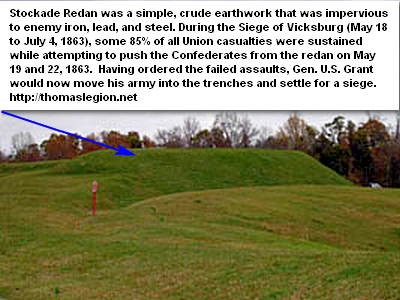
|
| Confederate Defenses of Stockade Redan |
With lines neatly dressed and their battle flags blowing in the breeze above them on May 19, Sherman's troops
surged across the fields at 2:00 p.m. and through the abatis (obstructions of felled trees) toward Stockade Redan. Although
the men of the 1st Battalion, 13th United States Infantry, planted their colors on the exterior slope of Stockade Redan, only
to be quickly removed, the attack was repulsed with Union losses numbering 942 men.
Grant planned another assault for May 22, but this time he hoped that greater numbers and a coordinated
attack would break the redan. The Union troops would first reconnoiter thoroughly and soften up the defenses
with artillery and naval gunfire. The lead units were supplied with ladders to ascend the fortification walls. Grant did
not want a long siege, for he was a fighter and he wanted to sack Vicksburg, and this attack was to be by the entire
army across a wide front. Although Grant had prepared well, so had the Confederates. The Union cannonade had little effect
and served only to announce an imminent assault on Stockade Redan. The Confederate position had not been softened by the artillery,
and as the Federals pressed toward the redan, they were met with stronger resistance than that of the 19th. This advance,
unlike the first, was pressed with such determination it was as though Grant was set on pushing the Rebs into the Mississippi
itself. As Union blue moved along the Graveyard Road, Confederate fire began to rip the ranks from several positions,
which made the approach a blazing hornets nest. The Federals, now falling like ripe sheaves that had been stricken by
the tried sickle, continued to press toward the works, but casualties were by no means
light, and they were mounting fast. Still, the Union general was unwavering in his determination to take that redan.
Progress of the battle was relayed to Grant, and it was not good. He heard that the Confederates had reinforced
the redan and that not a single Union soldier had neared the embankment. Union casualties were high, the report
continued. The men went forward as though the entire investment relied on May 22 alone. More reports from his commanders
showed that the ground was being sorely contested and that not one inch of soil had been yielded by the foe. Federal
casualties were exceedingly high, unacceptable by most accounts, but still no withdrawal from Grant. Push the men and
take the redan was heard along the infantry ranks, so the men, now exhausted, struggled toward the redan only to be mowed
down by relentless Confederate small arms fire. As blue uniforms had massed below the redan, the Confederates began
tossing grenades and rolling cannon balls effortlessly down the walls of the redan and into the piles of blue uniforms. It
was a slaughter. Finally, with more than 3,000 Union men killed and wounded and strewn across the knolls and in the trenches,
Grant had had enough--withdrawal the men, the general barked in frustration.
| Union cannon trained on Stockade Redan |

|
| A Union artillery battery was squarely in front of Stockade Redan |
First Assault on Vicksburg, May 19, 1863: Anxious
for a quick victory, Grant made a hasty reconnaissance of the Vicksburg defenses and ordered an assault on May 19, 1863. Of
his three corps, however, only one was in proper position to make the attack--Sherman's corps astride the Graveyard Road northeast
of Vicksburg. Early in the morning Union artillery opened fire and bombarded the Confederate works with solid shot and shell.
General Grant thought that Southern morale to be low (and it was) after
the defeats at Champion Hill and Big Black River Bridge, so he wanted to overwhelm the Confederates before they could
fully organize their defenses and ordered an immediate assault against Stockade Redan. Troops from Sherman's corps had a difficult
time approaching the position under rifle and artillery fire from the 36th Mississippi Infantry, Brig. Gen. Louis Hébert's
brigade—they had to negotiate a steep ravine protected by abatis and cross a 6-foot-deep, 8-foot-wide ditch before attacking
the 17-foot-high embankment of the redan. Not one Union soldier would reach the parapet.
General Francis P. Blair, Jr.'s division, Sherman's corps, continued pressing
toward the redan at the Confederate left. Blair's three brigades advanced over rough terrain obstructed by dozens of felled
trees cut by the Confederates to impede any Federal advances. Fresh Southern troops defended the redan, however, and as Blair's
men began to rise over the nearby knolls and hills, they fell quickly as trained Confederate guns began unleashing accurate
shots into the busted Union lines. Blair's advance, the Union first attempt, was easily repulsed.
Grant ordered an artillery bombardment to soften the defenses and at 2
p.m., Sherman's division under Maj. Gen. Francis P. Blair rose and advanced again, but only a small number of men were able
to move even as far as the ditch below the redan. A few blue uniforms would struggle into the ditch of the earthwork, but
before any attempt to scale the embankment and navigate the nearly 23-foot parapet was afforded, one of
the many mines that had been buried in the ditch detonated beneath the soldiers thus ending their part of the war. The
assault collapsed in a melee of rifle fire and hand grenades being lobbed into the Union position. Federal soldiers who
hurled grenades would watch as the 3-lb. anchors were released from their hands only to fall a few feet to their
front, causing more harm to themselves than the enemy. The Rebels merely tossed the grenades with ease over the redan
embankment and into the massed Yankees beneath. The presence of Union soldiers in the ditches at the base of the redan forced
the defenders to roll six- and twelve-pound cannon balls, with the timing fuse cut short, down into the men in blue. McPherson and McClernand, not yet in good position for attack, were unable to do more
than advance their corps several hundred yards closer to the siege line. Under the cover of night, the Federals withdrew.
At Stockade Redan the Confederates had converged behind its earthworks,
firing close-range volleys into the attacking Federals, while intense Union artillery fire along with keen-eyed sharpshooters,
raked and blanketed the field in attempts to pin the Confederates down as the blue uniforms appeared and moved like
blue waves rolling onto the scene. A few Union soldiers got close to the redan, but heavy Confederate fire pinned them down,
and under cover of darkness, the Federals withdrew. The Rebel Yell had been heard from
that day, but Grant would answer with another assault in just three days, believing that Union fortitude and more firepower
would soon carry the day.
The failed Federal assaults of May
19 damaged Union morale, deflating the confidence the soldiers felt after their string of victories across Mississippi. The
assaults were also costly, 942 total Union casualties: 157 killed, 777 wounded, and 8 missing, versus Confederate casualties
of 200. The Confederates, assumed to be demoralized, had withstood Grant's ill-fated assault and regained their fighting
edge.
| Battle of Vicksburg History |

|
| Siege of Vicksburg |
Second Assault on Vicksburg, May 22, 1863: Undaunted
by his failure on the 19th and realizing that he had been too hasty, Grant made a more thorough reconnaissance then ordered
another assault. Early on the morning of May 22, Union artillery opened fire and for four hours bombarded the city's defenses.
At 10:00 the guns fell silent and Union infantry was thrown forward along a three-mile front. Sherman attacked once again
down the Graveyard Road, McPherson in the center along the Jackson Road, and McClernand on the south along the Baldwin Ferry
Road and astride the Southern Railroad of Mississippi. Flags of all three corps were planted at different points along the
exterior slope of Confederate fortifications. McClernand's men even made a short-lived penetration at Railroad Redoubt. But
the Union forces were again driven back and their casualties, now triple the loss sustained on May 19, were 3,199
and not one inch of ground was gained. Gen. Grant, now obviously aware of the futility of the assaults, wisely accepted and
settled for a long siege. The style of fighting that Grant was now engaged in, would allow him to make many adjustments
for another fight at Richmond and Petersburg, when he and Gen. Lee would engage and grapple, only to withdrawal
and then sway to and fro in a cat and mouse attempt to outsmart the other while, Grant, stretching the siege lines daily,
eventually cracked Lee's line. Grant would be ready for the next siege, and it would be Lee who would settle in the trenches
for nearly ten months before Grant's overwhelming numbers would stretch and break the Confederate lines, and force Lee
to move his battered and bruised Army of Northern Virginia out of the lines and into the open in hopes of reaching the safety
of a better defensive position, but it would fail to materialize, and Lee would surrender to Grant within days.
| Second Assault on Vicksburg |

|
| Second Assault on Stockade Redan |
Following his failure on May 19, Grant still thought that his army could
successfully storm the Vicksburg defenses, and three days later, on May 22, he ordered another attack along the entire line.
Gen. William T. Sherman ordered his men to attack straight down the Graveyard Road to avoid the difficult terrain and Southern
obstructions. Additionally, 150 volunteers, carrying wooden planks to bridge the ditch in front of the redan and ladders to
climb the wall, went ahead of the Federal infantry.
The Confederates held their fire until the assaulting wave neared the
redan, then opened with a devastating volley. The Union advance buckled as soldiers fell, but they were able to bridge
the ditch and two color bearers planted flags on the redan's exterior slope. But Southern fire was so intense that the Federals
soon retreated with heavy losses. Following the second and more costly repulse of his troops on May 22, Grant did not
order any additional frontal assaults, but was forced to settle for a siege.
When General Grant arrived at Vicksburg he established his headquarters
in a wood frame house northeast of the Old Graveyard Road. During the night of May 21-22 he was aroused from his sleep as
soldiers, not knowing the General was inside, started removing boards and timbers from the exterior. Although at first upset,
Grant, upon learning the reason for the dismantling, soon gave his approval for the troops to continue their efforts. The
materials were used to construct planks and scaling ladders for the attack against the Stockade Redan on May 22. The general
used a tent for his quarters for the remainder of the siege.
Despite their bloody repulse on May 19, morale among Union soldiers was
high. They were well-fed with provisions they had foraged and were now well-rested. On seeing Grant pass by, a soldier commented,
"Hardtack". Soon the Union troops in the vicinity were yelling, "Hardtack! Hardtack!" The Union served hardtack, beans, and
coffee the night of May 21. The soldiers trusted Grant, and they expected Vicksburg to fall the next day.
On the evening of the 21st, Union forces bombarded the city without
ceasing, from 220 artillery pieces and naval gunfire from Rear Adm. David D. Porter's fleet in the river. Though the
sun had already set, the sky would resemble a rather eerie presentation of colorful lights caused by the 200-pound projectiles
that were soaring overhead. As nonstop shot and shell burst above the homes and trenches, the cries of the wounded
and dying could faintly be heard. Similar to an earthquake, the ground shook as the more powerful 13-inch mortars
and heavy artillery pieces rumbled and discharged their massive projectiles, and as shot and shell exploded continuously,
the sky was set ablaze making it difficult to see the stars. Smoke filled the air and it rolled ominously across the
bluffs and into the trenches as though the grim reaper himself had rolled onto scene to remind both armies that he too
had joined the fray. The booming cannon, shaking terrain, horrific sounds, and rancid odors all served to terrorize
the civilians who had been dwelling deep inside the 500 caves and bombproofs that had been carved from the hills and
bluffs. To live like a human was to die, but live like the rat was to survive, so it seemed because while.
On the night of the May 21, it was merely impossible to rest, and the
constant shelling claimed only a few lives, but it generally unnerved women and children. On the morning of May
22, the bombardment of the Confederate works increased and continued for four hours before the Union attacked once more
along a three-mile front at 10 a.m.
| Map of 2nd Attack on Stockade Redan, Vicksburg |

|
| Map of Vicksburg Battlefield during May 22nd Assault |
Sherman attacked once again down the Graveyard Road, with 150 volunteers
(nicknamed the Forlorn Hope detachment) leading the way with ladders and planks, followed by the divisions of Blair and Brig.
Gen. James M. Tuttle, arranged in a long column of regiments, hoping to achieve a breakthrough by concentrating their mass
on a narrow front. They were driven back in the face of heavy rifle fire. Blair's brigades under Cols. Giles A. Smith and
T. Kilby Smith made it as far as a ridge 100 yards from Green's Redan, the southern edge of the Stockade Redan, from where
they poured heavy fire into the Confederate position, but to no avail. Tuttle's division, waiting its turn to advance, did
not have an opportunity to move forward. On Sherman's far right, the division of Brig. Gen. Frederick Steele spent the morning
attempting to get into position through a ravine of the Mint Spring Bayou.
| 2nd Texas Lunette |

|
| Texas at Vicksburg |
McPherson's corps was assigned to attack the center along the Jackson Road.
On their right flank, the brigade of Brig. Gen. Thomas E. G. Ransom advanced to within 100 yards of the Confederate line,
but halted to avoid dangerous flanking fire from Green's Redan. On McPherson's left flank, the division of Maj. Gen. John
A. Logan was assigned to assault the 3rd Louisiana Redan and the Great Redoubt. The brigade of Brig. Gen. John E. Smith made
it as far as the slope of the redan, but huddled there, dodging grenades until dark before they were recalled. Brig. Gen.
John D. Stevenson's brigade advanced well in two columns against the redoubt, but their attack also failed when they found
their ladders were too short to scale the fortification. Brig. Gen. Isaac F. Quinby's division advanced a few hundred yards,
but halted for hours while its generals engaged in confused discussions.
On the Union left, McClernand's corps moved along the Baldwin Ferry Road
and astride the Southern Railroad of Mississippi. The division of Brig. Gen. Eugene A. Carr was assigned to capture the Railroad
Redoubt and the 2nd Texas Lunette; the division of Brig. Gen. Peter J. Osterhaus was assigned the Square Fort. Carr's men
achieved a small breakthrough at the 2nd Texas Lunette and requested reinforcements.
By 11 a.m., it was clear that a breakthrough was not forthcoming and the
advances by Sherman and McPherson were failures. Just then, Grant received a message from McClernand, which stated that he
was heavily engaged, the Confederates were being reinforced, and he requested a diversion on his right from McPherson's corps.
Grant initially refused the request, telling McClernand to use his own reserve forces for assistance; Grant was mistakenly
under the impression that McClernand had been lightly engaged and McPherson heavily, although the reverse was true. McClernand
followed up with a message that was partially misleading, implying that he had captured two forts—"The Stars and Stripes
are flying over them."—and that another push along the line would achieve victory for the Union Army. Although Grant
once again demurred, he showed the dispatch to Sherman, who ordered his own corps to advance again. Grant, reconsidering,
then ordered McPherson to send Quinby's division to aid McClernand.
Sherman ordered two more assaults. At 2:15 p.m., Giles Smith and Ransom
moved out and were repulsed immediately. At 3 p.m., Tuttle's division suffered so many casualties in their aborted advance
that Sherman told Tuttle, "This is murder; order those troops back." By this time, Steele's division had finally maneuvered
into position on Sherman's right, and at 4 p.m., Steele gave the order to charge against the 26th Louisiana Redoubt. They
had no more success than any of Sherman's other assaults.
In McPherson's sector, Logan's division made another thrust down the Jackson
Road at about 2 p.m., but met with heavy losses and the attack was called off. McClernand attacked again, reinforced by Quinby's
division, but with no success. Union casualties were 502 killed, 2,550 wounded, and 147 missing, about evenly divided across
the three corps. Confederate casualties were not reported directly, but were estimated to be less than 500. Grant blamed McClernand's
misleading dispatches for part of the poor results of the day, storing up another grievance against the political general
who had caused him so many aggravations during the campaign. As Grant had strived and failed to coordinate his corps
for a major, unified assault on Stockade Redan on May 19th, the second disastrous assailment must have been
nearly unbearable for the future U.S. President. While Grant never had any remorse about ordering the two failed advances,
he had but one regret for both assaults-- they failed. It is perhaps accurate to say that if the action on that first
day by Grant felt like purgatory as his generals pushed and entangled their divisions during the melee, the second
attempt to force his entire army into the fray in a winner take all effort to break and crack the redan must have been hell
for the general as the after battle reports showed that the earthwork was exactly the way it was back
on the 19th, but with more than 3,000 Federals now out of commission compared to
1,000 afore it surely must have been hell knowing that siege was also to follow.
The Confederates may have been joyous about the disparity in total
casualties with the Federals for both the 19th and 22nd, with less than 700 compared to more than 4,000 Union men, the attrition,
mainly by disease, however, that would riddle the ranks during the coming siege would take a much greater toll on the
Rebels than if the Federals would have simply ordered several more assaults.
But for now, still the Southern force was able to hold their position, and
following the failure of the May 22 assault, General Grant decided to conduct siege operations.
| Battle of Vicksburg |

|
| Trench and approach toward the Third Louisiana Redan |
| Vicksburg Mine, aka Vicksburg Crater |

|
| Jackson Road view of the Third Louisiana Redan at the Vicksburg Battlefield |
(About) Union view from Jackson Road of the Third Louisiana Redan. The Third
Louisiana Redan was built to help guard the Jackson Road entrance into the city of Vicksburg. The redan was named after the
regiment that garrisoned it, the Third Louisiana Infantry. The Confederates were aware of the Union approach trench and mine
digging, but despite efforts of sharpshooters, were unable to stop the Federals. On June 24, 1863, the Union mine reached
40 feet under the redan. It was filled with 2,200 pounds of black powder and at 3:30 pm on June 25, fuses were prepared and
the mine was exploded. Simultaneously, Northern artillery and infantry began firing all along the line. The 45th Illinois
Infantry spearheaded the attack against the redan where a huge crater (12 feet deep and 40 feet wide) was made. The assault
was unsuccessful, however, as the Confederates positioned at the rear of the redan held their ground and the attacking Union
soldiers could not advance out of the crater. The next day, Union soldiers withdrew after it was decided that the men could
make no further progress and too many lives would be lost if they remained in the open crater.
| Vicksburg Civil War Battle |
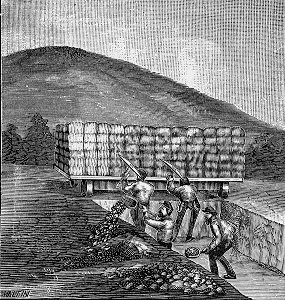
|
| Union soldiers dig approach trenches |
The
Siege of Vicksburg, May 23--July 3, 1863: After the unsuccessful
assault of May 22, only two attempts were made to break through the Confederate defenses, neither of which succeeded. Sherman,
holding the Union right opposite the strong Fort Hill position, determined to reduce the fort with naval aid, and on May 27
the gunboat Cincinnati, protected by logs and bales of bay, moved into position and engaged the several batteries of
that sector. Subjected to a deadly plunging fire which "went entirely through our protection—hay, wood, and iron," the
Cincinnati went down with her colors nailed to the stump of a mast.
(Right) Union soldiers dig approach trenches toward Confederate fortifications.
Siege life for the Confederate soldier was a hazardous ordeal; nearly 3,500
were killed or wounded. Because of the limited number of effective troops available to Pemberton, almost the entire Vicksburg
Army had to be placed in the trenches; sufficient numbers were not available to rotate frontline duty as was done by the Federal
Army. Never knowing when an attempt might be made to assault the defense line, it was necessary for them to be on guard at
all times, enduring sun, rain, mud, poor and inadequate food, as well as the bullets and shells of the Union Army for 47 days
and nights. The unending barrage of small arms and artillery fire, one Confederate exclaimed, "can be compared to men clearing
land—the report of musketry is like the chopping of axes and that of the cannon like the telling of trees."
Rations were generally prepared by details of soldiers behind
the lines and carried to the troops at the breastworks. Coffee, the soldier's staple, was soon unobtainable and an ersatz
beverage introduced, the somewhat questionable ingredients of which included sweet potatoes, blackberry leaves, and sassafras.
To replace the exhausted flour supply, a substitute was devised from ground peas and cornmeal. When this was baked over a
fire, one soldier complained, "it made a nauseous composition, as the corn-meal cooked in half the time the peas-meal did,
so this stuff was half raw. . . . It had the properties of india-rubber and was worse than leather to digest." Its effect
on the digestive systems of the Confederate soldiers was possibly the equivalent of a secret Yankee weapon. A more famous,
although not necessarily a more palatable, item of the besieged soldiers' diet was the mule meat introduced late in the siege.
General Pemberton heartily approved of its appearance, observing that mule proved "not only nutritious, but very palatable,
in every way preferable to poor beef."
For protection against artillery fire, the Confederate troops dug bombproofs
in the reverse slope of their fortified ridge. From these dugouts, bulwarked by heavy timbers, trenches connected with the
fortifications, affording the besieged some degree of relaxation in reading or playing cards a few yards from the front line.
To defend against surprise night attacks, they were forced to sleep on their arms in the trenches.
| Vicksburg and the Civil War |

|
| Camp life behind Union Siege lines was rather different than that found in the Rebel trenches... |
At night the unending bombardment from Porter's fleet provided the
troops of both armies with an awesome pyrotechnic display. Especially popular with the pickets were the giant 13-inch mortar
shells whose sputtering fuses described a tremendously high arc in the blackness before disappearing into the city. It was
a "wonderful spectacle," one soldier remembered, "to see the fuse from the shells—and you could see them plainly—the
comet or star-like streams of fire and then hear them coming down into the doomed city.
We used to watch them while on picket at night."
Only when the Union trenches approached
close to the defensive works were determined efforts made to halt the Union threat. Then the Union sap rollers (woven cane
cylinders filled with earth or cotton rolled in front of the open end of the trench to protect the work party) became targets
for destruction. Fuses were set on artillery shells which were then rolled down against the sap rollers, or they were ignited
by Minie balls dipped in turpentine. Occasional night sallies succeeded temporarily in driving off Union work parties and
filling up trenches, but no daylight forays were attempted by the Confederates.
Trench life for Grant's soldiers was
not so rigorous or dangerous as for the Vicksburg defenders. Food supplies were ample, although lack of pure water was a problem
for both armies and resulted in considerable disease. The burning sun and frequent rains made life miserable for both "Yank"
and "Reb." Particularly as a result of the low ammunition stores of the Vicksburg army, Union losses during the siege, after
the assaults of May 19 and 22, were comparatively light.
While many writers describe the conditions in Vicksburg during June of '63 as weary,
tiresome, reduced rations, and even low on morale, it does injustice to both the soldier and citizen who were there.
The facts, by all accounts and records, diaries, memoirs, and any other means of communication, show that the Confederate
soldiers in those trenches were so famished, disease ridden, and of such low morale that a great many officers in
June even wrote to and spoke directly with Confederate Gen. Pemberton himself, stating that if the general
didn't surrender the men from what they said was imminent death, that they would surrender themselves to the
Yankees. The Rebs were gravely dispirited, they had been spent, and they had fought well, but they no more fight left.
| Third Louisiana Redan and Hand-to-Hand Combat |

|
| Union detonate over one ton of explosives under Third Louisiana Redan. Vicksburg NPS. |
| Civil War Crater of Vicksburg |

|
| Battle of the Mine, Vicksburg, Mississippi |
| Civil War Mine of Vicksburg |

|
| Battle of the Crater, Vicksburg |
"We have our trenches pulled up so close to the enemy that we can throw hand grenades over
into their forts. The enemy do not dare show their heads above the parapet at any time, so close and so watchful are our sharpshooters.
The town is completely invested. My position is so strong that I feel myself abundantly able to leave it so and go out twenty
or thirty miles with force enough to whip two such garrisons." Ulysses S. Grant, writing to George G. Pride, June 15, 1863
| The Crater of Vicksburg |

|
| Fighting in Crater at Third Louisiana Redan |
The Vicksburg Mine, June 25--26: Following
the failure of the May 22 assault, Grant realized that Vicksburg could not be taken by storm and decided to lay siege to the
city. Slowly his army established a line of works around the beleaguered city and cut Vicksburg off from supply and communications
with the outside world. Commencing on May 26, Union forces constructed thirteen approaches along their front aimed at different
points along the Confederate defense line. The object was to dig up to the Confederate works then tunnel underneath them,
plant charges of black powder, and destroy the fortifications. Union troops would then surge through the breach and gain entrance
to Vicksburg. The latter would not occur however, because the besieged Confederates would surrender prior to Grant ordering
one more large mine detonated under the Confederate works.
The other attempt to pierce the defense line was by exploding a mine under the Third Louisiana Redan. Logan's
approach trench had reached the fort walls and from here a shaft was sunk under the fort and a powder charge prepared for
its demolition. The Confederate garrison, hearing the miners' picks at work beneath the fort, began countermines in a grim
race for survival.
During June, Union troops advanced their approaches slowly toward
the Confederate defenses. Protected by the fire of sharpshooters and artillery, Grant's fatigue parties neared their objectives
by late June. Along the Jackson Road, a mine was detonated beneath the Third Louisiana Redan on June 25, and Federal
soldiers swarmed into the crater attempting to exploit the breach in the city's defenses. The struggle raged for 26 hours
during which time clubbed muskets and bayonets were freely used as the Confederates fought with grim determination to deny
their enemy access to Vicksburg. The troops in blue were finally driven back at the point of bayonet and the breach sealed.
On July 1, a second mine was detonated but not followed by an infantry assault.
"We have our trenches pulled up so close to the enemy that we can throw hand grenades over into their forts.
The enemy do not dare show their heads above the parapet at any time, so close and so watchful are our sharpshooters. The
town is completely invested. My position is so strong that I feel myself abundantly able to leave it so and go out twenty
or thirty miles with force enough to whip two such garrisons." Ulysses S. Grant, writing to George G. Pride, June 15, 1863
The failed frontal assaults of Stockade Redan resulted in high casualties and low morale, so
as the siege continued, and Union troops now tunneled under the Third Louisiana Redan and packed a massive mine with
2,200 pounds of gunpowder. As the explosion blew apart the Confederate lines on June 25, it was followed by an infantry attack
by troops from Logan's XVII Corps division. The 45th Illinois Regiment (known as the "Lead Mine Regiment"), under Col. Jasper
A. Maltby, charged into the 40-foot diameter, 12-foot deep crater with ease, but were halted by recovering Confederate infantry.
The Union soldiers became pinned down while the defenders also rolled artillery shells with short fuses into the pit
with deadly results. Union engineers worked to set up a casemate in the crater in order to extricate the infantry, and soon
the soldiers fell back to a new defensive line. From the crater caused by the explosion on June 25, Union miners were constructing a
new mine to the south. On July 1, this mine was detonated but no infantry attack followed. Pioneers worked throughout July
2 and 3 to widen the initial crater large enough for an infantry column of four to pass through for future anticipated assaults.
The starving, diseased, and greatly reduced Confederate ranks, however, had no more to give, it was over, and Pemberton
would soon surrender the great fortress on the bluffs, and nearly 30,000 Rebels would be paroled. But the war would rage for
nearly two more years, and Grant, who would eventually command all Union forces, would be involved in another siege, but on
this occasion it would be a nearly ten month contest with none other than his nemesis Robert E. Lee. The many lessons
that Grant had learned while here in Vicksburg, he would employ and perfect during the Richmond-Petersburg Siege.
Throughout the weary month of June the gallant defenders of Vicksburg
suffered under the constant bombardment of enemy guns, and while some soldiers
were existing off a few crackers and some stray vermin, the ranks consisted mainly of sick soldiers who were too
weak to ensnare even a rat, so they relied on what was called reduced rations, but in fact it wasn't even food at all, because daily they were allotted but two spoons of salt, while their skeletal
frames were exposed to the harsh elements. Greatly reduced in numbers, the broken Confederate lines, having already been stretched,
were now too thin to offer resistance should another Union assault be ordered. Reduced in number by sickness and battle casualties,
the garrison of Vicksburg was now spread dangerously thin. Soldiers and citizens alike began to despair that relief would
ever come. At Jackson and Canton, General Joseph E. Johnston, commanding Army of the West, gathered a relief force
which took up the line of march toward Vicksburg on July 1. By then it was too late as the sands of time had expired for the
fortress city on the Mississippi River.
| Siege of Vicksburg History Map |

|
| Grant presses toward Vicksburg |
Pemberton's foremost objective in prolonging the siege had been to
afford Johnston and the Confederate government time to collect sufficient troops to raise the siege. But shortly after Grant
had invested the city, Gen. Robert E. Lee's Army of Northern Virginia began its invasion of the North, which ended on the
field of Gettysburg. No troops could be spared from that point. To have removed troops from Lt. Gen. Braxton Bragg's army
in Tennessee would have dangerously weakened that place in a desperate attempt
to save the Mississippi. Johnston wired Secretary of War James A. Seddon "We cannot hold both."
During June, General Johnston had succeeded in increasing
his force to about 30,000, many of whom were green troops, but efforts to secure adequate weapons, ammunition and wagons
to equip the regiments had been only partly successful. Preparing to encounter an expected move by Johnston against his rear,
Grant used reinforcements arriving from Memphis to construct and man a strong outer defense line facing Johnston's line of
advance. Grant then had two lines of works, one to hold Pemberton in, the other to hold Johnston out. While Seddon notified
Johnston "Rely upon it, the eyes and hopes of the whole Confederacy are upon you, with the full confidence
that you will act, and with the sentiment that it is better to fail nobly daring, than, through prudence even, to be inactive,"
Johnston notified his government on June 15 "I consider saving Vicksburg hopeless."
On July 1, Johnston moved his army of 4 infantry and 1 cavalry
divisions to the east bank of the Big Black River, seeking a vulnerable place to attack Grant's outer defenses. His reconnaissance
during the next 3 days convinced him that no move against the Federal position was practicable. Receiving word of the surrender
on July 4, he withdrew to Jackson.
By July, the Army of Vicksburg had held the line for 6 weeks,
but its unyielding defense had been a costly one. Pemberton reported 10,000 of his men so debilitated by wounds and sickness
as to be no longer able to man the works, and the list of ineffectives swelled daily from the twin afflictions of insufficient
rations and the searching fire of Union sharpshooters. Each day the constricting Union line pushed closer against the Vicksburg
defenses, and there were indications that Grant might soon launch another great assault which, even if repulsed, must certainly
result in a severe toll of the garrison. (Grant had actually ordered a general assault for July 6, 2 days after the surrender.)
General Pemberton, faced with dwindling stores and no
help from the outside, saw only two eventualities, "either to evacuate the city and cut my way out or to capitulate upon the
best attainable terms." Contemplating the former possibility, he asked his division commanders on July 1 to report whether
the physical condition of the troops would favor such a hazardous stroke. His lieutenants were unanimous in their replies
that siege conditions had physically distressed so large a number of the defending army that an attempt to cut through the
Union line would be disastrous. Pemberton's only alternative, then, was surrender.
Vicksburg Surrenders on July 4: Pemberton was boxed in with
lots of inedible munitions and little food. The poor diet was showing on the Confederate soldiers. By the end of June, half
were out sick or hospitalized. Scurvy, malaria, dysentery, diarrhea, and other diseases cut their ranks. At least one city
resident had to stay up at night to keep starving soldiers out of his vegetable garden. The constant shelling did not bother
him as much as the loss of his food. As the siege wore on, fewer and fewer horses, mules, and dogs were seen wandering about
Vicksburg. Shoe leather became a last resort of sustenance for many adults.
During the siege, Union gunboats lobbed over 22,000 shells into the town and
army artillery fire was even heavier. As the barrages continued, suitable housing in Vicksburg was reduced to a minimum. A
ridge, located between the main town and the rebel defense line, provided a diverse citizenry with lodging for the duration.
Over 500 caves were dug into the yellow clay hills of Vicksburg. Whether houses were structurally sound or not, it was deemed
safer to occupy these dugouts. People did their best to make them comfortable, with rugs, furniture, and pictures. They tried
to time their movements and foraging with the rhythm of the cannonade, sometimes unsuccessfully. Because of these dugouts
or caves, the Union soldiers gave the town the nickname of "Prairie Dog Village." Despite the ferocity of the Union fire against
the town, fewer than a dozen civilians were known to have been killed during the entire siege.
After a meeting with his division commanders, Gen. Pemberton, who would
conclude that surrender was inevitable, would send representatives under the white flag of truce on the morning of July
3, 1863, to deliver a proposal to discuss surrender terms to Gen. Grant. The two commanding generals would subsequently
meet under an oak tree midway between the opposing lines at 3:00 p.m., and on the following day, July 4, the Confederates
would vacate the trenches, stack their arms, and be paroled.
By the end of June, Pemberton realized his situation was desperate.
The hope of relief by General Johnston's army had quickly disappeared. Over 10,000 soldiers in Pemberton's Army of Vicksburg
were incapacitated due to illness, wounds, and malnutrition. With his troops exhausted and starving, and supplies and munitions
now at critically low levels, Pemberton was running out of options. Reinforcements were not coming and he knew that Grant
was planning another massive assault on the Confederate works in early July.
On the hot afternoon of July 3, 1863, a cavalcade of horsemen in gray rode
out from the city along the Jackson Road. Soon white flags appeared on the city's defenses as General Pemberton rode beyond
the works to meet with his adversary--Grant. The two generals dismounted between the lines, not far from the Third Louisiana
Redan, and sat in the shade of a stunted oak tree to discuss surrender terms. Unable to reach an agreement, the two men returned
to their respective headquarters. Grant told Pemberton he would have his final terms by 10 p.m. True to his word, Grant sent
his final amended terms to Pemberton that night. Instead of an unconditional surrender of the city and garrison, Grant offered
parole to the valiant defenders of Vicksburg. Pemberton and his generals agreed that these were the best terms that could
be had, and in the quiet of his headquarters on Crawford Street, the decision was made to surrender the city.
At 10 a.m., on July 4, white flags were again displayed from the Confederate
works and the brave men in gray marched out of their entrenchments, stacked their arms, removed their accouterments, and furled
their flags, at which time the victorious Union army marched in and took possession the city. When informed of the fall of
Vicksburg, President Lincoln exclaimed, "The Father of Waters again goes unvexed to the sea."
| Vicksburg National Military Park Map. NPS |

|
| Vicksburg Battlefield Map. NPS |
Casualties: The total casualties for the nearly
six month struggle to subdue Vicksburg have been difficult to ascertain, and because Confederate reports were incomplete,
casualties vary for both phases of the campaign. The casualty reports were derived from every respective action
of the Siege of Vicksburg, and the figures add to the exact total of the Second Phase, known as Grant's Operations Against
Vicksburg.
As a result of the 47-day Battle of Vicksburg, May
18 to July 4, the Confederate army suffered 3,202 casualties while Union losses totaled 4,835. Grant's
Operations Against Vicksburg, lasting 97-days from March 29 to July 4, claimed 10,142 Union casualties and 9,091 Confederates
in killed, wounded, missing, and captured. At Vicksburg the Confederates surrendered 29,500 prisoners,
together with 172 cannon and about 60,000 muskets, and a large amount of ammunition. The 29,500 soldiers were paroled,
but not without controversy.
| Vicksburg Battlefield Map |

|
| Siege of Vicksburg Map |
Aftermath: The Confederate surrender following the
Siege at Vicksburg is often considered a turning point of the war, but when combined with Gen. Robert E. Lee's defeat at Gettysburg
by Maj. Gen. George G. Meade the previous day, a major turning point had occurred. The capitulation of Vicksburg cut
off the states of Arkansas, Louisiana, and Texas from the rest of the Confederacy, as well as communication with Confederate
forces in the Trans-Mississippi Department for the remainder of the war. Lee, turned back from Pennsylvania, would never
attempt another invasion of the North, and his Lee's army, now dispirited, realized that their commander too was not
immortal.
On July 4 when Vicksburg capitulated
and some 29,500 Confederates were captured, although soon paroled, Grant would unleash his best lieutenant, William "Uncle
Billy" Sherman, on the onlooker Johnston, who had continued to sit and mass an army while pleading his case with
Richmond for more troops, men that the Confederacy just did not have. Johnston, now with some 31,000 well-rested soldiers,
had formed his men in a semi-circle around Jackson, Mississippi, hoping that Sherman would try to plow through. Sherman meanwhile was
in command of a high-spirited Union army numbering 50,000 strong when he advanced toward Jackson. Instead of a
frontal assault, which is what Grant may have attempted, Sherman began to push his wings around both Confederate flanks,
stretching and threatening the smaller enemy force with a textbook style double envelopment. Johnston and Sherman were
both graduates of West Point and had studied the same tactics and strategies of warfare, so Johnston, understanding the
move, soon withdrew and moved his army east.
After his surrender, Pemberton was exchanged as a prisoner on October 13,
1863, and he returned to Richmond. There he spent some eight months without an assignment. At first Gen. Braxton Bragg thought
he could use Pemberton, but after conferring with his own ranking officers he advised Davis that taking on the discredited
lieutenant general "would not be advisable." Pemberton resigned as a general officer on May 9, 1864.
Gen. Robert E. Lee would be promoted to General-in-Chief of Confederate
forces on January 31, 1865, and surrender to Gen. Grant on April 9, 1865, at Appomattox Court House, VA. Gen. Joe Johnston
would continue to fight, and then meet again with Gen. William T. Sherman and surrender the Army of Tennessee and all
remaining Confederate forces still active in North Carolina, South Carolina, Georgia, and Florida, on April 26, making it
the largest surrender of the war, totaling 89,270 soldiers. Gen. Ulysses S. Grant would ride his war fame into politics and
become the 18th U.S. President, and when he died, his pallbearers included Sheridan, Sherman and none other than Joe Johnston
himself, who had become friends with his late foe during their waning years.
Analysis: With the capture of Vicksburg, the mighty Mississippi
River was under Union control and the South was sliced in halves, but while it was a strategic Union victory, the Confederacy
was able to recycle the majority of the 29,500 men paroled by Grant, which perhaps only served to add more men in
the killed columns of the casualty reports since the war would continue for another 21 months.
Grant, in his Memoirs,
discusses the Confederate capitulation at Vicksburg: "The enemy surrendered this morning. The only terms allowed is their
parole as prisoners of war. This I regard as a great advantage to us at this moment. It saves, probably, several days
in the capture, and leaves troops and transports ready for immediate service. Sherman, with a large force, moves immediately
on Johnston, to drive him from the State. I will send troops to the relief of Banks, and return the 9th army corps to Burnside."
During the Siege of Vicksburg, May
18 to July 4, 1863, 29,500 prisoners were surrendered,
with 172 cannon, approximately 60,000 muskets, and a large amount of ammunition.
The Vicksburg Campaign, which included the
battle and siege of Vicksburg, was a series of maneuvers and battles in the Western Theater of the Civil War directed
against Vicksburg, Mississippi, a fortress city that dominated the last Confederate-controlled section of the Mississippi
River. The Union Army of the Tennessee, commanded by Maj. Gen. Ulysses S. Grant, gained control of the river by capturing
this stronghold and defeating Lt. Gen. John C. Pemberton's Confederate forces stationed there.
On July 3, Pemberton sent a note to Grant,
who, as at Fort Donelson, first demanded unconditional surrender. But Grant reconsidered, not wanting to feed 30,000 hungry
Confederates in Union prison camps, and offered to parole all prisoners. Considering their destitute state, dejected and starving,
he never expected them to fight again; he hoped they would carry home the stigma of defeat to the rest of the Confederacy.
In any event, it would have occupied his army and taken months to ship that many prisoners north. Most of the men who were
paroled on July 6 were exchanged and received back into the Confederate Army on August 4, 1863, at Mobile Harbor, Alabama.
They were back in Chattanooga, Tennessee, by September and some fought in the Battles for Chattanooga in November and against
Sherman's invasion of Georgia in May 1864. The Confederate government protested the validity of the paroles on technical grounds
and the issue was referred to Grant who, in April 1864, was general in chief of the Army. The dispute effectively ended all
further prisoner exchanges during the war except for hardship cases. Surrender was formalized by an old oak tree, "made historical by the event."
The surrender was finalized on July 4, Independence Day, a day Pemberton had hoped would bring more sympathetic terms
from the United States. Although the Vicksburg Campaign continued with some minor actions, the fortress city had fallen and,
with the surrender of Port Hudson on July 9, the Mississippi River was firmly in Union hands and the Confederacy split in
two. President Lincoln famously announced, "The Father of Waters again goes unvexed to the sea."
After Vicksburg surrendered
on July 4, its residents refused to celebrate the holiday for 81 years. While it is correct to note that Vicksburg did occasionally
commemorate the holiday during the 81 year drought, it was only until the Second World War that July 4th would henceforth
be recognized and celebrated on a annual basis.
| Aftermath of Vicksburg |

|
| Sherman pursues Johnston |
Understanding
Vicksburg: The Battle of Vicksburg is also known as the Siege of Vicksburg and was fought from May 18 to July 4,
1863. The basis for referring to the activity at Vicksburg as both a siege and battle is from the fact that more than 85%
of the total Union casualties were derived from two Federal assaults during May 19 and 22.
The 47-day Siege was
part of Grant's Operations Against Vicksburg, which spanned 97-days from March 29 to July 4, and the full Vicksburg
Campaign (December 29, 1862–July 4, 1863) is oftentimes divided by military historians into
two formal phases: Operations Against Vicksburg (December 1862–January 1863) and Grant's Operations
Against Vicksburg (March–July 1863).
Since both phases are
made up of operations, it is important to state clearly which phase or operation is being studied and to be consistent
when using the terms for any offensive involving Vicksburg. The National Park Service, for instance, has some conflicting
dates and casualties for all things Vicksburg. While the Park shows Battle of Vicksburg it presents erroneous dates
and casualty figures for the timeframe (more than 19,000 casualties), and this is perhaps the primary reason for a lot
of the conflicting numbers that are available to the reader online.
Because many historians
and authors frequently interchange the term campaign when examining any battle, portion, or phase of the
more than six month contest for Vicksburg (December 29, 1862 to July 4, 1863), it has been very difficult to understand
even the basic history of the siege and from complicated to impossible to know the casualties of both armies. Whereas
writers often use the word campaign while discussing the Battle of Vicksburg, the subject becomes
rather muddled when either of the two phases of the Vicksburg Campaign are examined in another chapter or section.
The Union casualties
for the Battle of Vicksburg are derived from the Skirmishes About Vicksburg on May 18, 20, and 21, (56
casualties); First and Second Assaults on May 19 and 22, (4141 casualties); and Siege Operations from May
23--July 4 (638 casualties), for a grand total of 4845. The Confederate casualties during its Vicksburg Defense, May
18--July, were 3,202. Grand total of 8,047 casualties during the Battle of Vicksburg.
| Total Casualties for Battle of Vicksburg |

|
| Battle of Vicksburg Total Killed, Wounded, and Captured Soldiers |
Vicksburg National Military Park: The 1,800 acre Vicksburg
National Military Park is home to hundreds of priceless artifacts that commemorate the Siege of Vicksburg in 1863. The
park is home to 1,300 monuments, reconstructed forts, cannons and largest National Cemetery of Union soldiers in the country.
Within the park rests the U.S.S. Cairo which was retrieved from the bottom of
the Yazoo River in 1964. It is the only remaining Union ironclad gunboat. The adjacent museum displays innumerable artifacts
that were found on-board. The Old Court House Museum and the Vicksburg Battlefield Museum house collections of Civil War era
treasures.
The once cleared topography has changed since the Civil War. The Vicksburg Battlefield today bears
little semblance to the landscape at the time of the siege and defense of Vicksburg. At the time of the battle, the land of
the Mississippi Delta had been cleared of its trees to make room for farms, but in the 1930s, trees were planted on the Vicksburg
Battlefield to minimize erosion.
(Sources and related reading listed below.)
Recommended Reading: Vicksburg
Is the Key: The Struggle for the Mississippi River (Great Campaigns of the Civil War).
Description: The struggle for control of the Mississippi River was the longest and most complex
campaign of the Civil War. It was marked by an extraordinary diversity of military and naval operations, including fleet engagements,
cavalry raids, amphibious landings, pitched battles, and the two longest sieges in American history. Every existing type of
naval vessel, from sailing ship to armored ram, played a role, and military engineers practiced their art on a scale never
before witnessed in modern warfare. Union commanders such as Grant, Sherman, Farragut, and Porter demonstrated the skills
that would take them to the highest levels of command. Continued below...
When the immense contest finally
reached its climax at Vicksburg and Port Hudson in the summer of 1863, the Confederacy suffered a blow from which
it never recovered. Here was the true turning point of the Civil War. This
fast-paced, gripping narrative of the Civil War struggle for the Mississippi River is the
first comprehensive single-volume account to appear in over a century. Vicksburg Is the Key: The Struggle for
the Mississippi River tells the story of the series of campaigns the Union conducted on land and water to conquer Vicksburg and of the many efforts by the Confederates to break the siege
of the fortress. William L. Shea and Terrence J. Winschel present the unfolding drama of the campaign in a clear and readable
style, correct historic myths along the way, and examine the profound strategic effects of the eventual Union victory.
Related Studies:
Recommended Reading: Vicksburg:
The Campaign That Opened the Mississippi (Civil War America). Description: When Confederate troops surrendered Vicksburg
on July 4, 1863--the day after the Union victory at Gettysburg--a
crucial port and rail depot for the South was lost. The Union gained control of the Mississippi River,
and the Confederate territory was split in two. In a thorough yet concise study of the longest single military campaign of
the Civil War, Michael B. Ballard brings new depth to our understanding of the Vicksburg
campaign by considering its human as well as its military aspects. Continued below.
Ballard examines soldiers' attitudes,
guerrilla warfare, and the effects of the campaign and siege on civilians in and around Vicksburg.
He also analyzes the leadership and interaction of such key figures as U.S. Grant, William T. Sherman, John Pemberton, and
Joseph E. Johnston, among others. Blending strategy and tactics with the human element, Ballard reminds us that while Gettysburg has become the focal point of the history and memory of the Civil War, the outcome at Vicksburg was met with as much celebration and relief in the North as was the Gettysburg victory, and he argues that it should be viewed as equally important today.
Sources: Vicksburg
National
Military Park; Library of Congress; National
Archives and Records Administration; National Park Service; Official Records of the Union
and Confederate Armies; Civil War Trust, civilwar.org; United States Army, history.army.mil; Ballard, Michael B. Vicksburg, The Campaign that Opened the Mississippi. Chapel Hill:
University of North Carolina Press, 2004. ISBN 0-8078-2893-9; Ballard, Michael B. Grant at Vicksburg: The General and the
Siege. Carbondale, IL: Southern Illinois University Press, 2013. ISBN 978-0-8093-3240-3; Bearss, Edwin C. Receding Tide: Vicksburg
and Gettysburg: The Campaigns That Changed the Civil War. Washington, DC: National Geographic Society, 2010. ISBN 978-1-4262-0510-1;
Bearss, Edwin C. The Campaign for Vicksburg. 3 vols. Dayton, OH: Morningside House, 1985. ISBN 978-0-89029-312-6; Bonekemper,
Edward H. A Victor, Not a Butcher: Ulysses S. Grant's Overlooked Military Genius. Washington, D.C.: Regnery Publishing, 2004.
ISBN 0-89526-062-X; Catton, Bruce. The Centennial History of the Civil War. Vol. 3, Never Call Retreat. Garden City, NY: Doubleday,
1965. ISBN 0-671-46990-8; Eicher, David J. The Longest Night: A Military History of the Civil War. New York: Simon & Schuster,
2001. ISBN 0-684-84944-5; Esposito, Vincent J. West Point Atlas of American Wars. New York: Frederick A. Praeger, 1959. OCLC
5890637; Foote, Shelby. The Civil War: A Narrative. Vol. 2, Fredericksburg to Meridian. New York: Random House, 1958. ISBN
0-394-49517-9; Grabau, Warren E. Ninety-Eighty Days: A Geographer's View of the Vicksburg Campaign. Knoxville: University
of Tennessee Press, 2000. ISBN 1-57233-068-6; Grant, Ulysses S. Personal Memoirs of U. S. Grant. 2 vols. Charles L. Webster
& Company, 1885–86. ISBN 0-914427-67-9; Kennedy, Frances H., ed. The Civil War Battlefield Guide. 2nd ed. Boston:
Houghton Mifflin Co., 1998. ISBN 0-395-74012-6; Groom, Winston. Vicksburg, 1863. New York: Knopf, 2009. ISBN 978-0-307-26425-1;
Korn, Jerry, and the Editors of Time-Life Books. War on the Mississippi: Grant's Vicksburg Campaign. Alexandria, VA: Time-Life
Books, 1985. ISBN 0-8094-4744-4; McPherson, James M. Battle Cry of Freedom: The Civil War Era. Oxford History of the United
States. New York: Oxford University Press, 1988. ISBN 0-19-503863-0; Shea, William L. and Terrence J. Winschel. Vicksburg
is the Key: The Struggle for the Mississippi River. Lincoln, NE: University of Nebraska Press, 2003. ISBN 978-0-8032-9344-1;
Smith, Jean Edward. Grant. New York: Simon & Schuster, 2001. ISBN 0-684-84927-5; Simon, John Y., ed. The Papers of Ulysses
S. Grant. Vol. 8, April 1 – July 6, 1863. Carbondale: Southern Illinois University Press, 1979. ISBN 0-8093-0884-3;
Winschel, Terrence J. Triumph & Defeat: The Vicksburg Campaign. Campbell, CA: Savas Publishing Company, 1999. ISBN 1-882810-31-7;
Winschel, Terrence J. Triumph & Defeat: The Vicksburg Campaign, Vol. 2. New York: Savas Beatie, 2006. ISBN 1-932714-21-9;
Winschel, Terrence J. Vicksburg: Fall of the Confederate Gibraltar. Abilene, TX: McWhiney Foundation Press, 1999. ISBN 978-1-893114-00-5;
Woodworth, Steven E., ed. Grant's Lieutenants: From Cairo to Vicksburg. Lawrence: University Press of Kansas, 2001. ISBN 0-7006-1127-4;
Woodworth, Steven E. Jefferson Davis and His Generals: The Failure of Confederate Command in the West. Lawrence: University
Press of Kansas, 1990. ISBN 0-7006-0461-8; Woodworth, Steven E. Nothing but Victory: The Army of the Tennessee, 1861–1865.
New York: Alfred A. Knopf, 2005. ISBN 0-375-41218-2; Harper's Weekly.
|
