|
Battle of Plymouth
Plymouth and the Civil War
Battle of Plymouth
Other Names: None
Location: Washington County
Campaign: Operations Against Plymouth (April-May 1864)
Date(s): April 17-20, 1864
Principal Commanders: Brig. Gen. Henry W. Wessells [US]; Brig.
Gen. R. F. Hoke [CS]
Forces Engaged: Plymouth Garrison [US]; Hoke’s Division [CS]
Estimated Casualties: 3,684 total (US 2,834; CS 850)
Result(s): Confederate victory
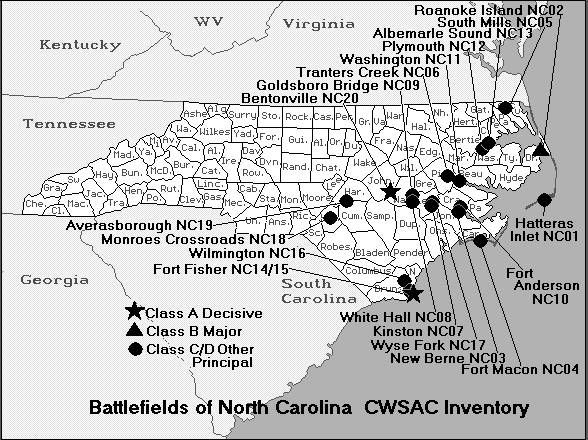
| Battle of Plymouth |
|
| Civil War Battle of Plymouth Map |
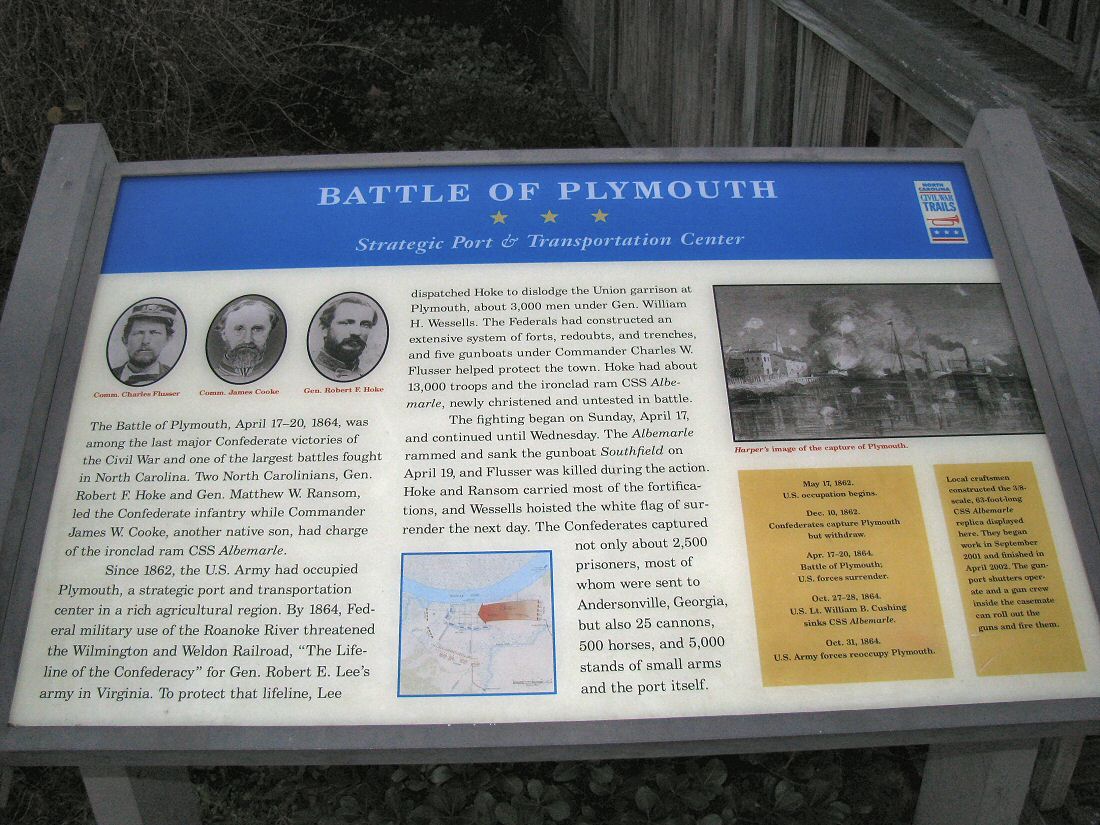
Introduction: In a combined operation with the ironclad ram CSS Albemarle, Confederate forces under Brig. Gen. Robert F. Hoke attacked the
Federal garrison at Plymouth, North Carolina, on April 17, 1864. On April 19, the ram appeared in the river, sinking
the USS Southfield, damaging the USS Miami, and driving off the other Union ships supporting the Plymouth garrison. Confederate forces captured Fort Comfort, driving the Federals into Fort Williams. On
the 20th, to avoid further bloodshed, Brig. Gen. Henry W. Wessells surrendered
the garrison to Hoke. But it would prove to be a short-lived Confederate
victory, because Hoke's division would immediately be ordered to Virginia in support of Gen. Robert E. Lee's fight against
Lt. Gen. Ulysses S. Grant. (See also Battle of Plymouth: A History.)
History: The
Battle of Plymouth, perhaps the most effective Confederate combined-arms operation of the Civil War, was waged in April
1864. Two years earlier, in May 1862, Union forces had occupied Plymouth, near the mouth of the Roanoke River. From their
bases in Plymouth, New Bern, and Washington, N.C., the Federals conducted frequent raids in eastern North Carolina. Meanwhile,
by the spring of 1862, two Confederate ironclads under construction at Edward's Ferry on the Roanoke River and at Kinston
on the Neuse River were nearing completion. The assistance of these vessels, the Albemarle and the Neuse, was essential to
the success of any attempt to recapture the coastal towns. Brig. Gen. Robert F. Hoke, acting with Cdr. James Cooke of the
Albemarle, concentrated first on Plymouth.
By late afternoon on Apr. 17, 1864, three brigades of infantry, some
10,000 troops, commanded by Brig. Gen. Hoke was within five miles of Plymouth. Defending the town was a Union garrison of
2,834 men. Although badly outnumbered, the Federals had strongly fortified the post and repulsed the first Confederate attacks.
But the next day, April 18, saw heavy shelling, with Union vessels in the river sunk or damaged and forced to retreat to Plymouth.
Meanwhile, U.S. Navy gunboats provided artillery support against the Confederates, but their success was short-lived.
"I have stormed and captured this place [Plymouth], capturing 1 brigadier, 1600 men, stores, and 25 pieces of artillery."
Brigadier General Robert F.
Hoke, April 20, 1864*
During the night the Albemarle, taking advantage of an abnormally high river
level, safely passed over the obstructions and slipped undamaged past Fort Gray, west of Plymouth. In the predawn hours of
April 19, Cooke's ship encountered the USS Southfield and USS Miami, the most powerful Union vessels on the Roanoke. The Albemarle
promptly sank the first and heavily damaged the second, forcing the Miami and two other gunboats to retreat. Late that afternoon,
Hoke launched a double envelopment attack against both the east and west sides of the town. The Albemarle, having returned
to Plymouth, furnished supporting fire on the east side of town.
| Battle of Plymouth |
|
| Battle of Plymouth |
| Battle of Plymouth |
|
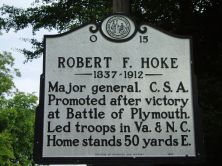
| General Robert Hoke |
On April 20, Hoke renewed the attack on each flank, capturing forts from both directions. But the Union
commander, Brig. Gen. Henry Wessells, refused to surrender and gathered the remainder of his forces inside Fort Williams,
the Federals' last remaining stronghold, near the center of Plymouth. Hoke unleashed his artillery on the bastion, and the
Albemarle added its two large rifled cannons to the bombardment. Heavily shelled from all sides, Wessells unconditionally
surrendered his entire command. In addition to the Union garrison, Hoke captured 25 artillery pieces, many provisions, including 100,000 pounds of meat, and his victory provided a badly needed morale boost
for the Confederacy.
Ransom's Brigade suffered 476 of the estimated 850 Confederate killed,
wounded or missing. Brig. Gen. Wessells reported Union losses of 2,834 in killed, wounded and missing. He further noted
that "there were also present portions of two companies Second North Carolina volunteers, native troops, under Captains Johnson
and Haggard. During its siege and in the night a considerable number of North
Carolina soldiers (many of them deserters from the enemy, and all of them fearing bad treatment in the event of capture), left their companies without authority, escaping in canoes, being picked up, as I have
understood, by our boats in the sound."
The role of the Albemarle proved critical to the Rebel victory. In addition
to driving off several Union gunboats, whose guns had been heavily relied upon for protecting the garrison, the
Confederates had added the ironclad's two rifles to the fight. While Federal commanders would now focus on destroying the
Albemarle, one Union general noted that an ironclad or torpedo would be needed to counter the formidable Rebel ram. Following the fall of Plymouth, Union forces would abandon Washington, N.C., or Little Washington as the Federals often
referred to the town. The Confederates would hold the town until the Albemarle was sunk by Union
raiders in late October 1864. With the ironclad removed, the Southern troops abandoned Plymouth, which returned and remained
in Federal hands for the duration of the war.
Casualties: Casualty reports and figures for the Battle of Plymouth,
April 17-20, 1864, have been from muddled to exaggerated, but while Federal losses were stated more specifically,
though not absolute, Confederate casualty tallies were incomplete or inaccurate. Best casualty estimates for the respective
Union and Confederate forces were derived from a variety of sources, including regimental drummers, attending physicians,
brigade commanders, and opposing commanding generals themselves. Union forces at Plymouth suffered 2,834 casualties,
including captured and an estimated 150 in dead or seriously wounded. Confederate losses, for the three day fight, were
believed to be some 850 in killed or wounded. Ransom's Brigade alone suffered at least
476 in killed or wounded, while casualties in the other two brigades, Kemper's, under Col. William R. Terry, and Hoke's, under
Col. John T. Mercer, remain unknown. The latter two brigades, notwithstanding, having been involved in a fierce contest on
the Union right, undoubtedly suffered heavy losses. During repeated assaults on the 85th Redoubt and nearby earthworks, and
outlying forts and breastworks, both sides reported heavy losses in the brigades
under Terry and Mercy, who himself was mortally wounded on April 18 while charging
the enemy's works.
Casualty
reports or returns from Confederate commanders were incomplete for
Plymouth, so while accurate figures remain elusive, a variety of contemporary writings allow us a general idea of
the losses for those three days in April 1864. Preliminary reports, known as
after battle reports, were often revised just days or even months later. An example of a revision was moving soldiers
from wounded to mortally wounded, or from missing to killed. On the other hand,
reminiscences and diaries for oftentimes stated from outright embellishments
to perhaps unintentional exaggerations. Casualty figures were also speculation
or hearsay, such as one referenced by Union Maj. Gen. John L. Peck, Headquarters,
Army and District of North Carolina, New Berne, N.C., April 24, 1864, when he reported that refugees picked up by the US gunboat
Whitehead said that General Wessells had lost about 400, while the enemy suffered not less than 1,500 killed and wounded.
|
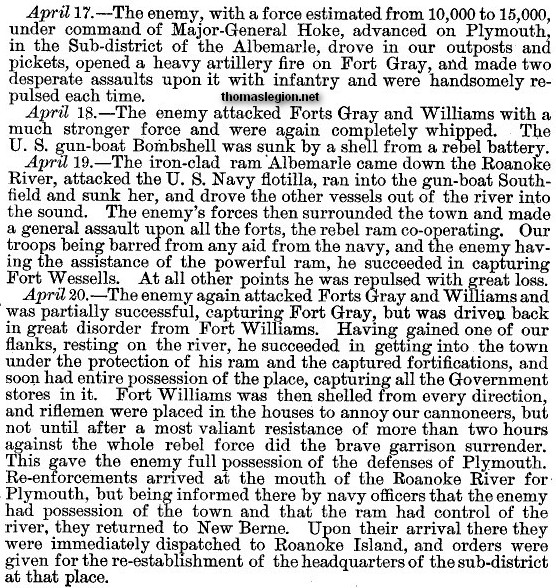
| Union Return for District of North Carolina for April 1864. |
The day following Union capitulation, April 21, Col. J. Taylor Wood, Aid-de-Camp, reported
to Confederate President Davis, "our loss about 300 in all." While the Aid-de-Camp had estimated 300 casualties for
Hoke's command, the regimental and battalion returns had not yet been completed. But a few weeks later, the Fayetteville
Observer, May 9, shows identical casualty figures for Ransom's Brigade (476 casualties, or 62 killed and 414 wounded)
from both John W. Faison, Adjutant, and Captain S. H. Gee, Assistant Adjutant and Inspector General. But in 1901, Ransom's
Brigade, Histories of the Several Regiments and Battalions from North Carolina in the Great War 1861-'65, Volume
4, the writer said that "The loss in Ransom's Brigade was over one hundred killed, and five hundred wounded. The brigade
captured three thousand prisoners, one hundred pieces of artillery, five hundred horses, a large number of small arms and
a large quantity of quartermaster and commissary stores."
As a Confederate POW, Wessells would file his reports during the summer
of 1864, and just months after the fight. While he gave specifics for Union casualties, he also gave estimates for total
Confederate losses. Whereas Wessells gave casualty figures for each unit under his command, Confederate commanders would also
state the exact tally given by Wessells for their official reports. Much later, around 1900, when North Carolina made its
grand effort to write and preserve the histories of the several regiments and battalions from the Old North State in the Civil
War, many of those who wrote the histories gave estimates, while some gave round numbers,
or the best figures available to them at that time.
A few weeks following the engagement,
Captain S. H. Gee, Assistant Adjutant and Inspector General, gave specific figures on losses for Ransom's Brigade, which was
one of the three participating Confederate brigades at Plymouth. In 1900, or 35 plus years later, many writing their
unit histories gave rounded figures, such as, Ransom's Brigade suffered 100 killed and 500 wounded. These figures were often
accompanied by other rounded tallies, such as 3,000 Union prisoners and the capture of 100 artillery pieces. In 1901, for
its official sketch, Histories of the Several Regiments and Battalions from North Carolina in the Great War 1861-'65,
Volume 1, the writer affirmed 154 casualties for the 8th N.C. Regiment alone, a higher figure, or 21% increase, than
the 127 reported by the brigade itself following the battle. "Plymouth was a brilliant victory, but the Eighth Regiment paid
dearly for its share in it. The regiment lost one hundred and fifty-four men killed and wounded, about one-third of its number."
H. T. J. Ludwig, Drummer, Company H, Eighth Regiment North Carolina State Troops.
For a year and a half, the Union military had erected an extensive ring of defenses in
and around Plymouth. The Confederates made, at intervals for three days, continued infantry assaults headlong into a
well-dug in and fortified adversary, which would easily attribute and explain the 850 plus casualties, in killed or wounded,
that Brig. Gen. Wessells asserted in August 1864. And with Confederate reports of nearly 500 casualties in the lone brigade
commanded by Ransom, then to extrapolate another 350 or so casualties split between the other two active brigades, in
addition to the numerous unattached battalions in the fray, is by no means a stretch at Plymouth. (See also Battle of Plymouth: In Their Own Words.)
*D. H. Hill, Jr., Confederate Military History
Of North Carolina: North Carolina In The Civil War, 1861-1865, page 174, stated the number at "nearly 3,000 men and 25 pieces of artillery,"
which would be the entire Federal garrison. Hoke's preliminary report, dated April 20, 1864, is often quoted by many
authors and historians, but, since the entire garrison had surrendered, less casualties, the number of "nearly [less] 3,000"
would reflect the after battle report. On p. 193, furthermore, Hill, quoting Colonel Henry Burgwyn of the 26th North Carolina,
stated, "Capturing Plymouth...with some [at least] 2,500 prisoners." Whereas both Confederate and Union reports and records placed
the Union total between 2,500 and 3,000, according to p. 618, Histories of the Several Regiments and Battalions from
North Carolina in the Great War 1861-'65 (Volume 2), Brig. Gen. Wessells reported Union losses of exactly 2,834.
Sources: ncpedia.org; National Park Service; Official Records of the
Union and Confederate Armies; Walter Clark, ed. Histories of the Several Regiments and Battalions from North Carolina
in the Great War 1861-'65, Volumes 1-5.
Recommended Reading: Battle of Plymouth, North Carolina
(April 17-20, 1864): The Last Confederate Victory, by Juanita Patience Moss. Description: Are you familiar
with the Battle of Plymouth? Not Plymouth, Massachusetts,
but how about Plymouth, North Carolina?
If you have never heard of it, you are in the company of many others, even those who consider themselves avid Civil War buffs.
The Battle of Plymouth took place April 17-20, 1864, during the “Operations against Plymouth,”
and even though the engagement was one year before Lee surrendered to Grant, the sounds of America’s
costliest and bloodiest conflict would yield havoc on North Carolina’s
coastal communities. Continued below…
In
this fascinating book, you will read about the second largest battle in North Carolina
and it was fought at a small North Carolina coastal town
named Plymouth,
where the Confederates tasted their last victory. Intense action transpired during those four days, and the atmosphere was
filled with surprise, fate, intrigue, bravery, ingenuity, hope, daring, dedication, gallantry, victory, disappointment, and
defeat. The battle witnessed the likes of Cooke, Cushing, Flusser, Hoke, and Wessells, and the formidable CSS Albemarle, an
ironclad warship that was not built in the traditional shipyard, but rather in a Southern cornfield. The battle epitomized
the brothers’ war, with North Carolina Federal regiments fighting their North Carolina Confederate brethren; it also
witnessed African American regiments (USCT) in the thick of the fight. The combined Union
and Confederate casualties were just shy of 3,000, and the author offers an informative, enlightening, and interesting view
of the “Last Confederate Victory." Although a bit repetitive,
it is a worthy addition because it is currently the only full-length text dedicated to the battle. It is a welcome addition
to North Carolina and school libraries, and to the buff that enjoys reading about the lesser-known
Civil War battles and it troops (Union and Confederate) that fought valiantly. Three stars.
Recommended Reading: Storm over Carolina: The Confederate
Navy's Struggle for Eastern North Carolina. Description: The struggle for control of the eastern waters of North Carolina during the War Between the States was a bitter, painful,
and sometimes humiliating one for the Confederate navy. No better example exists of the classic adage, "Too little, too late." Burdened
by the lack of adequate warships, construction facilities, and even ammunition, the South's naval arm fought bravely and even
recklessly to stem the tide of the Federal invasion of North Carolina from the raging Atlantic. Storm Over Carolina is the account of the
Southern navy's struggle in North Carolina waters and it
is a saga of crushing defeats interspersed with moments of brilliant and even spectacular victories. It is also the story
of dogged Southern determination and incredible perseverance in the face of overwhelming odds. Continued below...
For most of
the Civil War, the navigable portions of the Roanoke, Tar, Neuse, Chowan, and Pasquotank rivers were
occupied by Federal forces. The Albemarle and Pamlico sounds, as well as most of the coastal towns and counties, were also
under Union control. With the building of the river ironclads, the Confederate navy at last could strike a telling blow against
the invaders, but they were slowly overtaken by events elsewhere. With the war grinding to a close, the last Confederate vessel
in North Carolina waters was destroyed. William T. Sherman
was approaching from the south, Wilmington was lost, and the
Confederacy reeled as if from a mortal blow. For the Confederate navy, and even more so for the besieged citizens of eastern
North Carolina, these were stormy days indeed. Storm Over Carolina describes their story, their struggle, their history.
Recommended Reading: Ironclads and Columbiads: The Coast (The Civil War in North Carolina)
(456 pages). Description: Ironclads and Columbiads
covers some of the most important battles and campaigns in the state. In January 1862, Union forces began in earnest to occupy
crucial points on the North Carolina coast. Within six months,
Union army and naval forces effectively controlled coastal North Carolina from the Virginia line south to present-day Morehead
City. Union setbacks in Virginia, however, led to the withdrawal of many
federal soldiers from North Carolina, leaving only enough Union troops to hold a few coastal strongholds—the vital ports
and railroad junctions. The South during the Civil War, moreover, hotly contested the North’s ability to maintain its
grip on these key coastal strongholds.
Recommended Reading: The Civil War in the Carolinas (Hardcover). Description: Dan Morrill relates the experience of two quite different states bound together in
the defense of the Confederacy, using letters, diaries, memoirs, and reports. He shows
how the innovative operations of the Union army and navy along the coast and in the bays and rivers of the Carolinas
affected the general course of the war as well as the daily lives of all Carolinians. He demonstrates the "total war" for
North Carolina's vital coastal railroads and ports. In
the latter part of the war, he describes how Sherman's operation
cut out the heart of the last stronghold of the South. Continued below...
The author offers fascinating sketches of major and minor personalities, including the new president
and state governors, Generals Lee, Beauregard, Pickett, Sherman, D.H. Hill, and Joseph E. Johnston. Rebels and abolitionists,
pacifists and unionists, slaves and freed men and women, all influential, all placed in their context with clear-eyed precision.
If he were wielding a needle instead of a pen, his tapestry would offer us a complete picture of a people at war. Midwest Book Review: The Civil War in the Carolinas by civil
war expert and historian Dan Morrill (History Department, University of North Carolina at Charlotte, and Director of the Charlotte-Mecklenburg
Historical Society) is a dramatically presented and extensively researched survey and analysis of the impact the American
Civil War had upon the states of North Carolina and South Carolina, and the people who called these states their home. A meticulous,
scholarly, and thoroughly engaging examination of the details of history and the sweeping change that the war wrought for
everyone, The Civil War In The Carolinas is a welcome and informative addition to American Civil War Studies reference collections.
Recommended
Reading: The Civil War in Coastal North Carolina (175 pages) (North Carolina
Division of Archives and History). Description: From the drama of blockade-running to graphic descriptions of battles on the state's islands
and sounds, this book portrays the explosive events that took place in North Carolina's
coastal region during the Civil War. Topics discussed include the strategic importance of coastal North Carolina, Federal occupation of coastal areas, blockade-running, and the impact of
war on civilians along the Tar Heel coast.
Recommended
Reading: Lifeline of the Confederacy: Blockade Running During the Civil War (Studies in Maritime History Series). From Library Journal: From the profusion of books
about Confederate blockade running, this one will stand out for a long time as the most complete and exhaustively researched.
Though not unaware of the romantic aspects of his subject, Wise sets out to provide a detailed study, giving particular attention
to the blockade runners' effects on the Confederate war effort. It was, he finds, tapping hitherto unused sources, absolutely
essential, affording the South a virtual lifeline of military necessities until the war's last days. This book covers it all:
from cargoes to ship outfitting, from individuals and companies to financing at both ends. An indispensable addition to Civil
War literature.
|
