|
Missouri Compromise of 1820
Missouri Compromise of 1820 History
Missouri Compromise Act
A Balance of Power in 1820
History
According to
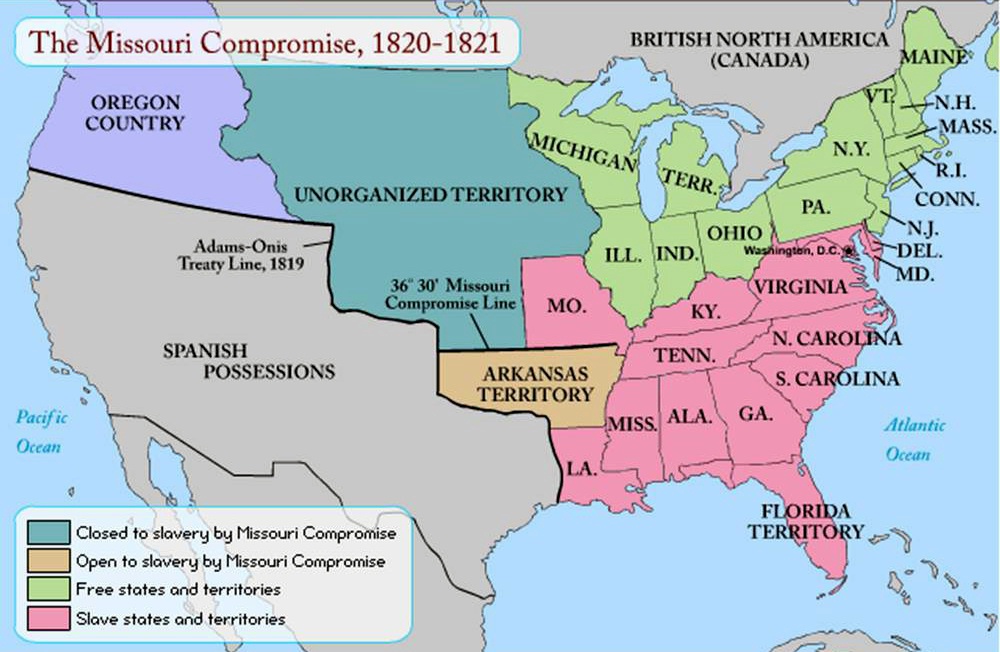
Henry Clay’s proposal, if the Southern states agreed to the admission of Maine as a free state, Missouri would be admitted as a slave state. In addition, all lands acquired in the Louisiana Purchase north of 36° 30' N latitude would be free. Both the free and the slave states agreed
to Clay's compromise. The Missouri Compromise was ratified by President James Monroe on March 6, 1820, and its influence
would last nearly thirty years before it would be repealed by the Kansas Nebraska Act.
| 1820 Missouri Compromise Map |
|
| Map of a Divided Nation : 1820 Missouri Compromise |
In 1819, as
Missouri began drafting a state constitution in preparation for statehood, New York congressman James Tallmadge introduced
two antislavery amendments to the bill which allowed for the creation of Missouri as a state. Despite the fact that Tallmadge's
bills were not passed, the issue involving slavery threatened to explode.
The issue of
slavery had remained controversial in America
since 1787. In 1819, half of America's twenty two states were free states (northern), and half were slave states (southern). Because
the free states had larger populations, they controlled
the House of Representatives. Free and slave states shared equal representation in the Senate. The admission of Missouri as a free state or slave
state would upset the balance. Antislavery members of Congress argued that slavery should be prohibited in new states, while
Pro-slavery members of Congress argued that the state should have the right to determine if slavery was legal or illegal within
its borders.
The institution
of slavery had been a divisive issue in the United States for decades before
the territory of Missouri petitioned Congress
for admission to the Union as a state in 1818. Since the Revolution, the country had grown
from 13 states to 22 and had managed to maintain a balance of power between slave and free
states. There were 11 free states
and 11 slave states, a situation that gave each faction equal representation in the Senate and the power to prevent the passage
of legislation not to its liking. The free states, with
their much larger populations, controlled the House of Representatives, 105 votes to 81.
In February
1819, New York Representative James Tallmadge proposed an amendment to ban slavery in Missouri
even though there were more than 2,000 slaves living there. The country was again confronted with the volatile issue of the
spread of slavery into new territories and states. The cry against the South's "peculiar institution" had grown louder through
the years. "How long will the desire for wealth render us blind to the sin of holding both the bodies and souls of our fellow
men in chains?" Asked Representative Livermore from New Hampshire.
Although the
United States introduced the nation to
'black slavery', it was vital to the South's economy. 200 years of living with the institution had made it an integral
part of Southern life and culture. The South, furthermore, demanded that the North recognize its right to have slaves
as secured in the Constitution.
Through the
efforts of Henry Clay, "the great pacificator," a compromise was finally reached on March 3, 1820, after Maine petitioned Congress for statehood. Both states were admitted -- a free Maine and a slave Missouri -- and
the balance of power in Congress continued, thus postponing the inevitable showdown
for another generation. In an attempt to address the "issue of the further spread
of slavery," the Missouri Compromise stipulated that all the Louisiana Purchase territory north of the southern boundary
of Missouri, except Missouri, would be free, and the territory below that line would be slave.
The Missouri Compromise of 1820, however, was repealed by the Kansas-Nebraska Act of 1854, which was declared unconstitutional in the 1857 Dred Scott decision. See also:Missouri Civil War History and Kansas Civil War History.
Recommended Reading: The Radical and the Republican: Frederick Douglass, Abraham Lincoln, and the Triumph of Antislavery
Politics. Publishers Weekly: The perennial tension between principle and pragmatism in politics frames this engaging
account of two Civil War Era icons. Historian Oakes (Slavery and Freedom) charts the course by which Douglass and Lincoln,
initially far apart on the antislavery spectrum, gravitated toward each other. Lincoln began as a moderate who advocated banning
slavery in the territories while tolerating it in the South, rejected social equality for blacks and wanted to send freedmen
overseas—and wound up abolishing slavery outright and increasingly supporting black voting rights. Conversely, the abolitionist
firebrand Douglass moved from an impatient, self-marginalizing moral rectitude to a recognition of compromise, coalition building
and incremental goals as necessary steps forward in a democracy. Continued below...
Douglass's
views on race were essentially modern; the book is really a study through his eyes of the more complex figure of Lincoln.
Oakes lucidly explores how political realities and military necessity influenced Lincoln's
tortuous path to emancipation, and asks whether his often bigoted pronouncements represented real conviction or strategic
concessions to white racism. As Douglass shifts from denouncing Lincoln's foot-dragging to
revering his achievements, Oakes vividly conveys both the immense distance America
traveled to arrive at a more enlightened place and the fraught politics that brought it there. AWARDED FIVE STARS by americancivilwarhistory.org
Recommended Reading: Inhuman
Bondage: The Rise and Fall of Slavery in the New World. Description: Winner of a Pulitzer Prize and a National Book Award, David Brion
Davis has long been recognized as the leading authority on slavery in the Western World. Now, in Inhuman Bondage, Davis sums up a lifetime of insight in this definitive account of New World
slavery. The heart of the book looks at slavery in the American South, describing black slaveholding planters, rise of the
Cotton Kingdom,
daily life of ordinary slaves, highly destructive slave trade, sexual exploitation of slaves, emergence of an African-American
culture, abolition, abolitionists, antislavery movements, and much more. Continued below…
But though
centered on the United States, the book offers a global perspective spanning four continents. It
is the only study of American slavery that reaches back to ancient foundations and also traces the long evolution of anti-black
racism in European thought. Equally important, it combines the subjects of slavery and abolitionism as very few books do,
and it connects the actual life of slaves with the crucial place of slavery in American politics, stressing that slavery was
integral to America's success as a nation--not
a marginal enterprise. This is the definitive history by a writer deeply immersed in the subject. Inhuman Bondage offers a
compelling portrait of the dark side of the American dream.
Recommended Reading: Amazing Grace: William Wilberforce and the Heroic Campaign to End Slavery. Description:
Amazing Grace tells the story of the remarkable life of the British abolitionist William Wilberforce (1759-1833). This accessible
biography chronicles Wilberforce's extraordinary role as a human rights activist, cultural reformer, and member of Parliament.
At the center of this heroic life was a passionate twenty-year fight to abolish the British slave trade, a battle Wilberforce
won in 1807, as well as efforts to abolish slavery itself in the British colonies, a victory achieved just three days before
his death in 1833. Continued below...
Metaxas discovers in this
unsung hero a man of whom it can truly be said: he changed the world. Before Wilberforce, few thought slavery was wrong. After
Wilberforce, most societies in the world came to see it as a great moral wrong. To mark the 200th anniversary of the abolition
of the British slave trade, HarperSanFrancisco and Bristol Bay Productions have joined together to commemorate the life of
William Wilberforce with the feature-length film Amazing Grace and this companion biography, which provides a fuller account
of the amazing life of this great man than can be captured on film. This account of Wilberforce's life will help many become
acquainted with an exceptional man who was a hero to Abraham Lincoln and an inspiration to the anti-slavery movement in America.
From the Back Cover: Amazing Grace is the biography of William Wilberforce, a British statesman and reformer from the early
part of the 19th century. It chronicles his extraordinary contributions to the world, primarily his 20-year fight to abolish
the British slave trade, which he won in 1807. He was also instrumental in passing legislation to abolish slavery in the British
colonies, a victory he won just three days before his death in 1833. He was a hero to Abraham Lincoln and an inspiration to
the anti-slavery movement in America. America needs to become reacquainted with this moral hero. This biography of one of
the foremost abolitionists of Britain’s anti-slavery movement is the official tie-in book to the film Amazing Grace
by Walden Media. The hardcover edition spent four weeks on the New York Times bestseller list.
Recommended
Reading:
Abolitionist Politics and the Coming of the Civil War. Description: Before the Civil War,
slaveholders made themselves into the most powerful, most deeply rooted, and best organized private interest group within
the United States. Not only did slavery
represent the national economy's second largest capital investment, exceeded only by investment in real estate, but guarantees
of its perpetuation were studded throughout the U.S. Constitution. The vast majority of white Americans, in North and South,
accepted the institution, and pro-slavery presidents and congressmen consistently promoted its interests. Continued below…
In Abolitionist Politics and the
Coming of the Civil War, James Brewer Stewart explains how a small group of radical activists, the abolitionist movement,
played a pivotal role in turning American politics against this formidable system. He examines what influence the movement
had in creating the political crises that led to civil war and evaluates the extent to which a small number of zealous reformers
made a truly significant political difference when demanding that their nation face up to its most excruciating moral problem.
In making these assessments, Stewart addresses a series of more specific questions: What were the abolitionists actually up
against when seeking the overthrow of slavery and white supremacy? What motivated and sustained them during their long and
difficult struggles? What larger historical contexts (religious, social, economic, cultural, and political) influenced their
choices and determined their behavior? What roles did extraordinary leaders play in shaping the movement, and what were the
contributions of abolitionism's unheralded foot soldiers? What factors ultimately determined, for better or worse, the abolitionists'
impact on American politics and the realization of their equalitarian goals?
Recommended Reading: Reconstruction:
America's Unfinished Revolution, 1863-1877.
Review: This "masterful treatment of one of the most
complex periods of American history" (New Republic)
made history when it was originally published in 1988. It redefined how Reconstruction was viewed by historians and people
everywhere in its chronicling of how Americans -- black and white -- responded to the unprecedented changes unleashed by the
war and the end of slavery. This "smart book of enormous strengths" (Boston Globe) has since gone on to become the classic
work on the wrenching post-Civil War period -- an era whose legacy reverberates still today in the United States. Continued below...
About
the Author: Eric Foner, DeWitt Clinton Professor
of American History at Columbia University, is the author of numerous
works on American history, including Free Soil, Free Labor, Free Men: The Ideology of the Republican Party Before the Civil
War; Tom Paine and Revolutionary America; and The Story of American Freedom. He has served as president of both the Organization
of American Historians and the American Historical Association, and has been named Scholar of the Year by the New York Council
for the Humanities.
Recommended Reading: American Creation: Triumphs and Tragedies at the Founding of the Republic (Hardcover).
Review: From the prizewinning author of the best-selling
Founding Brothers and American Sphinx,
a masterly and highly ironic examination of the founding years of our country. The last quarter of the eighteenth century
remains the most politically creative era in American history, when a dedicated and determined group of men undertook a bold
experiment in political ideals. It was a time of triumphs; yet, as Joseph J. Ellis makes clear, it was also a time of tragedies—all
of which contributed to the shaping of our burgeoning nation. Continued below...
From the first
shots fired at Lexington to the signing of the Declaration of Independence to the negotiations for the Louisiana Purchase,
Ellis guides us through the decisive issues of the nation’s founding, and illuminates the emerging philosophies, shifting
alliances, and personal and political foibles of our now iconic leaders—Washington, Jefferson, Madison, Hamilton, and
Adams. He casts an incisive eye on the founders’ achievements, arguing that the American Revolution was, paradoxically,
an evolution—and that part of what made it so extraordinary was the gradual pace at which it occurred. He shows us why
the fact that it was brought about by a group, rather than by a single individual, distinguished it from the bloodier revolutions
of other countries, and ultimately played a key role in determining its success. He explains how the idea of a strong federal
government, championed by Washington, was eventually embraced by the American people, the majority of whom had to be won over,
as they feared an absolute power reminiscent of the British Empire. And he details the emergence of the two-party system—then
a political novelty—which today stands as the founders’ most enduring legacy. But Ellis is equally incisive about
their failures, and he makes clear how their inability to abolish slavery and to reach a just settlement with the Native Americans
has played an equally important role in shaping our national character. He demonstrates how these misjudgments, now so abundantly
evident, were not necessarily inevitable. We learn of the negotiations between Henry Knox and Alexander McGillivray, the most
talented Indian statesman of his time, which began in good faith and ended in disaster. And we come to understand how a political
solution to slavery required the kind of robust federal power that the Jeffersonians viewed as a betrayal of their most deeply
held principles. With eloquence and insight, Ellis strips the mythic veneer of the revolutionary generation to reveal men
both human and inspired, possessed of both brilliance and blindness. American Creation is a book that delineates an era of
flawed greatness, at a time when understanding our origins is more important than ever. About the Author: Joseph J. Ellis received the Pulitzer
Prize for Founding Brothers and the National Book
Award for his portrait of Thomas Jefferson, American Sphinx. He is the Ford Foundation Professor of History at Mount
Holyoke College. He lives in
Amherst, Massachusetts, with
his wife, Ellen, and their youngest son, Alex.
Try the Search Engine for Related Studies: Missouri
Compromise, 1820 Missouri Compromise Act History, Missouri
Compromise of 1820 Results, African American Civil Rights, US Slavery, Blacks and Equal Rights, Black Americans Racism
and Racial Equality, The Black Experience and Segregation.
|
