 |
| Thomas' Legion |
| American Civil War HOMEPAGE |
| American Civil War |
| Causes of the Civil War : What Caused the Civil War |
| Organization of Union and Confederate Armies: Infantry, Cavalry, Artillery |
| Civil War Navy: Union Navy and Confederate Navy |
| American Civil War: The Soldier's Life |
| Civil War Turning Points |
| American Civil War: Casualties, Battles and Battlefields |
| Civil War Casualties, Fatalities & Statistics |
| Civil War Generals |
| American Civil War Desertion and Deserters: Union and Confederate |
| Civil War Prisoner of War: Union and Confederate Prison History |
| Civil War Reconstruction Era and Aftermath |
| American Civil War Genealogy and Research |
| Civil War |
| American Civil War Pictures - Photographs |
| African Americans and American Civil War History |
| American Civil War Store |
| American Civil War Polls |
| NORTH CAROLINA HISTORY |
| North Carolina Civil War History |
| North Carolina American Civil War Statistics, Battles, History |
| North Carolina Civil War History and Battles |
| North Carolina Civil War Regiments and Battles |
| North Carolina Coast: American Civil War |
| HISTORY OF WESTERN NORTH CAROLINA |
| Western North Carolina and the American Civil War |
| Western North Carolina: Civil War Troops, Regiments, Units |
| North Carolina: American Civil War Photos |
| Cherokee Chief William Holland Thomas |
| HISTORY OF THE CHEROKEE INDIANS |
| Cherokee Indian Heritage, History, Culture, Customs, Ceremonies, and Religion |
| Cherokee Indians: American Civil War |
| History of the Eastern Band of Cherokee Indian Nation |
| Cherokee War Rituals, Culture, Festivals, Government, and Beliefs |
| Researching your Cherokee Heritage |
| Civil War Diary, Memoirs, Letters, and Newspapers |
|
|
|
|
American
Civil War
Includes books and
dvds with reviews and ratings.
Editor's Choice: The Civil War - A Film by Ken Burns. Review: The
Civil War - A Film by Ken Burns is the most successful public-television miniseries in American history. The 11-hour Civil War didn't just captivate a nation,
reteaching to us our history in narrative terms; it actually also invented a new film language taken from its creator. When
people describe documentaries using the "Ken Burns approach," its style is understood: voice-over narrators reading letters
and documents dramatically and stating the writer's name at their conclusion, fresh live footage of places juxtaposed with
still images (photographs, paintings, maps, prints), anecdotal interviews, and romantic musical scores taken from the era
he depicts. Continued below...
The Civil War uses all of these devices to evoke atmosphere and resurrect an event that many knew
only from stale history books. While Burns is a historian, a researcher, and a documentarian, he's above all a gifted storyteller,
and it's his narrative powers that give this chronicle its beauty, overwhelming emotion, and devastating horror. Using the
words of old letters, eloquently read by a variety of celebrities, the stories of historians like Shelby Foote and rare, stained
photos, Burns allows us not only to relearn and finally understand our history, but also to feel and experience it. "Hailed
as a film masterpiece and landmark in historical storytelling." "[S]hould be a requirement for every
student."
HIGHLY Recommended Viewing! The American Civil War (DVD Megaset)
(2009) (A&E Television Networks-The History Channel) (14 DVDs) (1697 minutes) (28 Hours 17 Minutes
+ extras). Experience for yourself the historical and personal impact of the Civil War in a way that only HISTORY
can present in this moving megaset™, filled with over 28 hours of American Civil War content. This
MEGASET is the most comprehensive American Civil War compilation to date and is the mother of all Civil War documentaries.
A multifaceted look at “The War Between the States,” this definitive collection brings the most legendary Civil
War battles, and the soldiers and leaders who fought them, vividly to life. From Gettysburg and Antietam to Shiloh, and led
by the likes of Sherman, McClellan, Grant, Beauregard, Lee, Davis, and Jackson, delve into the full military and political
contexts of these men, their armies, and the clashes between them. Continued below...
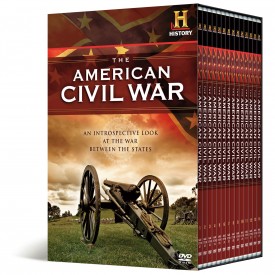
Almost 150 years after Lee’s surrender at Appomattox Court House,
the unexpected secrets and little-known stories from Civil War history are divulged with fascinating detail. Cutting-edge
CGI and accurate dramatizations illustrate archival letters and original diary entries, and the country’s most renowned
historians describe the less familiar incidents that add perspective and depth to the war that divided a nation. If the DVDs
in this Megaset were purchased separately, it could cost hundreds of dollars. This one-of-a-kind compilation belongs on the
shelf of every Civil War buff, and if you know anyone that is interested in the most costliest and bloodiest war in American
history, buy this, they will love it.
THE AMERICAN CIVIL WAR contains the following programs:
* The Most Daring Mission Of The Civil War
* April 1865
* Battlefield
Detectives: The Civil War (3 Episodes): Antietam, Gettysburg, Shiloh
* Secret Missions Of The Civil War
* The Lost Battle
Of The Civil War
* Tales Of The Gun: Guns Of The Civil War
* Eighty Acres Of Hell
* Lincoln
* Investigating History:
Lincoln: Man Or Myth
* Man, Moment, Machine: Lincoln & The Flying, Spying Machine
* Conspiracy?: Lincoln Assassination
*
High Tech Lincoln
* Sherman’s March
* The Hunt For John Wilkes Booth
* Civil War Combat (4 Episodes): The Hornets’
Nest At Shiloh, The Bloody Lane At Antietam, The Wheatfield At Gettysburg, The Tragedy At Cold Harbor
* Civil War Journal
(8 Episodes): John Brown's War, Destiny At Fort Sumter, The Battle of 1st Bull Run, The 54th Massachusetts, West Point Classmates—Civil
War Enemies, Robert E. Lee, Stonewall Jackson, Sherman And The March To The Sea
BONUS FEATURES:
* Full-Length Documentary “Save Our History: Sherman’s Total
War Tactics”
* Behind the Scenes Featurettes for “Sherman’s March” and “Lincoln”
FIVE STARS! Recommended Reading:
The Civil War: A Narrative, by Shelby Foote (3 Volumes Set) [BOX SET]
(2960 pages) (9.2 pounds). Review: This beautifully
written trilogy of books on the American Civil War is not only a piece of first-rate history, but also a marvelous work of
literature. Shelby Foote brings a skilled novelist's narrative power to this great epic. Many know Foote for his prominent
role as a commentator on Ken Burns's PBS series about the Civil War. These three books, however, are his legacy. His southern
sympathies are apparent: the first volume opens by introducing Confederate President Jefferson Davis, rather than Abraham
Lincoln. But they hardly get in the way of the great story Foote tells. This hefty three volume set should be on the bookshelf
of any Civil War buff. --John Miller. Continued below…
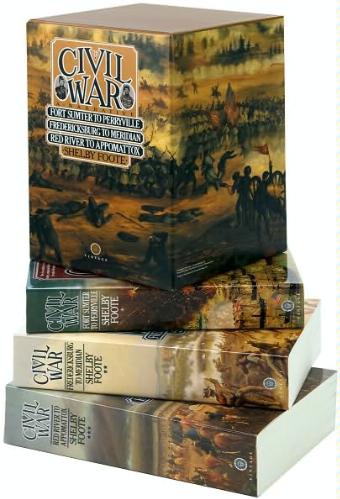
Product Description:
Foote's comprehensive history
of the Civil War includes three compelling volumes: Fort Sumter to Perryville, Fredericksburg
to Meridian, and Red River to Appomattox.
Collected together in a handsome boxed set, this is the perfect gift for any Civil War buff.
Fort Sumter to Perryville
"Here, for a certainty,
is one of the great historical narratives of our century, a unique and brilliant achievement, one that must be firmly placed
in the ranks of the masters." —Van Allen Bradley, Chicago
Daily News
"Anyone who wants to relive
the Civil War, as thousands of Americans apparently do, will go through this volume with pleasure.... Years from now, Foote's
monumental narrative most likely will continue to be read and remembered as a classic of its kind." —New York Herald Tribune Book Review
Fredericksburg to Meridian
"This, then, is narrative
history—a kind of history that goes back to an older literary tradition.... The writing is superb...one of the historical
and literary achievements of our time." —The Washington
Post Book World
"Gettysburg...is described
with such meticulous attention to action, terrain, time, and the characters of the various commanders that I understand, at
last, what happened in that battle.... Mr. Foote has an acute sense of the relative importance of events and a novelist's
skill in directing the reader's attention to the men and the episodes that will influence the course of the whole war, without
omitting items which are of momentary interest. His organization of facts could hardly be bettered." —Atlantic
Red
River to Appomattox
"An unparalleled achievement,
an American Iliad, a unique work uniting the scholarship of the historian and the high readability of the first-class novelist."
—Walker Percy
"I have never read a better, more
vivid, more understandable account of the savage battling between Grant's and Lee's armies.... Foote stays with the human
strife and suffering, and unlike most Southern commentators, he does not take sides. In objectivity, in range, in mastery
of detail in beauty of language and feeling for the people involved, this work surpasses anything else on the subject....
It stands alongside the work of the best of them." —New Republic
Recommended Reading: Encyclopedia
of the American Civil War: A Political, Social, and Military History, by David J. Coles (Editor), David
Stephen Heidler (Editor), Jeanne T. Heidler Ph.D. (Editor, Introduction), Jeanne T. Heidler (Author), James M. McPherson (Author)
(Hardcover) (2784 pages). Review From Booklist: After more than
100 years, the Civil War still attracts more public interest than any other event in U.S. history. This fact is reflected
in the inordinate number of books, well over 50,000, written about the conflict. ABCCLIO has published the most comprehensive
reference work, offering more than 1,600 signed entries, over 300 contributors, more than 500 illustrations and 75 maps, and
over 250 primary source documents. Continued below...
The encyclopedia provides
in A-Z format information on the war's strategic aims, diplomatic and political maneuvering, key military actions (with descriptions
of more than 60 engagements), key participants (civilian and military), and impact on American society and history. Mary Ann
Ball Bickerdyke, a Union Army nurse; Matthew Brady, a photographer who accompanied the Union Army in the first main battle;
and military leaders such as Ulysses S. Grant, Robert E. Lee, and James Longstreet are just a few of the individuals covered.
The encyclopedia not only treats the military aspects of the war but presents full coverage of the politics, literature, art,
music, and homefront events. Every conceivable subject--from Chickamauga, Battle of to
Harper's Weekly to Gatling gun to Jews-- receives consideration. .Entries range from less than one-half page to more than
eighteen pages for the Atlanta Campaign. Each essay is followed by see also references to related entries elsewhere in the
set, as well as extensive suggested readings for deeper research on that particular subject. The final volume compiles more
than 250 topically arranged documents, including Abraham Lincoln's famous "A house divided against itself cannot stand" speech,
excerpts from Frederick Douglass' "My Escape from Slavery" speech, Jefferson Davis' "Proclamation of 1861," the Battle Hymn
of the Republic, and more. These primary source materials are an invaluable enhancement to the set. Following the documents,
one finds five appendixes. Appendix I lists the Confederate States of America's
general officers, followed by its government in appendix II. Appendix III lists the officers of the United States of America, followed by its government in appendix IV. Appendix V
is a directory of Civil War battlefield sites with addresses, phone numbers, and maps. Following the appendixes is a "Civil
War Chronology" showing relationships between military actions and political, diplomatic, and social developments. A brief
glossary provides definitions for the researcher unfamiliar with such terms as cashier ("dishonorably discharge an office")
and retrograde ("an orderly retreat usually designed to move away from an enemy"). An extensive bibliography lists all the
resources referenced throughout the volumes. The index indicates main entries in bold print, while illustrations are identified
with italics. The index is detailed and comprehensive. For example, under African American sailors, there are references to
individuals who relate to this category, such as Gideon Welles and Francis Shoup. Under Gettysburg,
battle of one finds page references not only to information about the battle but also to related people, places, and events.
The set is handsomely designed, with numerous period photographs complementing the text.. There are some minor criticisms
regarding layout, which makes maneuvering the set a bit cumbersome. The index to all volumes can only be found in volume five,
which means the researcher has to use two volumes most of the time; a cumulative index in each volume would have made access
easier. The index cites only page numbers, leaving the user to guess which volume a page might be in. Neither the bibliographies
nor the directory to battle sites makes reference to the copious information that is available through the World Wide Web.
However, these are small shortcomings. Encyclopedia of the American Civil War is the most comprehensive reference work written
about its topic, providing both the novice and the expert an opportunity to expand their knowledge of this vital aspect of
U.S. history. Recommended for high-school,
public, and academic libraries. Copyright © American Library Association. All rights reserved.
From the Inside Flap (Special
features): 1,600+ signed, A-to-Z entries, each with references to further reading. 300+ contributors, including some of the
leading Civil War scholars at work today. 500+ illustrations, including contemporary photographs, lithographs, and drawings.
75 maps created specially for this encyclopedia. 250+ primary source documents that provide "you-are-there" immediacy: the
Dred Scott decision, Lee’s Farewell Address—speeches, legislation, military and civilian correspondence, editorials,
and eyewitness reports. Chronology of major political, diplomatic, and military events. Glossary that defines military terms
and explains usages peculiar to the period. In-depth coverage of the often-overlooked roles of African Americans, immigrants,
and women, in battle and on the home front. Comprehensive treatment of subjects usually covered only in specialized monographs,
from social conditions and public reactions to the war to press coverage and elections. Full accounts of the major battles,
complete with detailed dispositions of forces, commanders, and orders of battle—as well as smaller engagements and their
role in the larger military context. Coverage of subjects related to or affected by the war: slavery, states’ rights,
secession, emancipation, Reconstruction, the involvement of foreign powers, literature, photography, art, conscription, conscientious
objection, the role of immigrants. Biographies of military, political, diplomatic, and cultural figures, among them Horace
Greeley, “Bloody Bill” Anderson, Fitzhugh Lee, George E. Pickett, Herman Melville, Eppa Hunton, Petroleum V. Nasby,
Henry Wirz. Lists of the officers of the Union and Confederate armies and the members of
the two governments. Special battlefield section for sites in sixteen states, with location maps and visitor information.
Exhaustive subject index and cross-referencing.
Recommended Viewing:
Gone with the Wind (Four-Disc Collector's Edition)
1939 (1941) Description: First off, if you're a GWTW fanatic, you must buy this four-disc collection. But then again, you
probably don't need to read this to make that decision. For the rest of us, know that the kitchen-sink approach has been established
here with two full discs of extras. Continued below…
The film's restoration under Warner's
brilliant Ultra-Resolution process is the major contribution to the set. However, the bare-bones version released years ago
isn't bad and the film still doesn't pop off the screen as do films from the headier days of Technicolor (like the earlier
Ultra-Resolution DVD release of Meet Me in St. Louis). That said, the set is worthy of the most popular movie ever made. Rudy
Behlmer's feature-length commentary is dry but an exhaustive reference guide to the entire history of the film. Need more?
There's the excellent full-length documentary The Making of a Legend (1989) narrated by Christopher Plummer, plus two hour-long
older biographies on the two main stars. There are many new vignettes on the rest of the cast, all narrated by Plummer (a
nice touch to tie everything together). The new 30-minute interview/reminisce with Oliva de Havilland will be interesting
to older fans, but tiresome for the younger set. The usual sort of trailers and premiere footage is here along with a curious
short ("The Old South," directed by Fred Zinnemann) that was produced to help introduce the world to the history of the South.
--Doug Thomas
Recommended
Reading: The Civil War Battlefield
Guide: The Definitive Guide, Completely Revised, with New Maps and More Than 300 Additional Battles (Second Edition)
(Hardcover). Description: This new edition of the definitive guide to Civil War battlefields
is really a completely new book. While the first edition covered 60 major battlefields, from Fort Sumter to Appomattox, the
second covers all of the 384 designated as the "principal battlefields" in the
American Civil War Sites Advisory Commission Report. As in the first edition, the essays are authoritative
and concise, written by such leading Civil War historians as James M. McPherson, Stephen W. Sears, Edwin C. Bearss, James
I. Robinson, Jr., and Gary W. Gallager. Continued below...
The second edition also features 83 new four-color maps covering the most important battles. The Civil War
Battlefield Guide is an essential reference for anyone interested in the Civil War. "Reading
this book allows the reader to envision the heroic Union and Confederate soldiers charging across those smoke filled battlefields
during America's darkest hour..."
Recommended Reading: The
History Buff's Guide to the Civil War (400 pages). Description: Exploring
the Civil War can be fascinating, but with so many battles, leaders, issues, and more than 50,000 books on these subjects,
the task can also be overwhelming. Was Gettysburg the most important battle? Were Abraham Lincoln and Jefferson Davis so different
from each other? How accurate is re-enacting? Who were the worst commanding generals? Thomas R. Flagel uses annotated lists
organized under more than thirty headings to see through the powder smoke and straighten Sherman’s neckties, ranking
and clarifying the best, the worst, the largest, and the most lethal aspects of the conflict. Continued below...
Major sections are fashioned around the following topics:
• Antebellum: Investigates the critical years before the war, in particular
the growing crises, extremists, and slavery.
• Politics: Contrasts the respective presidents and constitutions
of the Union and Confederacy, the most prominent politicians, and the most volatile issues of the times.
• Military Life: Offers insights into the world of the common soldiers,
how they fought, what they ate, how they were organized, what they saw, how they lived, and how they died.
• The Home Front: Looks at the fastest growing field in Civil War
research, including immigration, societal changes, hardships and shortages, dissent, and violence far from the firing lines.
• In Retrospect: Ranks the heroes and heroines, greatest victories
and failures, firsts and worsts.
• Pursuing the War: Summarizes Civil War study today, including films,
battlefield sites, books, genealogy, re-enactments, restoration, preservation, and other ventures.
From the antebellum years to Appomattox and beyond, The History Buff’s
Guide to the Civil War is a quick and compelling guide to one of the most complex and critical eras in American history.
Recommended Reading:
The Politically Incorrect Guide to the Civil War (Politically Incorrect
Guides). Description: Get ready for a rousing rebel yell as bestselling author H.W. Crocker, III (Robert E. Lee on Leadership)
charges through bunkers and battlefields in The Politically Incorrect Guide(TM) to the Civil War. Crocker busts myths and
shatters stereotypes as he profiles eminent--and colorful--military generals while taking readers through chapters such as
"The Civil War in Sixteen Battles You Should Know" and culminating in the most politically incorrect chapter of all, "What
if the South Had Won." Revealing little-known truths, like why Robert E. Lee had a higher regard for African Americans than
Lincoln did, this is the "P.I.G." that every Civil War buff
and Southern partisan will want on their bookshelf, in their classroom, and under their Christmas tree. Continued below…
From the Inside Flap: Think
you know the Civil War? You don't know the full story until you read The Politically Incorrect GuideTM to the Civil War. Bestselling author and former Conservative Book Club editor H. W. Crocker III
offers a quick and lively study of America's own Iliad--the Civil War--in this provocative
and entertaining addition to The Politically Incorrect GuideTM series. In
The Politically Incorrect GuideTM to the Civil War Crocker profiles eminent--and colorful--military generals including the
noble Lee, the controversial Sherman, the indefatigable Grant, the legendary Stonewall Jackson, and the notorious Nathan Bedford
Forrest. He also includes thought-provoking chapters such as "The Civil War in Sixteen Battles You Should Know" and the most
devastatingly politically incorrect chapter of all, "What If the South Had Won?" Along the way, he reveals a huge number of
little-known truths, including why Robert E. Lee had a higher regard for African Americans than Lincoln did; how, if there
had been no Civil War, the South would have abolished slavery peaceably (as every other country in the Western Hemisphere
did in the nineteenth century); and how the Confederate States of America might have helped the Allies win World War I sooner.
Bet your history professor never told you:
* Leading Northern generals--like
McClellan and Sherman--hated abolitionists
* Bombing people "back to
the Stone Age" got its start with the Federal siege of Vicksburg
* General Sherman professed
not to know which was "the greater evil": slavery or democracy
* Stonewall Jackson founded
a Sunday school for slaves where he taught them how to read
* General James Longstreet
fought the Battle of Sharpsburg in his carpet slippers
This is the Politically Incorrect
GuideTM that every Civil War buff and Southern partisan--and everyone who is tired of liberal self-hatred that vilifies America's greatest heroes--must have on his bookshelf.
Recommended Reading: Touring
the Carolina's Civil War Sites (Touring the Backroads Series). Description:
Touring the Carolina's Civil War Sites helps travelers find the Carolinas' famous Civil War battlefields, forts, and memorials,
as well as the lesser skirmish sites, homes, and towns that also played a significant role in the war. The book's 19 tours,
which cover the 'entire Carolinas,' combine riveting history with clear, concise directions and maps, creating a book that
is as fascinating to the armchair reader as it is to the person interested in heritage travel. Below are some examples from
this outstanding book:
1.
Fort Fisher - the largest sea fort in the war that protected the vital town of Wilmington N.C., and the blockade runners so
important for supplying Lee's Army of Northern Virginia.
2. Charleston - where the whole shootin'
match started.
3. Bentonville - the last large scale battle of the war.
4.
Outer Banks - early Union victories here were vital to capturing many parts of Eastern North Carolina from which the Union
could launch several offensives.
5. Sherman's March - the destruction of certain towns in both
Carolinas (particularly South Carolina) further weakened the South's will to continue the struggle.
I also enjoyed reading
about the locations of various gravesites of Confederate generals and their Civil War service. Indeed, if not for this book,
this native North Carolinian and long-time Civil War buff may never have learned of, and visited, the locations of some of
the lesser-known sites other than those mentioned above.
Johnson's writing style is smooth--without being overly simplistic--and
contains several anecdotes (some humorous ones too) of the interesting events which took place during the Civil War years.
Highly recommended!
NEW! North Carolina
Troops, 1861-1865: A Roster (Volume XVI: Thomas's Legion) (Hardcover: 537 pages), North Carolina Office of Archives and
History (June 26, 2008). Description: The volume begins with an authoritative
246-page history of Thomas's Legion. The history, including Civil War battles and campaigns, is followed by a complete
roster and service records of the field officers, staff, and troops that served in the legion. A thorough index completes
the volume. Continued...
Volume XVI of North Carolina Troops: A Roster contains the
history and roster of the most unusual North Carolina Confederate Civil War unit, significant because of the large number
of Cherokee Indians who served in its ranks. Thomas's Legion was the creation of William Holland Thomas, an influential businessman,
state legislator, and Cherokee chief. He initially raised a small battalion of Cherokees in April 1862, and gradually
expanded his command with companies of white soldiers raised in western North Carolina, eastern Tennessee, and Virginia. By
the end of 1862, Thomas's Legion comprised an infantry regiment and a battalion of infantry and cavalry. An artillery battery
was added in April 1863. Furthermore, in General Early's Army of the Valley, the Thomas Legion was well-known for its fighting
prowess. It is also known for its pivotal role in the last Civil War battle east
of the Mississippi River. The Thomas Legion mustered more than 2,500 soldiers and it closely resembled a brigade. With troop roster, muster records, and Compiled Military Service Records (CMSR) this volume is
also a must have for anyone interested in genealogy and researching Civil War ancestors. Simply stated, it is
an outstanding source for genealogists.
FIVE STARS! Mountain
Myth: Unionism in Western North Carolina (Hardcover), by Terrell T. Garren. Description: Civil
War historian Terrell T. Garren and author of acclaimed The Secret of War: A Dramatic History of Civil War Crime in Western North Carolina , delivers another masterpiece and challenges previous 'historical assumptions' regarding Unionism in Western North
Carolina. Garren, who spent thousands of hours researching Mountain Myth, states that readers of his new book
"may be surprised to learn that Western North Carolina citizens of that day were as much or more dedicated to the Confederate
cause than the people of any other area in the entire South." It is RATED 5 STARS, the highest rating, by thomaslegion.net , delivers another masterpiece and challenges previous 'historical assumptions' regarding Unionism in Western North
Carolina. Garren, who spent thousands of hours researching Mountain Myth, states that readers of his new book
"may be surprised to learn that Western North Carolina citizens of that day were as much or more dedicated to the Confederate
cause than the people of any other area in the entire South." It is RATED 5 STARS, the highest rating, by thomaslegion.net
|
|
|
|
|
|
|
|