|
Causes of the Civil War
What Caused the Civil War
What Caused the Civil War
Causes and Origins of the Civil War
States' Rights* (Bill of Rights and the 10th Amendment), High Tariffs, Nullification Crisis, Sectionalism, Missouri Compromise, Kansas-Nebraska Act, Manifest Destiny, Compromise of 1850 (which included the controversial Fugitive Slave Act), Dred Scott Case, Bleeding Kansas, Crittenden Compromise, John Brown, and President Abraham Lincoln's election (Lincoln didn't receive a single Southern electoral vote). However,
according to President Lincoln's position, the principal or main cause of the Civil War was Secession itself.
| Causes of the Civil War |
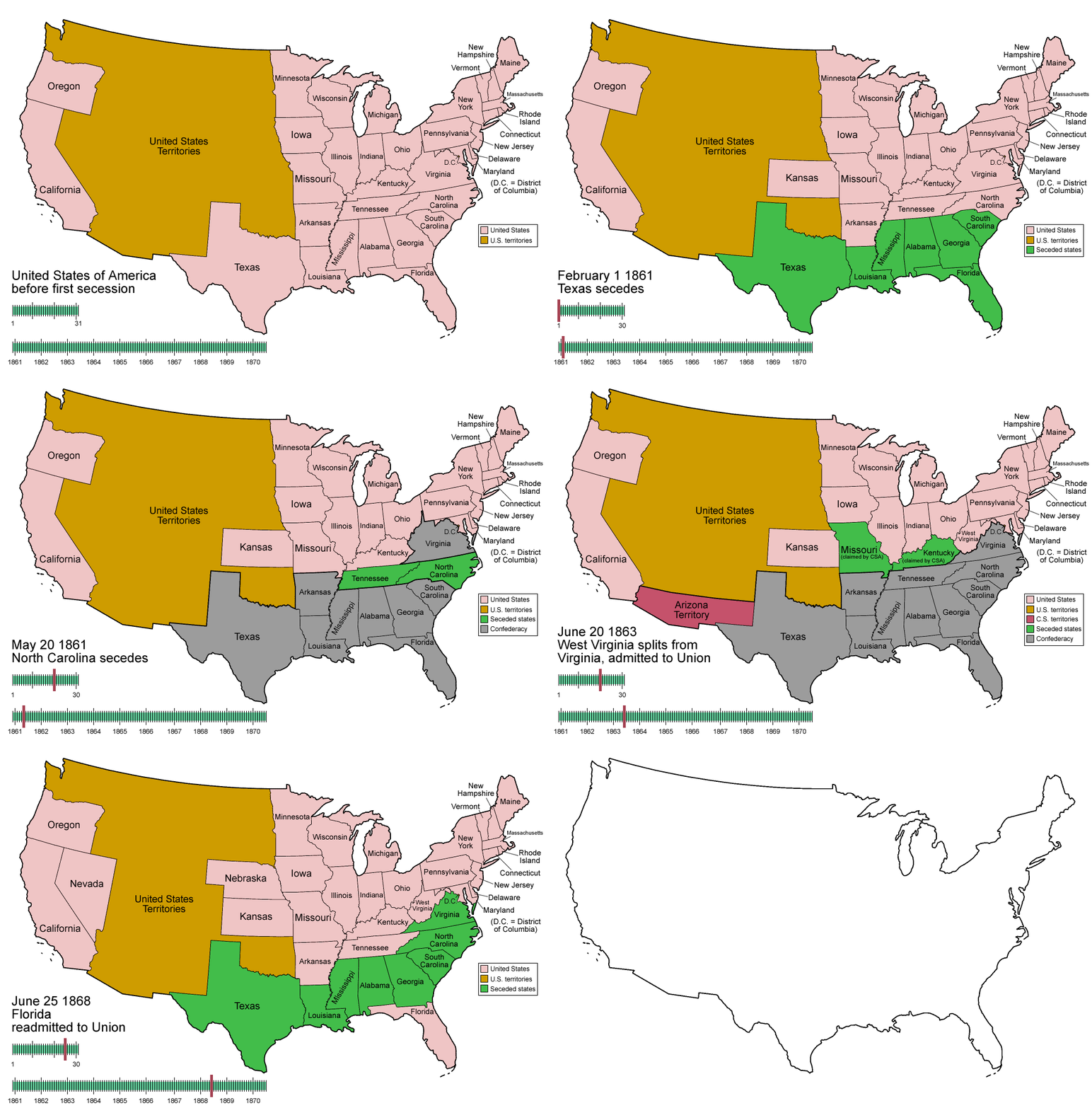
|
| What caused the Civil War? The war caused more deaths than any other US war. |
Regarding
what caused the Civil War (aka Causes of the Civil War), the President of the United States--as commander-in-chief and chief
executive--declared that the sole cause of the Civil War was secession. Lincoln chose war to suppress what he deemed a rebellion
in the Southern states. If the South embraced and espoused slavery and if the South stated that the institution, alone,
justified war, it was ultimately the President of the United States, possessing absolute responsibility and duty as chief
executive for the nation, who, to the contrary, declared war on the South because of secession. As President, Lincoln
declared that the South was guilty only of rebellion, and, without the consent of Congress and contrary to
pleas from the Supreme Court, Lincoln raised an army and subsequently invaded the Southern states. Moreover, the decision
to declare war or to suppress a rebellion, and to state what caused the Civil War, was proclaimed by President Abraham
Lincoln himself; and he stated his position for war clearly.
Prior to April 15, 1861, seven Southern states, South Carolina, Georgia, Alabama, Florida, Mississippi, Louisiana and Texas, had seceded from the Union. On April 15, 1861, Lincoln stated in his Call For Troops that the only cause of the Civil War was secession in the Southern states,
and that troops were being called upon in order to "suppress the rebellion" and force the states back into the Union.
Just 2 days after Lincoln's Call for Troops to raise an army and invade the South, Virginia seceded (April 17), followed by Arkansas, North Carolina and Tennessee. Kentucky, meanwhile, refused to recruit a single soldier for Lincoln's "wicked cause," and Maryland, a free state, was invaded by U.S. troops and placed under martial law, while Delaware, though of divided loyalty, did not attempt it. In Missouri, on October 31, 1861, a pro-CSA remnant of the General Assembly met and passed an ordinance
of secession.
Lincoln, moreover, never stated publicly or in any document that abolishing the
institution of slavery was why he called upon the troops, or to free the slaves was the cause of the Civil War. The Southern
states had seceded, and Lincoln was now determined to suppress it. According to the president, secession was the cause of
the Civil War.
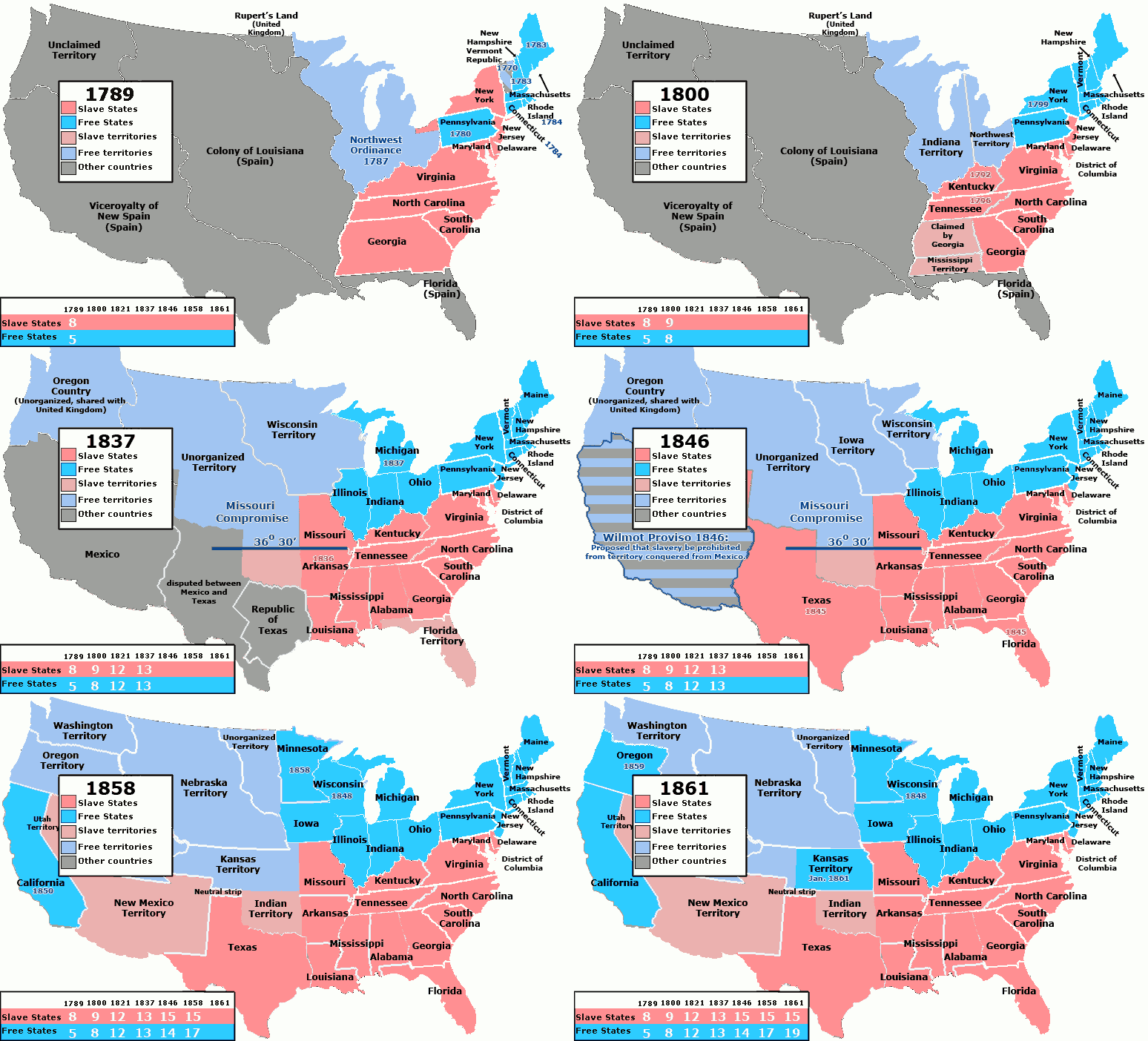
| Causes of the Civil War List |
|
| What Caused American Civil War |
The Five Civilized Tribes even aligned themselves with the Confederacy, and the Cherokee Nation in its formal
declaration to unite with the Southern states leveled, among many, the following blistering accusations against Lincoln and
the Union: “But in the Northern States the Cherokee people saw with alarm a violated Constitution, all civil liberty
put in peril, and all the rules of civilized warfare and the dictates of common humanity and decency unhesitatingly disregarded.
In States which still adhered to the Union a military despotism has displaced the civil power and the laws became silent amid
arms. Free speech and almost free thought became a crime. The right to the writ of habeas corpus, guaranteed by the Constitution,
disappeared at the nod of a Secretary of State or a general of the lowest grade. The mandate of the Chief Justice of the Supreme
Court was set at naught by the military power, and this outrage on common right approved by a President sworn to support the
Constitution. …Lincoln sent armies into Southern States to aid in subjugating a people struggling for freedom, to burn,
to plunder, and to commit the basest of outrages on women; while the heels of armed tyranny trod upon the necks of Maryland
and Missouri, and men of the highest character and position were incarcerated upon suspicion and without process of law in
jails, in forts, and in prison-ships, and even women were imprisoned by the arbitrary order of a President and Cabinet ministers;
while the press ceased to be free.”
The lawful and constitutional right for a state to secede (secession) from the
Union (United States) has been debated from Civil War buffs to constitutional scholars. Regarding Southern Secession, however,
it had never been discussed before the United States Supreme Court, which was the nation's
highest court and final lawful arbiter.
Why wasn't the lawful and constitutional right for any state to secede or withdrawal
from the Union decided by the highest court? Because President Lincoln believed and opined that secession was illegal and therefore strongly opposed and obstructed
the U.S. Supreme Court from convening and rendering a decision.
When U.S. Supreme Court Chief Justice Roger
Brooke Taney stated that Southern Secession must be decided by the Supreme Court, President Lincoln simply rebuked
Taney. Taney, himself, believed that "secession, not forbidden by the Constitution, was therefore legal." The Judicial
Branch (also known as the Judiciary) was equal, separate, and not subject to the Executive Branch (known as Separation
of Powers). If the Executive Branch oversteps its constitutional powers, then the nation becomes a despotism.
In the midst of the secession crisis that would lead to the Civil War, President
James Buchanan, in his final State of the Union address on December 3, 1860, acknowledged the South would "after having
first used all peaceful and constitutional means to obtain redress, would be justified in revolutionary resistance to the
Government of the Union."
The Union (United States) had been compared to a compact or agreement between the
states as referenced in the Declaration of Independence, and the Federal government had been stated as having limited
powers with the states as referenced in the 10th Amendment to the U.S. Constitution.
Many analogies have also been used or applied to the Union and secession. Perhaps
one of the best analogies regarding secession is divorce. When a couple divorces, there is dissolution of the union or agreement
between two parties. The cause or causes which led to the divorce may vary, but the end result is that the two parties are
no longer in union. When the parties are engaged in a contested divorce, consequently, it must then proceed to court. What
led to the divorce is now irrelevant and moot; the principal fact is that the divorce itself is being contested. If the divorce
is denied the right to a hearing, then the divorce itself is now the sole subject in question and it leads to the core and
greatest question: Why do we have courts and laws and the Constitution? Regarding said discussion, to resolve disputes between
parties.
Furthermore, what are the roles and responsibilities of
the three branches of government and what is the purpose of Separation of Powers? When the Executive Branch obstructs the Judiciary, or Judicial Branch, it also denies the Supreme
Court's existence, essence, and purpose. We
then become a lawless nation. Secession, like divorce, was denied the most basic and fundamental right to the nation's legal
system and process. So, what caused the Civil War? Secession was therefore the principal or main cause of the Civil War.
(See also President Lincoln and the Chief Justice and Abraham Lincoln and Ex Parte Milligan.)
The
day after the firing on Fort Sumter,
the United States Secretary of War, Edwin Stanton, directed that all United States Military Academy (West Point) cadets must take a "new oath
of allegiance." Previously, each cadet had taken an "oath
of allegiance to his respective State." Now, they were required to "swear feilty** to the United States
paramount to any other state, county or political entity." While the cadets were in full uniform, the new oath was administered
in the chapel in the presence of the Academy staff.
**feilty
is an old English word that is not in all dictionaries but is best equated to the modern word ‘fidelity’.
Robert E. Lee had rejected the offer to command the Union forces on the grounds that he could
not draw his sword against his beloved home state of Virginia. Lee stated that his "loyalty to Virginia ought to take
precedence over that which is due the Federal Government." He further proclaimed that he had no greater duty than to his native state of Virginia. Lee was a 4th generation Virginian, son of Henry "Light Horse Harry" Lee (one of George Washington's favorite lieutenants), and Lee's wife, Mary Anne Custis, was the great granddaughter of
Martha Washington.
Today, most people view and identify
themselves as Americans. During the 1800s, however, many identified and viewed themselves
as North Carolinians, Virginians, Texans, Tennesseans, etc.
Through the ages, we, as a people, have evolved and placed a greater emphasis on national identity.
Robert
E. Lee also had very strong family ties to the South, and many of his relatives served in the Confederate Army: Major General George Washington Custis Lee (graduated
first in West Point class of 1854), eldest son of Robert E. Lee and Mary Anne Custis Lee; General
William Henry Fitzhugh Lee,
second son of Robert E. Lee and Mary Anne Custis Lee; Captain Robert
Edward Lee, Jr., youngest son of Robert E. Lee and Mary Anne Custis Lee,
and the sixth of their seven children; General Fitzhugh Lee, nephew of Robert E. Lee;
Brigadier General Edwin Gray Lee,
second cousin of Robert E. Lee. Continued below...
(Related reading below)
Recommended Reading:
The South Was Right! (Hardcover). Description: Kin Hubbard said "'Tain't what a man don't know that hurts him; it's
what he does know that just ain't so." Much of what people "know" about the causes, conduct, and consequences of the Civil
War "just ain't so." The Kennedy brothers make a strong case that the real reasons and results of the War Between the States
have been buried under the myth of Father Abraham and his blue-clad saints marching south to save the Union
and free the slaves. Continued below...
Sure, the tone is polemical. But the "enlightened" elements of American opinion have been engaging in a polemic
against the South and its people for decades… This book adopts the "following the money approach" to analyzing who profited
most from slavery – a convincing argument that reflects that much of the wealth went to the North. It also points out
that slavery was not new to Africa, and was practiced by Africans against Africans without
foreign intervention. A strong case is made that the North and Lincoln held strong racist views. Lincoln proposed shipping,
or transporting, blacks back to Africa… The
blacks residing in the Northern states were in a precarious predicament (e.g. draft riots and lynchings in NY City). The authors,
however, do not make any argument supporting slavery - their consistent line is the practice is vile. The fact that many blacks
served, assisted and provided material support to Union and Confederate Armies is beyond
refute. Native Americans also served with distinction on both sides during the Civil War. “A controversial
and thought-provoking book that challenges the status-quo of present teachings…”
Recommended Reading: Ordeal By Fire: The Civil War
and Reconstruction (816 pages). Description: Pulitzer Prize winning author, James McPherson, Battle Cry of Freedom: The Civil War Era and For Cause and Comrades: Why Men Fought in the Civil War , describes the causes and origins of the Civil War; motivations and experiences of common soldiers and the role
of women; social, economic, political and ideological conflicts; as well as a comprehensive study of the Reconstruction Era
and its consequences. Continued below... , describes the causes and origins of the Civil War; motivations and experiences of common soldiers and the role
of women; social, economic, political and ideological conflicts; as well as a comprehensive study of the Reconstruction Era
and its consequences. Continued below...
McPherson also includes many visual aids such as detailed maps and comprehensive charts. Will make
a great addition to the pro-Northern library, but will be a disappointment for the pro-Southern buff. The work is painstakingly
biased with Lincoln portrayed as the next best thing since the bread was sliced. According to McPherson, Lincoln could do
no wrong, but the South was only filled with slave loving folks with the entire Civil War was based solely on Southern
love for slavery. This is not balanced, but biased.
Recommended Reading: Battle Cry of Freedom:
The Civil War Era (Oxford History of the United
States) (Hardcover) (904 pages). Description: Published in 1988 to universal acclaim, this single-volume treatment of the Civil War quickly became
recognized as the new standard in its field. James M. McPherson, who won the Pulitzer
Prize for this book, impressively combines a brisk writing style with an admirable thoroughness. Continued below...
James McPherson's
fast-paced narrative fully integrates the political, social, and military events that crowded the two decades from the outbreak
of one war in Mexico
to the ending of another at Appomattox. Packed with drama
and analytical insight, the book vividly recounts the momentous episodes that preceded the Civil War including the Dred Scott
decision, the Lincoln-Douglas debates, and John Brown's raid on Harper's Ferry. It flows into a masterful chronicle of the
war itself--the battles, the strategic maneuvering by each side, the politics, and the personalities. Particularly notable are McPherson's new views on such matters as Manifest Destiny,
Popular Sovereignty, Sectionalism, the slavery expansion issue in the 1850s, the origins of the Republican Party, the
causes of secession, internal dissent and anti-war opposition in the North and the South, and the reasons for the Union's victory. The book's title
refers to the sentiments that informed both the Northern and Southern views of the conflict. The South seceded in the name
of that freedom of self-determination and self-government for which their fathers had fought in 1776, while the North stood
fast in defense of the Union founded by those fathers as the bulwark of American liberty.
Eventually, the North had to grapple with the underlying cause of the war, slavery, and adopt a policy of emancipation as
a second war aim. This "new birth of freedom," as Lincoln called it, constitutes the proudest
legacy of America's bloodiest conflict.
This authoritative volume makes sense of that vast and confusing "second American Revolution" we call the Civil War, a war
that transformed a nation and expanded our heritage of liberty. . Perhaps more than
any other book, this one belongs on the bookshelf of every Civil War buff.
Recommended Reading: Confederates in the Attic: Dispatches from
the Unfinished Civil War. Description: Pulitzer Prize-winning journalist Tony Horwitz returned from years
of traipsing through war zones as a foreign correspondent only to find that his childhood obsession with the Civil War had
caught up with him. Near his house in Virginia, he happened
to encounter people who reenact the Civil War--men who dress up in period costumes and live as Johnny Rebs and Billy Yanks.
Intrigued, he wound up having some odd adventures with the "hardcores," the fellows who try to immerse themselves in the war,
hoping to get what they lovingly term a "period rush." Horwitz spent two years reporting on why Americans are still so obsessed
with the war, and the ways in which it resonates today. Continued below...
In the course of his work, he made a sobering side trip to cover a "murder that was provoked by the display
of the Confederate flag," and he spoke to a number of people seeking to honor their ancestors who fought for the Confederacy.
Horwitz has a flair for odd details that spark insights, and Confederates in the Attic is a thoughtful and entertaining
book that does much to explain America's continuing obsession with the Civil War.
Recommended Reading: The Real Lincoln: A New Look at
Abraham Lincoln, His Agenda, and an Unnecessary War. Description: It hardly seems possible that there is more to say about someone who has been subjected to such minute
scrutiny in thousands of books and articles. Yet, Thomas J. DiLorenzo’s The Real
Lincoln manages to raise fresh and morally probing questions, challenging the image of the martyred 16th president
that has been fashioned carefully in marble and bronze, sentimentalism and myth. Continued below...
In doing so,
DiLorenzo does not follow the lead of M. E. Bradford or other Southern agrarians. He writes primarily not as a defender of
the Old South and its institutions, culture, and traditions, but as a libertarian enemy of the Leviathan state. DiLorenzo holds Lincoln and his war responsible for the triumph of "big government" and the birth of the
ubiquitous, suffocating modern U.S. state.
He seeks to replace the nation’s memory of Lincoln as the “Great Emancipator”
with the record of Lincoln as the “Great Centralizer.”

|
