|
Goldman
Bryson's [Union] Tennessee Cavalry
| Goldman Bryson Civil War |

|
| Bryson Cavalry Civil War History |
Cherokee County, N.C.,
Oct. 27, 1863.
Bryson's Tennessee Cavalry.
According to the reports of Confederate Gen. C. L. Stevenson,
Gen. Burnside sent Capt. Goldman Bryson, with his company of
cavalry belonging to the Tennessee national
guard, to get in
the Confederate rear.
Stevenson says he sent Gen. Vaughn, with a detachment of
mounted men, to intercept him, and that in
a skirmish near
Murphy, N.C., Bryson was killed, 17 of his company captured,
and the rest dispersed.
The Federal reports make no mention of the affair.
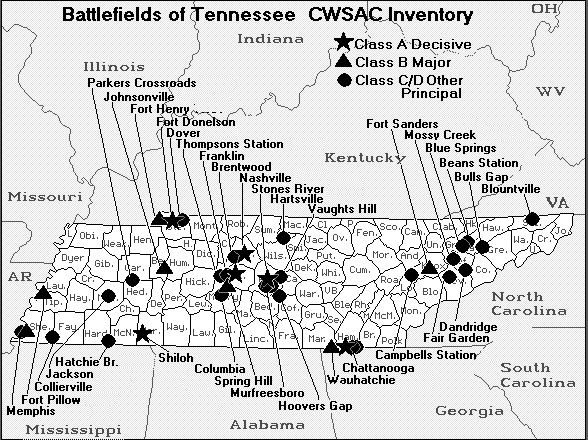
| Tennessee Civil War Map |
|
| Tennessee Civil War History Map |
Source: The Union Army, Vol. 5, p. 272
Recommended Reading: War at Every Door:
Partisan Politics and Guerrilla Violence in East Tennessee, 1860-1869. Description: One of the most divided
regions of the Confederacy, East Tennessee was the site of fierce Unionist resistance to secession, Confederate rule, and
the Southern war effort. It was also the scene of unrelenting 'irregular,' or guerrilla, warfare between Union and Confederate
supporters, a conflict that permanently altered the region's political, economic, and social landscape. In this study, Noel
Fisher examines the military and political struggle for control of East Tennessee from the secession crisis through the early
years of Reconstruction, focusing particularly on the military and political significance of the region's irregular activity.
Continued below...
Fisher portrays in grim detail the brutality and ruthlessness employed not only by partisan bands but also
by Confederate and Union troops under constant threat of guerrilla attack and government officials frustrated by unstinting
dissent. He demonstrates that, generally, guerrillas were neither the romantic, daring figures of Civil War legend nor mere
thieves and murderers, but rather were ordinary men and women who fought to live under a government of their choice and to
drive out those who did not share their views.
Recommended Reading: A History of the North
Carolina Third Mounted Infantry Volunteers: March 1864 to August 1865. Description: A History of the
North Carolina Third Mounted Infantry Volunteers: March 1864 to August 1865 - Ron V. Killian. For years preceding the Civil
War, the mountain people of western North Carolina lived under very different social and economic conditions than their plantation
farming counterparts in other parts of the state. The mountain people did not generally own slaves, making them reluctant
to contribute soldiers when North Carolina seceded from the Union. Many of these pro-Union Carolinians took up arms as Federal
troops and engaged in guerrilla raids to disrupt Confederate operations within their home state. Unlike neighboring East
Tennessee's Goldman Bryson Gang that was comprised mainly of murderers, thieves, and bushwhackers, the
Third Mounted North Carolina, commonly referred to as Kirk's Raiders, was composed of troops, principally disaffected
men, bound by the common bonds of mountain living that enjoyed plundering and mayhem for both survival
and personal gain. Continued below…
The Third Mounted Infantry was one such unit, organized under Col. George
Washington Kirk in February 1864. Ron V. Killian's history discusses the brief but sensational career of the Third Mounted
Infantry from its inception up to the occupation of Asheville, NC in 1865. Until now, little material has been published on
the role of the Third Mounted Infantry in the pacification of the Tennessee/North Carolina mountain region. Often erroneously
referred to as "bushwhackers" or "Tories," the patriotic fathers, sons and brothers that composed this regiment rendered commendable
service in the Camp Vance Raid, Stoneman's Raid against Confederate positions in both Tennessee and North Carolina, and various
skirmishes at Morristown, Russellville, Waynesville and Asheville. Detailed accounts of engagements involving the regiment
are supplemented by extensive rosters noting full name, month, year, and place of enlistment, and age at time of enlistment
for officers, staff, private soldiers and musicians. A biographical sketch of Col. Kirk is also included.
Recommended Reading: North
Carolinians in the Era of the Civil War and Reconstruction
(Hardcover). Description: Although North
Carolina was a "home front" state rather than a battlefield
state for most of the Civil War, it was heavily involved in the Confederate war effort and experienced many conflicts as a
result. North Carolinians were divided over the issue of secession, and changes in race and
gender relations brought new controversy. Blacks fought for freedom, women sought greater independence, and their aspirations
for change stimulated fierce resistance from more privileged groups. Republicans and Democrats fought over power during Reconstruction
and for decades thereafter disagreed over the meaning of the war and Reconstruction. Continued below...
With
contributions by well-known historians as well as talented younger scholars, this volume offers new insights into all the
key issues of the Civil War era that played out in pronounced ways in the Tar Heel State.
In nine fascinating essays composed specifically for this volume, contributors address themes such as ambivalent whites, freed
blacks, the political establishment, racial hopes and fears, postwar ideology, and North Carolina women. These issues of the
Civil War and Reconstruction eras were so powerful that they continue to agitate North Carolinians today.
Recommended Reading:
Bushwhackers, The Civil War in North Carolina:
The Mountains (338 pages). Description: Trotter's book (which could have been titled "Murder, Mayhem, and Mountain Madness") is an epic backdrop
for the most horrific murdering, plundering and pillaging of the mountain communities of western North Carolina during the
state’s darkest hour—the American Civil War. Commonly referred to as Southern Appalachia, the North
Carolina and East Tennessee mountains witnessed divided loyalties in its bushwhackers
and guerrilla units. These so-called “bushwhackers” even used the conflict to settle old feuds and scores, which,
in some cases, continued well after the war ended. Continued below...
Some bushwhackers
were highly organized ‘fighting guerrilla units’ while others were a motley group of deserters and outliers,
and, since most of them were residents of the region, they were familiar with the terrain and made for a “very formidable
foe.” In this work, Trotter does a great job on covering the many facets of the bushwhackers, including their: battles,
skirmishes, raids, activities, motives, the outcome, and even the aftermath. This book is also a great source for tracing
ancestors during the Civil War; a must have for the family researcher of Southern Appalachia.
Editor's Pick:
The Secret of War: A Dramatic History of Civil War Crime in Western North Carolina,
by Terrell T. Garren. Description: Civil War crime in western North Carolina is the subject of The Secret of War, by Terrell T. Garren. Based on the true-life
experience of Delia Russell Youngblood, the great-grandmother of the author, the book "captures what the Civil War was like
in the mountains and throughout the south." After hearing his great-grandmother's story, Garren spent nearly fifteen years
researching this story in particular and the Civil War history of western North
Carolina in general. It is the story of Joseph Youngblood and Delia Russell of Hoopers Creek in Henderson County, North Carolina. Continued
below…
The reader
will follow Joseph through his enlistment as a part of Company H, the "Cane Creek Rifles," of the 25th North Carolina Infantry
Regiment to the Battle of Malvern Hill, Virginia, and to battle in Sharpsburg, Maryland, where
he was captured. Taken to the Union Camp Morton in Indianapolis, Indiana,
he finally escapes and makes his way down the Ohio and Mississippi
rivers into Mississippi. Attempting to make his way back
to North Carolina, he is in Dalton, Georgia, in May of 1864 when fourteen Confederate soldiers, including a brother,
are executed for "desertion." Ultimately, being recaptured, he goes back to Camp
Morton until the end of the war. Told with historical accuracy, names,
battles, and places in this story are true to fact. Readers will recognize place names in Henderson,
Jackson, Haywood, Cherokee, Transylvania, Clay, Macon, and Buncombe Counties in North
Carolina. Family names mentioned include Fletcher, Carland, Lewis, Bishop, Bryson, Freeman, Henderson,
Fowler, Whitaker, Wheeler, Summey, Russell, Barnwell, Ward, Lanning, Hammond, Garren, Youngblood, and Blake. What sets this
book apart from many, however, is the story of what happened to the women left behind at home. The story reveals how the lowest
criminal element found its way into the Union Army. Many mountain men motivated by greed and an awareness of the demise of
Confederate authority signed up with no interest in any cause but their own. Union officers who enter the picture include
Generals George Stoneman, Alavan C. Gillem, and William J. Palmer. Palmer enters the story late but emerges as a man of genuine
integrity and selfless bravery opposed to and fighting this element in his own army. About the Author: Terrell T. Garren is
an eighth generation western North Carolinian. He was born in Asheville,
North Carolina, in 1951. He earned his B.S. and M.A. degrees from Western Carolina University
in Cullowhee, North Carolina.
A resident of Henderson County, North Carolina,
he has been a commercial writer for twenty years.
Dr. Newton
Smith of Western Carolina University says, "The Secret of War" is that rare historical novel that captures both the romance
and the grit and gore of war on the home front without distorting the history. It is about time someone did the story of the
Civil War in the southern mountains right."
Rob Neufeld,
writing in the Asheville (NC) Citizen-Times, has said the book "is a must read" and "as a contribution to our understanding
of the most disturbing passage in our history, it is indelible." He further writes, "Fiction? It really happened; and, if
it hadn't, the author wouldn't be around to tell it....Although Garren has written fiction, he wants you to treat it as history.
After all, at the back of his book, he provides an index."
|

